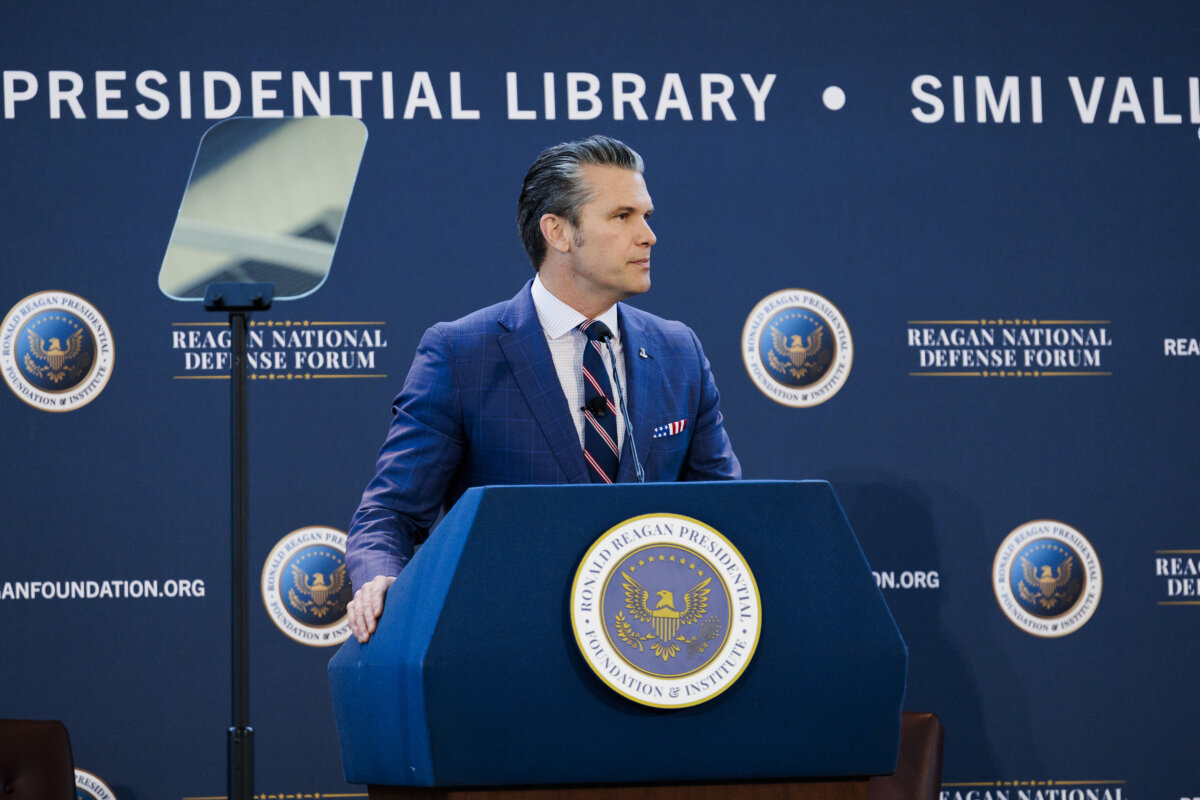

Secretary of War Pete Hegseth said on Dec. 6 that he supports the decision in early September to initiate a second strike on a drug boat in the South Caribbean that killed two survivors of a previous strike.
“I fully support that strike,” Hegseth said while speaking at the Reagan National Defense Forum in Simi Valley, California, on Dec. 6.
“I would have made the call myself.”
Hegseth also defended the broader rationale for the series of strikes over recent weeks, which have killed more than 80 people who U.S. officials say are drug traffickers.
Democrats and other critics say such strikes may have potentially violated international law if shipwrecked survivors were targeted in a subsequent strike.
The secretary suggested that the strikes are meant to protect Americans, comparing the military actions to the war on terror that commenced after the Sept. 11, 2001, terrorist attacks on U.S. soil. Hegseth said President Donald Trump can use the U.S. military however “he sees fit” to defend U.S. interests.
“If you’re working for a designated terrorist organization and you bring drugs to this country in a boat, we will find you, and we will sink you. Let there be no doubt about it,” Hegseth said. “President Trump can and will take decisive military action as he sees fit to defend our nation’s interests. Let no country on earth doubt that for a moment.”
The latest strike was announced on Dec. 4 by the Pentagon, which stated that it resulted in four deaths and took out a drug trafficking boat in the Eastern Pacific.
Trump administration officials, including Hegseth, have said that the war secretary did not order the follow-up strike on Sept. 2 that killed two survivors of a previous strike. Instead, Navy Adm. Frank “Mitch” Bradley, who was leading the Joint Special Operations Command at the time, determined that the boat needed to be destroyed as it might contain cocaine.
According to Sen. Tom Cotton (R-Ark.), who leads the Senate Intelligence Committee, Bradley told lawmakers during classified briefings on Dec. 4 that Hegseth did not give Bradley a “kill them all order.”
“He was given an order that, of course, was written down in great detail, as our military always does,” Cotton said. “There’s no vocal order either.”
Republicans, including Cotton, have defended Hegseth and the Trump administration’s actions striking alleged drug boats near Latin America, with the top Senate Republican calling the second September strike “entirely lawful and needed.”
Democrats, many of whom are calling for the Trump administration to release video of the second September strike, have offered a different reaction to the president’s increasing military buildup in the South Caribbean.
Rep. Jim Himes (D-Conn.), the leading Democrat on the House Intelligence Committee, told reporters on Dec. 4 that what he witnessed on video in the classified briefing he attended “was one of the most troubling things” he’s seen in his time in public service.
“You have two individuals in clear distress without any means of locomotion, with a destroyed vessel, [that] were killed by the United States,” Himes said, referring to the second strike on Sept. 2 ordered by Bradley.
The ongoing congressional investigation is seeking to determine whether the Department of Defense acted lawfully, as some legal experts have suggested that the attack could have been criminal if survivors were specifically targeted.
While defending the strikes, Cotton pointed out that in one example, “survivors actually were shipwrecked and distressed and not trying to continue on their mission, and they were treated as they should be, as non-combatants.”
A reporter asked Cotton whether he agreed with Himes, who had said after viewing the video that it looked as if the survivors were simply trying to get back on the boat and were not capable of conducting further operations.
“Jim may disagree with the entire operation,” Cotton said. “He may be OK with drug boats running to America, or at least thinking that it’s an effective tactic to interdict them. I just disagree with that.”
The Associated Press and Reuters contributed to this report.
 Friends Read Free
Copy
Facebook
Tweet
Friends Read Free
Copy
Facebook
Tweet