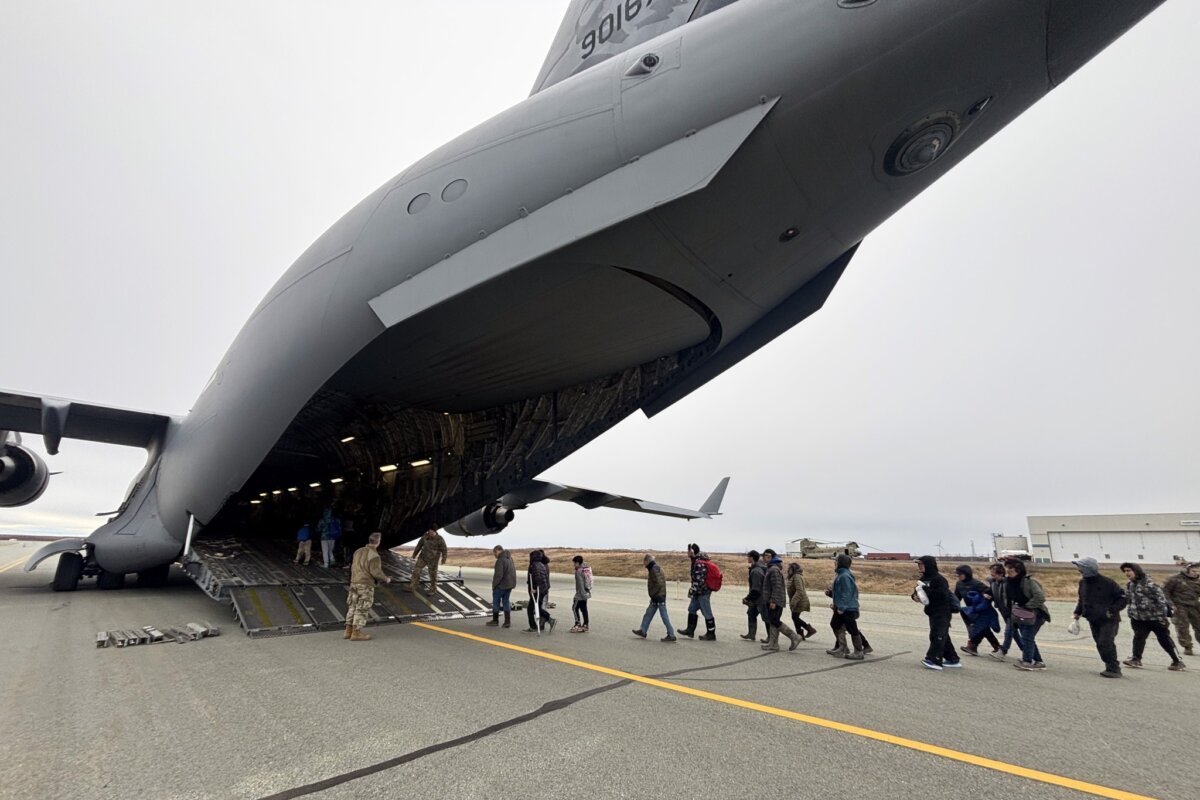

One of the Alaska Air National Guard’s behemoth C-17 Globemaster III landed in Anchorage, Alaska, on Oct. 15, filled with evacuees left homeless by the remnants of Typhoon Halong.
More than 1,500 people were displaced after the remnants, following an unnamed storm, delivered high winds and sea surges to the Yukon-Kuskokwim Delta, an area of southwest Alaska, nearly 500 miles away from Anchorage.
According to Alaska’s State Emergency Operations Center, as of Oct. 15, at least one person was killed—67-year-old Ella Mae Kashatok—and two people remain missing, Vernon Pavil, 71, and Chester Kashatok, 41.
Two dozen people were rescued by the Coast Guard after rising waters lifted their homes off their foundations and carried them out to sea.
Alaska’s Division of Homeland Security and Emergency Management confirmed in a statement that hundreds of survivors were being evacuated into safe, warm shelters across the state after havens in Bethel’s National Guard regional hub reached capacity.
The delta sits southeast of Nome near the Bering Strait and has several low-lying indigenous and homesteader communities that are cut off from the state’s main road system.
Residents are reliant on air and water transportation in and out.
Alaska’s Air National Guard was utilizing two Black Hawks, a medevac helicopter, and a Chinook to carry out the mission, along with the C-17 Globemaster III.
The helicopters were used to transport people to Bethel, where they boarded the C-17 bound for Anchorage.
However, the emergency division made it clear in its latest update that human evacuation was a priority and that people were forced to leave their pets behind.
“Safety and survival often require impossible choices in moments like these, and we want every pet owner to know that their love and concern for their animals has not gone unnoticed,” the division stated. “At this time, evacuation of people is the priority.
“The state’s Mass Care Task Force and our partner agencies, including the Alaska Department of Environmental Conservation State Veterinarian’s Office, are actively working to coordinate rescue efforts for stranded and displaced animals.
“Every effort is being made to reunite families with their animals safely and as quickly as possible.”
Public and Private Help
Alaska’s State Emergency Operations Center’s activation status rose to its highest level, with teams deploying to Bethel and Kotzebue.
The Alaska Organized Militia has deployed more than 100 personnel, and support has been received from other states, including Colorado, Virginia, South Carolina, Texas, and Arkansas.
“The American Red Cross is coordinating the sheltering and food service response once in Anchorage,” Alaska’s Division of Homeland Security and Emergency Management said in a statement.
“Additional support … is being provided by the municipality of Anchorage, Department of Health and Social Services, University of Alaska, and other local volunteer organizations.”
The disaster also drew the attention of nonprofit organization United Cajun Navy (UCN), which has been working to deploy volunteers and supplies into Bethel and Anchorage to assist those in need.
UCN President Todd Terrell told The Epoch Times on Oct. 16 that his organization already had people on the ground in Anchorage, Bethel, and the coastal villages.
They were tasked with aiding people in shelters, helping convince people to go to shelters, assisting with debris cleanup, and ensuring that pets left behind are reunited with their owners.
That work would continue through the weekend.
Terrell said his people were working with Bethel Search and Rescue and were receiving cooperation from the Alaska National Guard and Alaska Air National Guard.
Supplies were on the way, with more waiting at an airport warehouse in Baton Rouge, Louisiana.
“The weather in these areas will be below freezing starting the next few days, and highs will be at or below freezing,” UCN said on social media.
“Some affected areas could possibly be in the low 20s or teens. We are preparing to assist shelters and local tribal communities with coats, socks, blankets, clothes, shoes, personal hygiene items, food, water, and more.”
But transporting supplies to and across Alaska is a challenge, and Terrell continued to search for more aircraft and pilots willing and able to get the aid to people.
“UCN is always prepared to assist with disasters, and this disaster will be extremely challenging due to the distance from our supply warehouses and extreme cold and blizzard conditions upcoming,” UCN said.
The organization will have its own meteorologist on hand to monitor weather conditions.
Recap of Storm Timeline
The deadly storm made landfall on Oct. 12, triggering storm surge and high wind warnings for a significant portion of Alaska’s coastline from south of the Yukon-Kuskokwim Delta, up around to Utqiagvik (Barrow), and across the Arctic coast to the Canadian border.
The National Weather Service office in Fairbanks said some areas faced wind gusts up to 70 or 80 miles per hour (mph), and peak water levels reached 10 or 12 feet above normal high tides.
Several communities on Alaska’s west coast drew the emergency operations center’s attention, but two communities hit the hardest were Kipnuk, with a population of 715, and Kwigillingok, with 380 people.
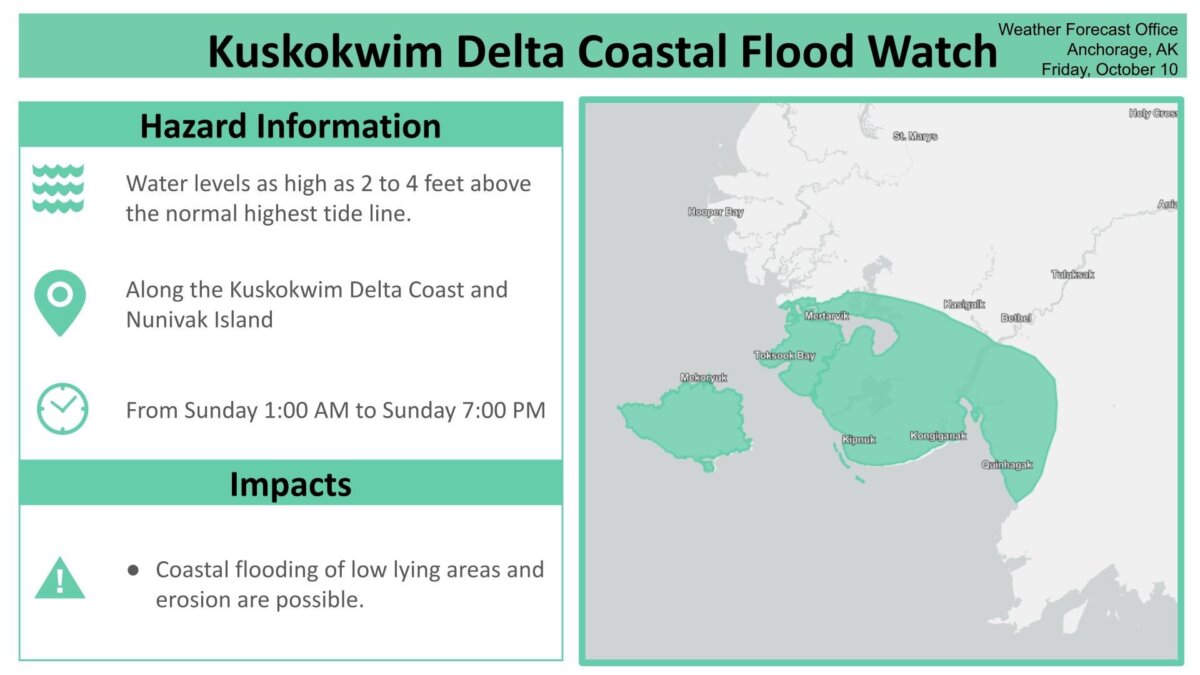
The National Weather Service office in Anchorage warned on Oct. 10 that wind gusts for the delta region could exceed 90 mph, and water levels could rise four feet above normal high tide.
Both communities experienced more than six feet of storm surge, according to Jeremy Zidek, a spokesperson with the state emergency management office.
“It’s catastrophic in Kipnuk. Let’s not paint any other picture,” Mark Roberts, incident commander with the state emergency management division, told a press conference on Oct. 14.
“We are doing everything we can to continue to support that community, but it is as bad as you can think.”
But, as of Oct. 15, communications with both of those communities had been restored thanks to Starlink, the runway at Kipnuk was reopened, pallets of water and fuel have been successfully delivered, and damage assessments were underway.
“We will do everything we can to get people back up on their feet as soon as possible,” Alaska Gov. Mike Dunleavy said on X. “@POTUS asked me to let Alaskans know he is monitoring the situation and more help is on the way.”
The Associated Press contributed to this report.
 Friends Read Free
Copy
Facebook
Tweet
Friends Read Free
Copy
Facebook
Tweet