
EMERALD ISLE, N.C.—It was a week of waves that surfers of North Carolina said they prayed for.
From Aug. 18 to Aug. 21, the surfers on Emerald Isle were faced with waves doubling and tripling the size of their usual swell that arrived in groups called “sets.” Each wave followed the other by a matter of seconds, and each set followed by a matter of minutes—often providing the only window for surfers to paddle from the shore.
This event was not exclusive to North Carolina. Surfers across the North American Atlantic Coast from Palm Beach, Florida, to Nova Scotia, Canada, were treated to set after set of unusually tall waves and strong surf.
It was called a “hurricane swell,” and its source was Hurricane Erin. Growing to a Category 5 hurricane in the Caribbean with sustained winds of 160 mph, Erin passed through the North Atlantic between the United States and Bermuda, dropping slowly in intensity but also expanding the reach of its tropical storm-force winds (39 mph to 73 mph) to as much as 300 miles.
Erin’s distance from shore diluted a potentially catastrophic natural disaster into a once-in-a-blue-moon surf event for most of the coastline. However, not all was spared. Hatteras Island and Ocracoke Island on North Carolina’s Outer Banks would face the closest pass, suffering intense storm surge flooding that made the main roadways impassible and caused damage to businesses and homes.
Hurricane Swell
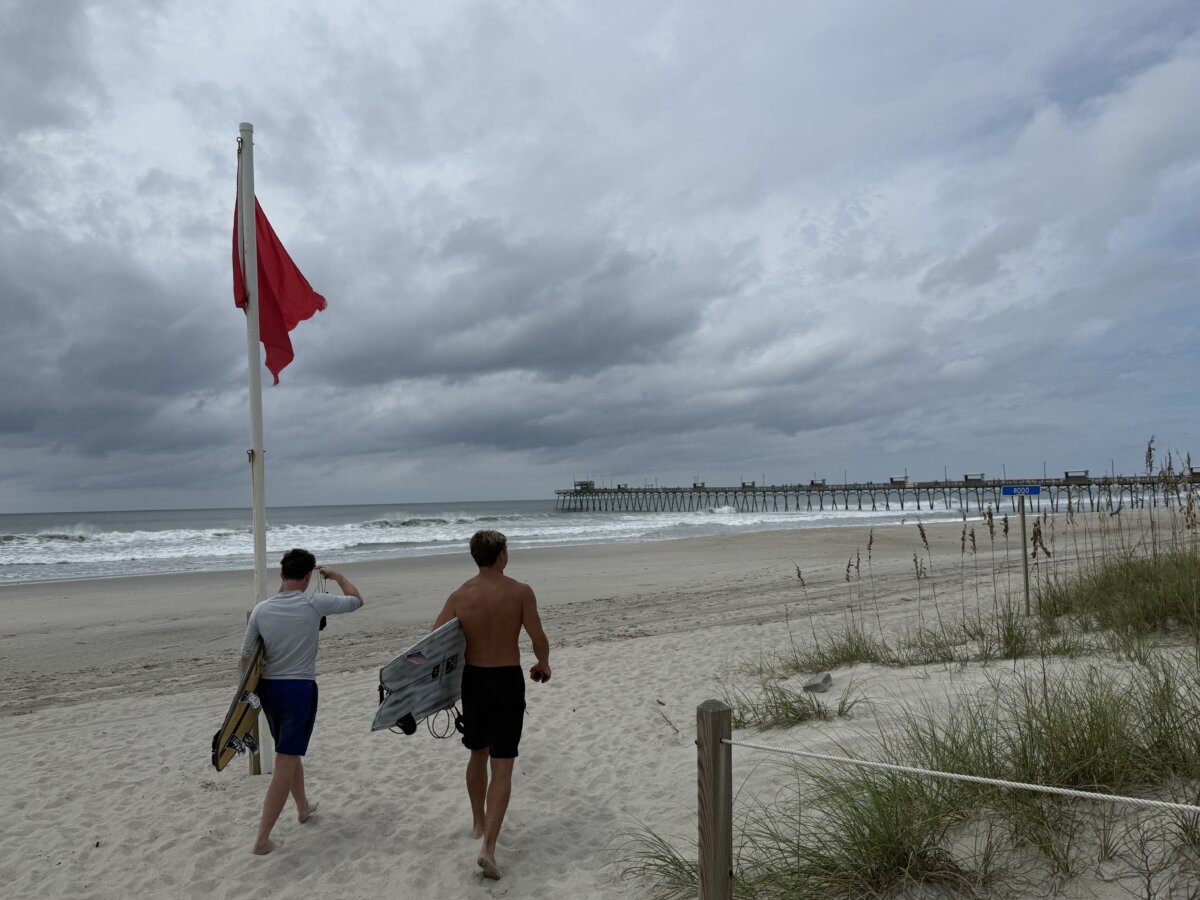
Owen Mohr, 22, and Jack Moore, 24, were paddling out to waves by 7:30 a.m. local time on Aug. 20.
An instructor for the EI Surf Company, a surf school founded by Navy veteran Rob Whaley in 2017, Mohr would normally be preparing for a day spent helping visitors catch their first waves.
“The smaller waves are very consistent here in the summer,” Whaley told The Epoch Times. “It is very easy to teach someone the basics and have them apply it themselves when they don’t have to worry about getting wrecked by a huge set.”
He also said the island is extremely close to the Gulf Stream, which give it a subtropical climate and warmer water for most of the year.
However, the surf school was out that week because of the hurricane swell.
Mohr told The Epoch Times that the waves at Emerald Isle normally max out at four feet high. The waves kicked up by Hurricane Erin, which began arriving on the evening of Aug. 18, were averaging about six feet and reaching 10 feet to 14 feet.
Whaley, however, left town on an annual family surf trip with his wife and kids to Santa Cruz, California, before the swell arrived.
“Literally every single person knew where EI was, and each one of them gave me absolute [expletive] for missing the swell,” he said, “EI” referring to Emerald Isle.
Those people included surf legends Bob Pearson and Frosty Hesson.
On Aug. 19, Mohr and Moore hit several spots along the barrier island between the towns of Emerald Isle and Atlantic Beach, such as the Islander Hotel, the Iron Steamer, and the Bogue Inlet Fishing Pier. At that time, Hurricane Erin was still off the coast of the Bahamas, and the National Hurricane Center issued a tropical storm warning for all of the North Carolina coast from Emerald Isle north through Virginia Beach and up to Delaware.
On Aug. 20, the swell was still strong, and the pair started with six-foot to 10-foot waves all to themselves off the Islander Hotel.
At 8 a.m., the National Weather Service declared that Hurricane Erin’s outer bands were expected to bring worsening conditions to North Carolina’s coastline by that evening and cautioned beachgoers against swimming along East Coast beaches.
Red flags blew in the wind at every public access point, warning of the dangerous surf and the rip current that hid underneath. That current pushed south, parallel to the shoreline, causing Mohr and Moore to constantly paddle or walk as much as a mile north to return to their starting position.
At about 11 a.m., they decided to try the Bogue Inlet pier, where several other surfers were already taking their shot at the six-foot to eight-foot waves coming in. Their idea was to use the rip current to their advantage and let it and the waves carry them south back to their car parked near the hotel.
Lifeguards with the Emerald Isle Fire Department’s Ocean Rescue team were also on hand at the pier, keeping watch over the lineup and talking to people before they went into the water.
“We got people from out of town who came here just to surf, and we got some locals who are definitely excited to be in there,” lifeguard Rachel Neider told The Epoch Times.
“I wouldn’t send any beginners in today to learn yet.”
Although she said they had gotten some calls, they were not “too serious,” and she credited the preventive measures being taken by her team to keep people safe.
As the afternoon began, rain clouds began rolling in over the pier, rapidly curving south-southeast as if they were caught by Hurricane Erin’s convection.
They said that swells were supposed to build throughout the day, and by 5 p.m., the skies had cleared over the pier, and waves came in consistently breaking 10 feet tall, shaking the pier in the process.
Locals and tourists alike gathered along the pier to watch Moore, Mohr, and several other surfers ride the big waves. One by one, they had their chance to perform for the crowd, resulting in a medley of tricks, smooth rides, wipeouts, and hard paddles against the swell back to the lineup.
“Everyone was happy in the water,” Moore said. “No one was being like, ‘No, this is mine.’ No one was pushing. Everyone was cheering.”
The Outer Banks
Just north of Emerald Isle, North Carolina’s iconic barrier island chain, known as the Outer Banks, was preparing for more serious effects of Hurricane Erin. Hatteras and Ocracoke Islands were ordered to evacuate on Aug. 17, and road closures and ferry cancellations soon followed.
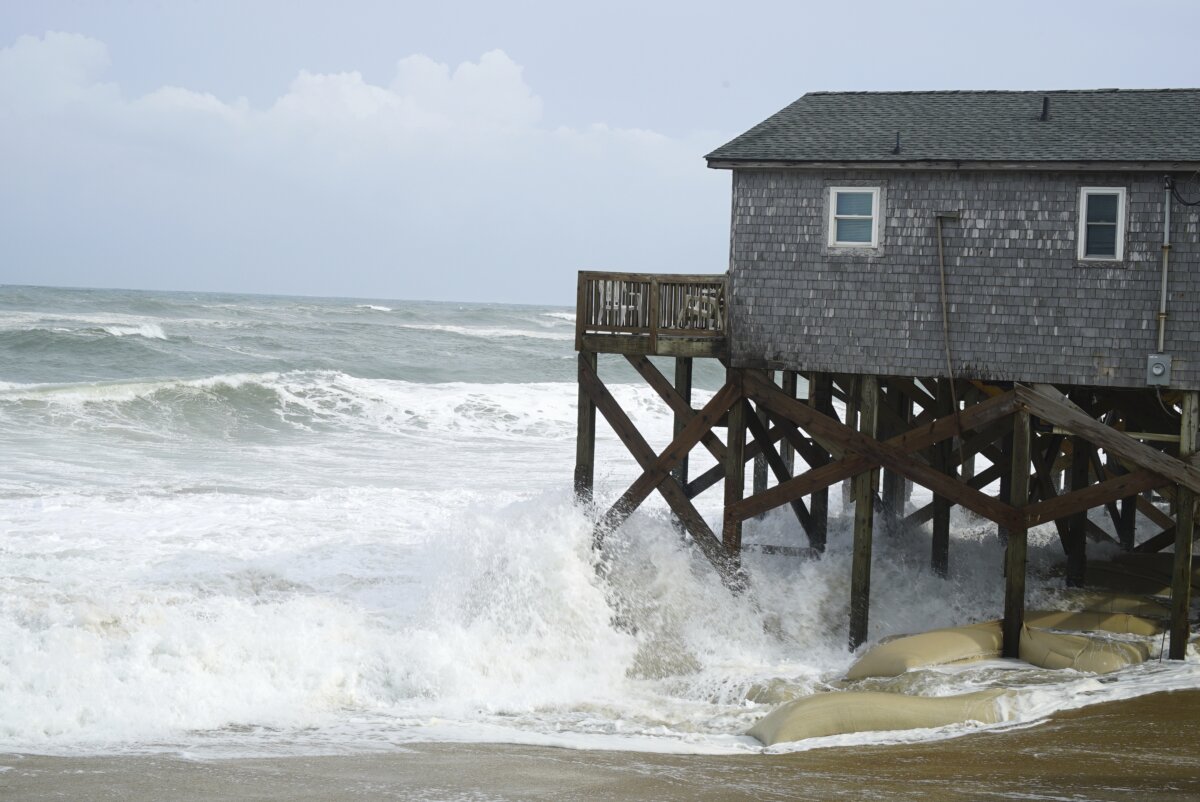
Hurricane Erin made its closest pass to North Carolina beginning at 2 a.m. on Aug 21, according to the National Hurricane Center, with its eye coming as close as 200 miles southeast of Cape Hatteras, putting the Outer Banks well within the 300-mile range of tropical storm-force winds.
By 8 a.m., Erin was still 210 miles east of Cape Hatteras, and the storm surge combined with the morning’s rising tide to cause flooding once again on the roads of Hatteras Island.
By 11 a.m., Erin began moving away, stretching the distance from Cape Hatteras to 260 miles.
However, the National Weather Service warned, “Storm surge flooding will also continue along the North Carolina Outer Banks through Thursday, with large waves leading to significant beach erosion and overwash, and some roads may become impassible.”
Surging seawater was also reported washing over the roads at about high tide that night and during the morning high tide on Aug. 22.
All the while, though, Erin remained a strong Category 1.
‘Dodged a Bullet’
North Carolina Gov. Josh Stein visited Hatteras Island on Aug. 22 to assess the damage and reported some structural damage but no loss of life.
“We saw some businesses that took it on the chin, and some homeowners experienced real damage to their property. But my goodness, North Carolina dodged a bullet with Hurricane Erin,” Stein said. “She was just a few more miles offshore, and that made the difference [between] widespread devastation and what we experienced today.”
Hatteras Island was reopened to the public at 5 a.m. on Aug. 24.
On Aug. 23, Emerald Isle’s shoreline had calmed enough to downgrade the red flags to yellow and for surf lessons at EI Surf Company to resume.
Mohr and Moore said they did not expect the waves to exceed four feet again until the winter and that they did not expect another surf event like Erin’s hurricane swell for another year.
They said they were grateful for the experience, especially understanding how lucky they were to avoid the real dangers that grazed their neighbors to the north.
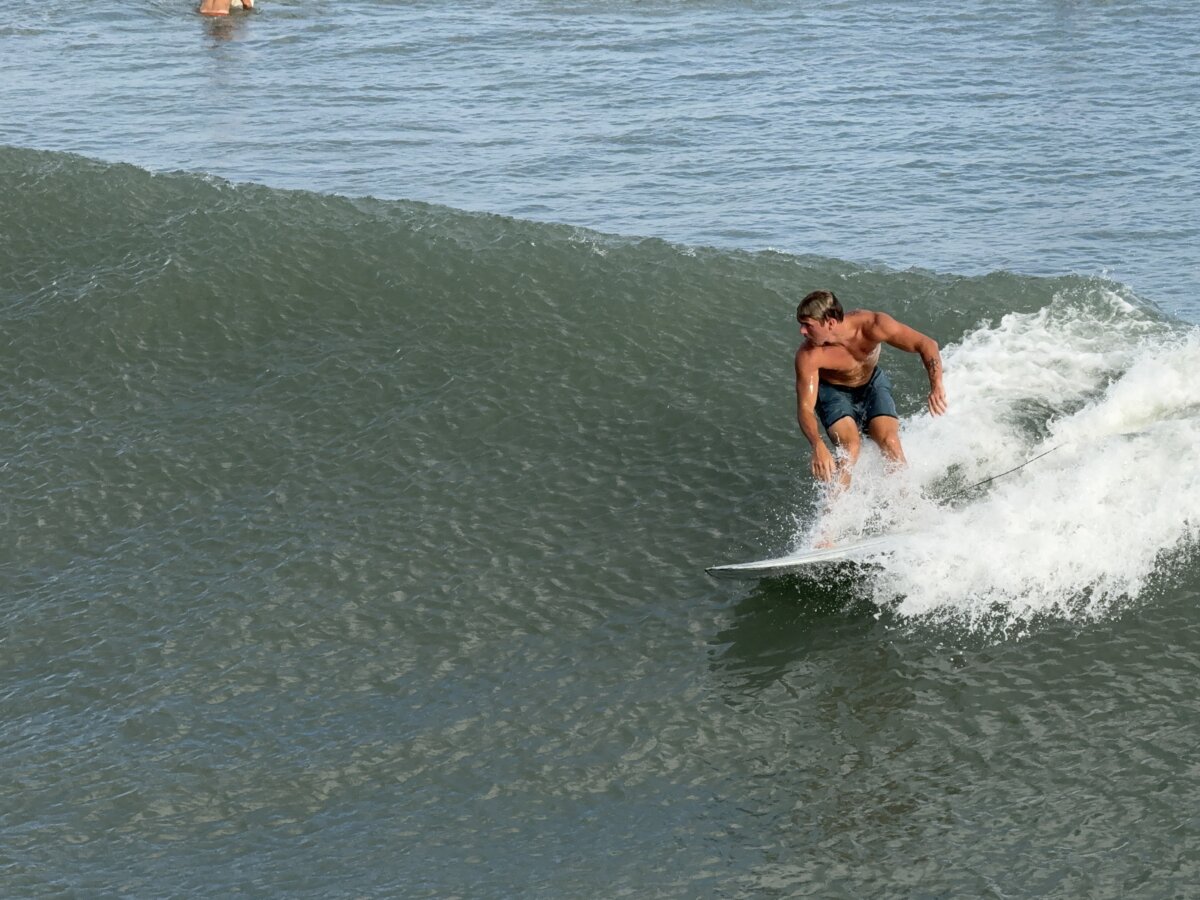
“I definitely said a lot of thank you prayers,” Mohr said. “I was definitely thanking God a lot, because … these huge waves, these cleaner conditions we had in the morning, is what we dream of constantly.
“Every time I go out surfing, I’m like, ‘Man, I wish it could be better,’ and today was the best. You just have to get over your fear of that 10-foot drop in, and then the wave is fantastic the entire time, even if you’re getting pummeled.”
 Friends Read Free
Copy
Facebook
Tweet
Friends Read Free
Copy
Facebook
Tweet