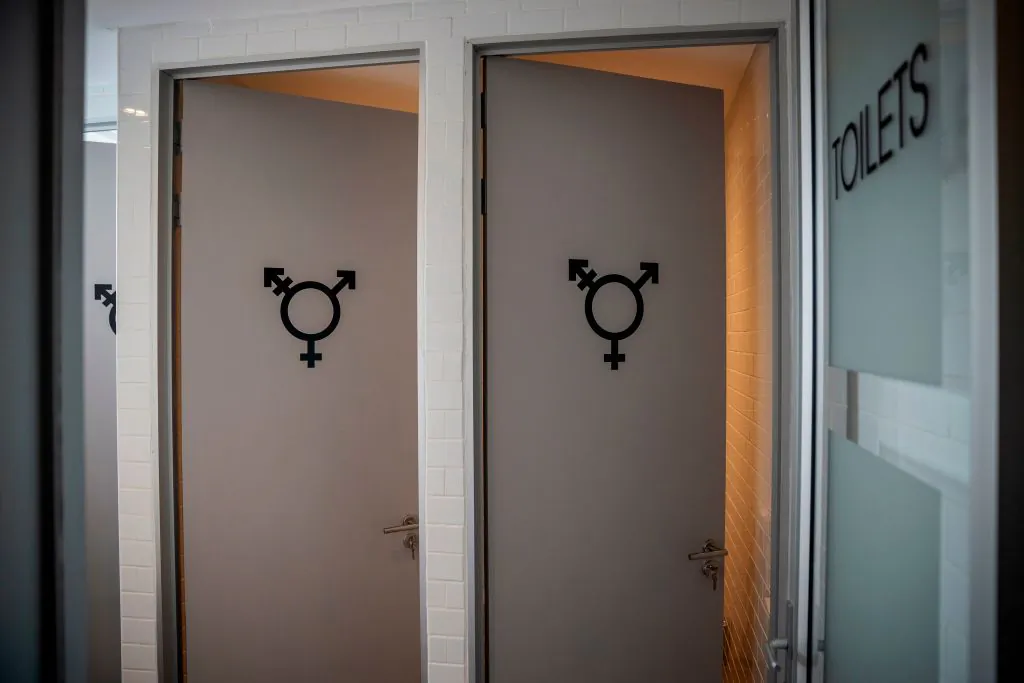

The Idaho Legislature on March 27 passed a bill that would make it a crime for anyone to use a public restroom or changing room of the opposite sex.
The state Senate approved the legislation 28–7 on March 27 after the state House passed it on March 16. Republican Gov. Brad Little is expected to sign the bill into law. H.R. 752 would take effect in July.
The measure applies to government buildings and any private business, restaurant, or store that offers public bathrooms or changing rooms.
Violators who “knowingly and willfully” enter a facility designated for the opposite sex would face a misdemeanor charge on the first offense, punishable by up to one year in jail. A second offense within five years would be a felony carrying up to five years in prison.
The state previously enacted a law allowing students to sue their schools for $5,000 if they encounter someone in a school bathroom who violates the policy.
That earlier statute focused only on public schools and provided a civil remedy rather than criminal penalties.
The new bill expands the restriction beyond schools into every level of government and every place of public accommodation across the state.
Lawmakers said the legislation is a necessary step to enforce clear boundaries in facilities where privacy is expected.
The vote followed weeks of debate in the state House and Senate. Republican majorities in both chambers moved the bill forward with little support from Democrats.
Supporters say the law protects privacy and safety in shared facilities. Opponents say it singles out people who identify as transgender and creates unnecessary criminal penalties for everyday needs.
“Private spaces such as restrooms, changing areas, and showers are sex-separated for a reason,” state Sen. Ben Toews, a Republican from Coeur d’Alene, said on the Senate floor on March 24. “Individuals in these vulnerable settings have a reasonable expectation of privacy and security.”
State Sen. Jim Guthrie, a dissenting Republican from McCammon, said on March 27 that the bill would put transgender-identifying individuals in a dilemma.
“They go in the bathroom they’re supposed to, they upset people,” Guthrie said. “If they go in the one that they now look like, they’re breaking the law, which could include pretty severe penalties.
“We seem to be really focused on this space and ignoring the fact that there are people that are just like us, human beings, just like us. What are they supposed to do?”
Idaho joins roughly 20 other states that have enacted similar legislation, according to a tally by the Movement Advancement Project, a nonprofit think tank.
The Idaho measure is among the broadest in the country because it applies to private businesses as well as government facilities. Most other states’ laws have been narrower, with most limited to schools or government buildings, according to the think tank.
At the national level, President Donald Trump issued an executive order in January 2025 titled “Defending Women From Gender Ideology Extremism and Restoring Biological Truth to the Federal Government,” which states that the U.S. government recognizes only two sexes: male and female.
“My Administration will defend women’s rights and protect freedom of conscience by using clear and accurate language and policies that recognize women are biologically female, and men are biologically male,” the order reads.
 Friends Read Free
Copy
Facebook
Tweet
Friends Read Free
Copy
Facebook
Tweet