
PETERSBURG, W.Va.—Science teacher Linda Lou Carlson stared at her cellphone. It was pointed at a blue model of an aquaporin—a protein that channels water in and out of cells.
The phone app that pairs with the model’s QR code was taking a little while to work.
“There!”
On Carlson’s screen, molecules of H20 coursed through the structure. A process that keeps us all alive had come to life digitally.
It is the sort of tech-enabled lesson she loves to teach her students at Petersburg High School. Yet, rather than let the students use their own devices, her approach is to pass her own around. She worries about the distractions caused by students having their phones with them during class.
Schools across West Virginia are stepping up restrictions on cellphones in classrooms, backed up by a new law signed by Gov. Patrick Morrisey that easily passed in the state legislature.
The law states that West Virginian students in elementary and secondary schools must keep cellphones, headphones, and earbuds out of sight and detached from their bodies during class, with ringers silenced.
Exceptions do exist for emergencies, disability accommodations, or teacher or administrator approval.
While concerns about student socialization, online bullying, and academic engagement have driven broad support for restrictions in a state that struggles with educational performance, some emphasize the positive side of smartphone access for many students, saying that the law is too rigid.
West Virginians weighed in on the law—from Petersburg and Charleston, to Green Bank, a community that has long lacked cellphone service because of sensitive astronomical research.
A Flexible Approach
West Virginia is one of many states, both blue and red, that have acted to limit or outright ban cellphones in schools. Some states, such as New York, have opted for bell-to-bell restrictions, keeping the whole school day phone-free.
Clare Morell, author of “The Tech Exit: A Practical Guide to Freeing Kids and Teens from Cell Phones,” told The Epoch Times that school cellphone bans are a rare bipartisan priority in a polarized country. “It has given me a lot of hope,” she said.
The Mountain State’s new law is flexible. At a minimum, it applies only to instructional time, and county boards of education have developed distinctive approaches. If they so choose, they can keep cellphones off school property altogether.
Under Principal Jodie Long, Petersburg High School has adopted a less restrictive policy than have some other districts in the state.
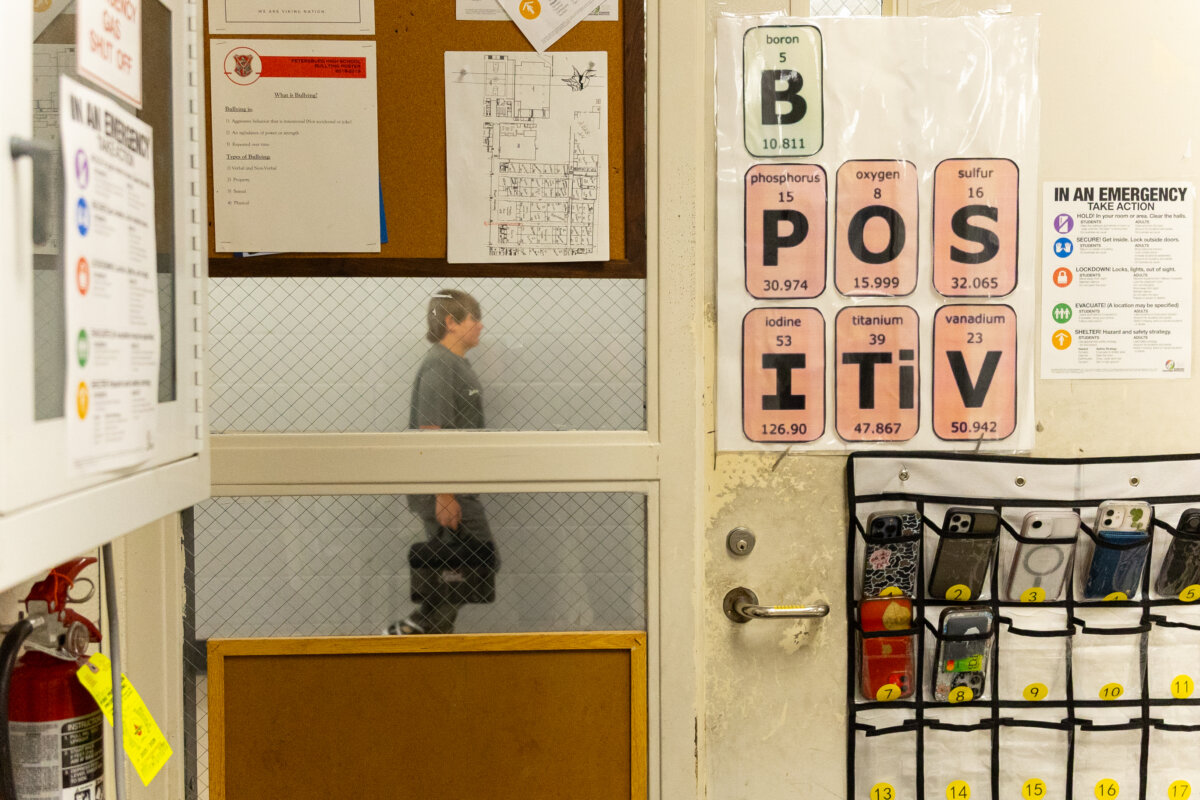
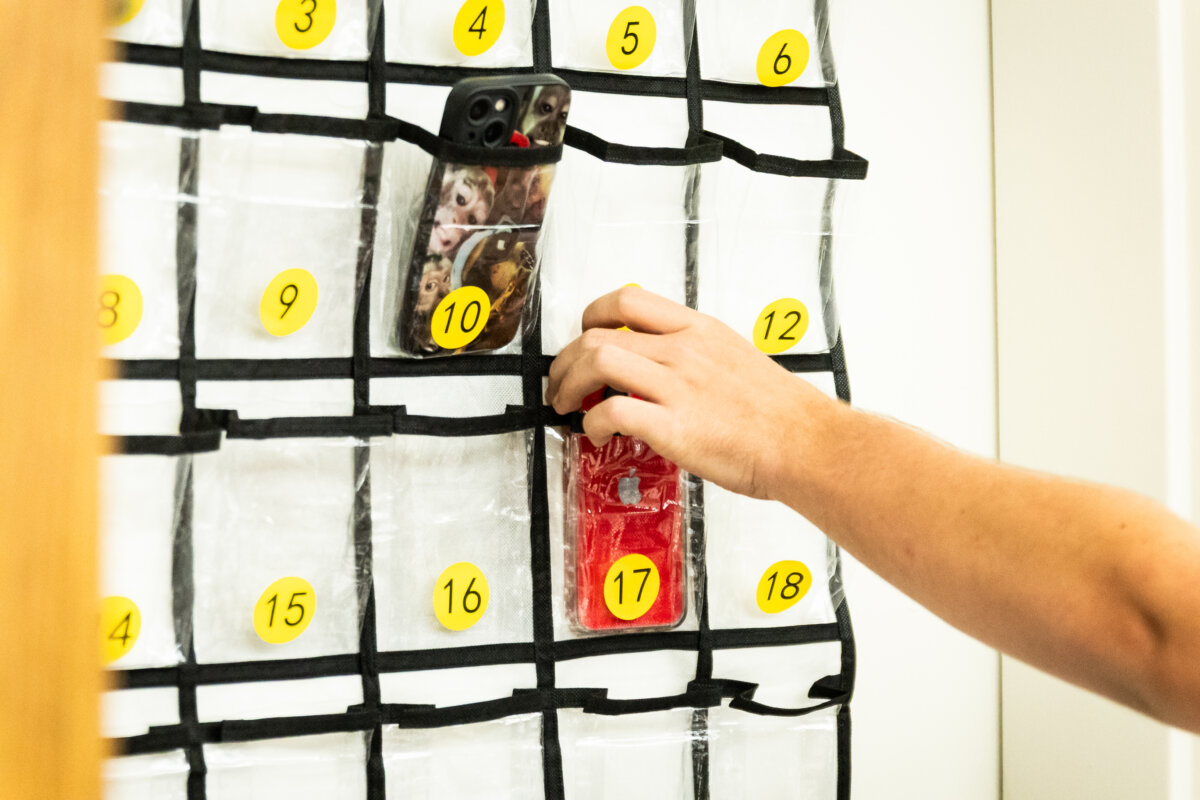
At the start of class, students place their phones in plastic pouches on the wall. They take them out when they leave.
“They’re very lucky,” Long told The Epoch Times, referring to her students. “They also know if they’re misusing their cellphone, then it’s super easy to lose the privilege.”
Jason Rohrbaugh, the school resource officer, described bullying and other toxic dynamics that have played out on social media, mainly Snapchat.
“Parents are a big issue because parents don’t want to do anything to help rectify the situation,” he said.
Rohrbaugh said most parents don’t pay enough attention to their children’s actions on social media. Some would even text or phone their children during instructional time, he said.
Morell said parents are often the biggest challenge to implementing phone restrictions in schools.
“I’ve seen the most success in communities where schools have done a good job of communicating the rationale to the parents, and where parents have been the ones supporting or pushing for the policy,” she said.
At Petersburg High School, 12th grade student Bryan Waldron said he didn’t miss his phone during class.
“I never really used it in class to begin with,” he told The Epoch Times.
Charley Rexrode, a 10th grader, said her phone was sometimes useful to coordinate with coaches and her mom.
“Other than that, really, I feel like it pulls us apart from each other more, because when we’re here with our peers already, we should interact in person,” she said.
Rexrode’s teacher, Michelle Harter, said she appreciates the limits, too.
“It’s nice to look, and they’re all looking at you, and you don’t have this,” she said, miming a student immersed in a phone.
“I do miss the selfies.”
An Unfair Law?
Aidan, a 12th grader who did not share her last name, said she would like more flexibility when it comes to the advanced classes she takes.
“If I don’t have enough space to use my MacBook, then I want my phone to look up articles or different websites to assist in the learning that I’m doing. I think that for that reason, it’s not really fair for the ones of us who do use them correctly to completely ban them,” she said.
Aidan’s concerns mirror those of state Sen. Mike Oliverio II, a Republican representing Morgantown. He was the only legislator who voted against the cellphone measure in April.
Oliverio told The Epoch Times that younger people helped persuade him to buck the consensus.
“A couple of students came to me and said, ‘We looked it up and found you’re a financial adviser. Could you do your job as a financial adviser from 8 to 5, or could you do your job as a state senator from 8 to 5, without your cellphone?’ And I had to answer them, ‘No, I couldn’t.’ And they said, ‘Well, we can’t be successful in the classroom either,’” he said.
Morell said she is doubtful that kids really need phones in classes, saying they could ask teachers for information or look up things later.
“I think we live in an era where people are used to instant access at their fingertips all the time, but there is a price that we pay for that, including having our attention diverted and diverted from the real-life moment that we are in,” she said.
Antero Garcia, associate professor in the Graduate School of Education at Stanford University, said phone bans could shortchange students who need guidance from schools on how to use the technology responsibly.
“Arguably, the reason we’re in much of this current mess, when it comes to broad concerns around media literacy, civic engagement, and distraction is because we have not had a substantial attempt at integrating a meaningful policy around cellphones that actually prepares young people for the real world,” he wrote in an email to The Epoch Times.
Oliverio, who said he wishes that the law preserved more autonomy for local teachers and authorities, said the state should target basic reading skills rather than phones.
West Virginia’s poor educational performance is another reason for debate over the cellphone law.
U.S. News and World Report ranks West Virginia 47th out of the 50 U.S. states in education. In 2024, its fourth grade and eighth grade reading and mathematics scores fell far below the national public school average.
Morrisey alluded to those issues as the drivers behind West Virginia’s cellphone restrictions in schools.
“As Governor, one of my top priorities is to improve West Virginia’s educational rankings. To do that, we must focus on academics and remove classroom distractions,” he said in a statement after signing the law in April.
Yet, it is unclear if the measure’s impact on academics will be systematically assessed.
Long is unaware of any effort to track test scores or other outcomes in relation to the law.
“It’ll be nice to look at that,” the high school principal said.
When The Epoch Times asked about that topic and other facets of the law, the West Virginia Department of Education declined to comment.
Morrisey did not respond to questions from The Epoch Times.

Dead Zones
For now, many students across the state are getting used to spending less time on their cellphones.
In Green Bank, residents of all ages know the feeling all too well.
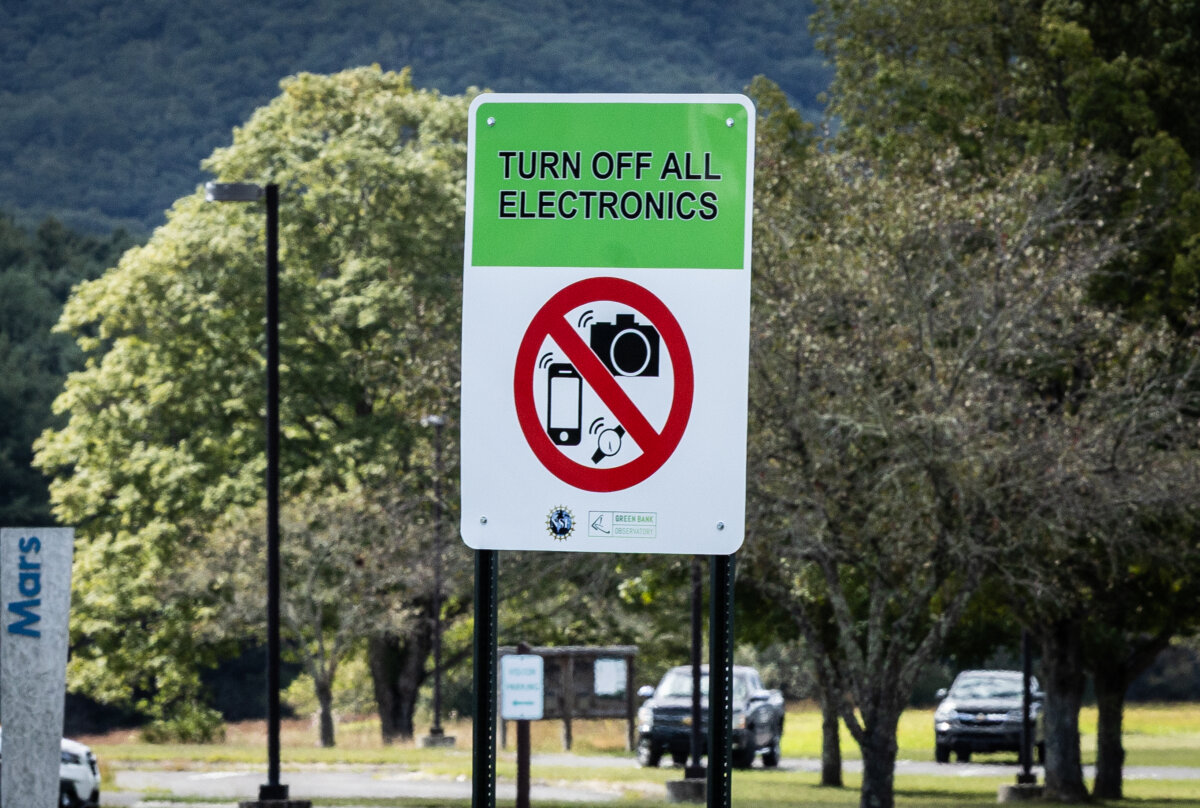
The Green Bank Observatory and, 30 miles away, a National Security Agency station are protected by the National Radio Quiet Zone, a 13,000-square-mile chunk of Virginia and West Virginia. The smaller West Virginia Radio Astronomy Zone extends 10 miles in all directions around the observatory.
There is no cellphone coverage for miles around Green Bank, although satellite internet and other options are available.
In nearby Arbovale, Donny Ervin, who works in the country store owned by his father, said that even without cellphone coverage, the devices are taking over children’s lives.
“I have two stepkids, and I can see the difference in the way they’re growing up,” he said, adding that they attend Green Bank Elementary-Middle School.
At a mall in Charleston, the state capital, Francis Workman and her school-aged grandson, Jaden, agreed that the school cellphone restrictions are a good idea.
Cellphones give students “way too much power,” she said.
Ted, an older man at the mall who did not share his last name because he was working, said he saw it much the same way.
“I can just imagine being a teacher and dealing with that—looking and seeing the kids are buried in their phones,” he said.
Ted added that he had studied education in college but never pursued it as a profession.
One younger mallgoer threw some cold water on the attempts to regulate teens’ tech use.
“They’re not really banning [cellphones] because kids are still sneaking them in,” said Caleb Barnes, a recent high school graduate from nearby Sissonville.
He described the approach he knew as “hush hush.”
Joy Hoffay, a 12th grader from Sissonville, interrupted Barnes to defend the policy by saying, “It definitely does keep it out of classes.”
Jane, a teacher from California who used a pseudonym because of her district’s policies regarding talking to journalists, said some of her students also defy her classroom cellphone restrictions.
“It is a daily challenge. But the more everyone else does it, the easier it is to call those students out,” she said.
Various school officials across West Virginia did not respond to requests for comment.
 Friends Read Free
Copy
Facebook
Tweet
Friends Read Free
Copy
Facebook
Tweet