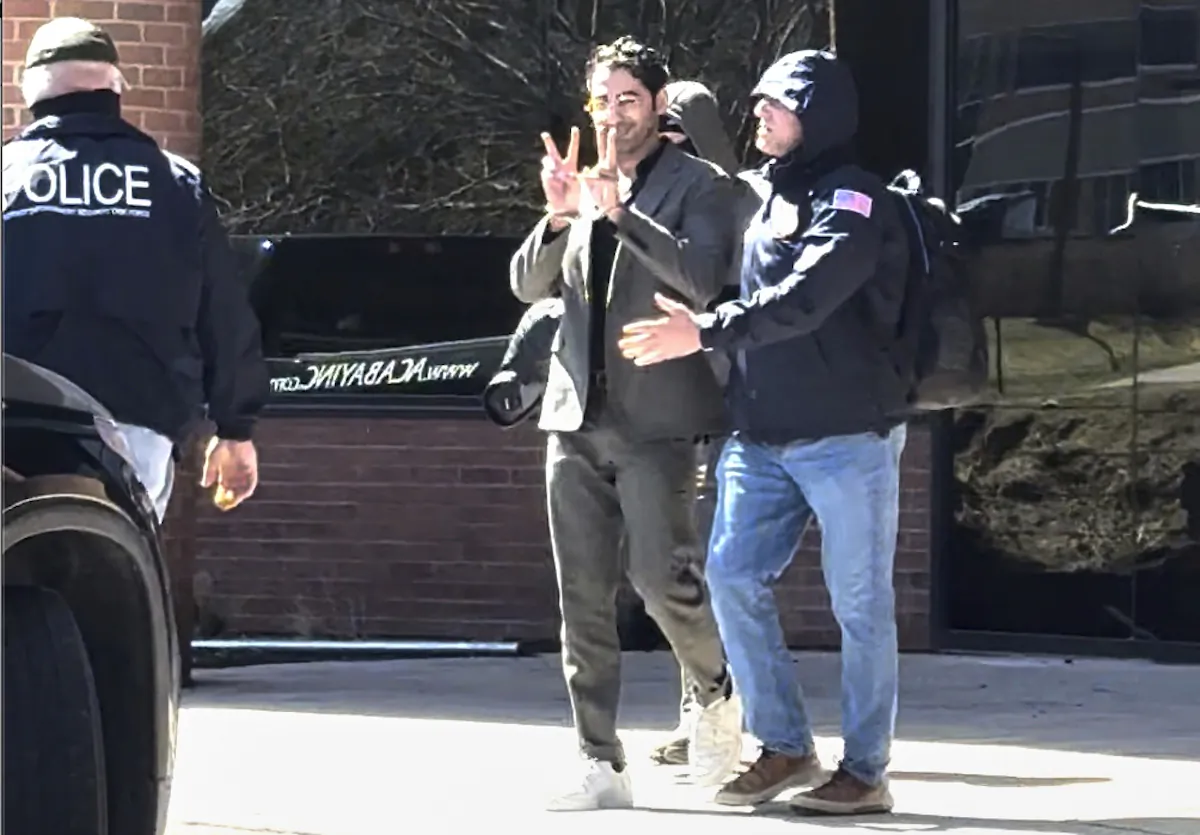

A federal appeals court said on Tuesday that a judge wrongly released a pro-Palestinian protester, Mohsen Mahdawi, whom the Trump administration arrested and moved to deport last year.
In a 3–0 decision, the U.S. Court of Appeals for the Second Circuit said the judge lacked jurisdiction to rule on Mahdawi’s arguments that the administration violated his constitutional rights.
Instead, federal law required the judge to allow a separate immigration court to process Mahdawi’s case, U.S. Circuit Judge Debra Ann Livingston said in an opinion joined by her colleagues.
Livingston pointed to a section of the Immigration and Nationality Act that barred judicial review of removal cases like Mahdawi’s. The appeals court judges, however, did not order that the man be taken back into custody.
Earlier this year, an immigration judge blocked the Trump administration’s bid to deport him. That judge was subsequently fired, and the federal government appealed the decision.
In April, the Board of Immigration Appeals ruled that Mahdawi was, in fact, removable, overturning the previous judge’s decision.
The case was handed off to another immigration judge who issued an order of removal last month, which Mahdawi and his lawyers are appealing.
He enrolled at Columbia University in 2021 and became an outspoken critic on campus of Israel’s military campaign in Gaza after Hamas’s Oct. 7, 2023, attacks that killed about 1,200 Israelis.
During a naturalization interview in April 2025, authorities arrested Mahdawi.
Secretary of State Marco Rubio determined he was removable under the Immigration and Nationality Act because his “presence or activities in the United States would have potentially serious adverse foreign policy consequences for the United States.”
The Trump administration further alleged Mahdawi called for the destruction of Israel and engaged in threatening rhetoric and intimidation against pro-Israeli individuals during protests at Columbia University.
The Department of Homeland Security (DHS) provided an emailed statement to The Epoch Times but stopped short of clarifying whether it would pursue Mahdawi’s detainment again.
“The Second Circuit’s decision to vacate an activist judge’s order to release a terrorist sympathizer is a win for public safety and the rule of law,” a DHS spokesperson said.
“When you advocate for violence, glorify and support terrorists that relish the killing of Americans, and harass Jews, that privilege should be revoked, and you should not be in this country.”
Homeland Security added that being granted a visa or green card to live and study in the United States is a privilege.
The Department of Justice did not respond to a request for comment about whether it would seek to place Mahdawi back in immigration detention while his removal proceedings continue.
The man’s legal team, which includes the American Civil Liberties Union (ACLU) and attorneys from multiple other firms, posted a joint statement in response to the Second Circuit’s ruling, claiming the government has no authority to re-detain Mahdawi.
“The government is claiming the unprecedented power to detain people for months or even years on end to censor their speech, with no ability to challenge their detention in court,” said Michael Tan, deputy director of the ACLU’s Immigrants’ Rights Project.
Mahdawi indicated he would pursue another appeal asking for the entire Second Circuit to reconsider the case.
“I still have faith that the full court will correct the legal error and restore the constitutional principles that protect all people equally,” he said in a statement.
Mahdawi has lived in the United States for about a decade.
U.S. District Judge Geoffrey Crawford had argued that the Immigration and Nationality Act’s bar on judicial review didn’t apply in Mahdawi’s case, which involved constitutional claims.
“Mr. Mahdawi has raised a substantial claim that the government arrested him to stifle speech with which it disagrees,” Crawford said in April of 2025.
“Such an act would be a violation of the Constitution—quite separate from the removal procedures followed by the immigration courts.”
The Trump administration argued the district court lacked jurisdiction and produced years-old evidence arguing for Mahdawi’s continued detainment.
A 2015 police report contained a statement from a gun store owner in Vermont who said Mahdawi sought to purchase a sniper rifle and machine gun, telling the owner he “used to build … submachine guns to kill Jews while he was in Palestine.”
The FBI had investigated him over the statement, but Mahdawi denied saying it.
The Trump administration also pointed to how, in 2019, border agents allegedly found Mahdawi in possession of various drugs and thousands of dollars in cash.
He was charged, but the case was dropped after he completed a diversion program.
 Friends Read Free
Copy
Facebook
Tweet
Friends Read Free
Copy
Facebook
Tweet