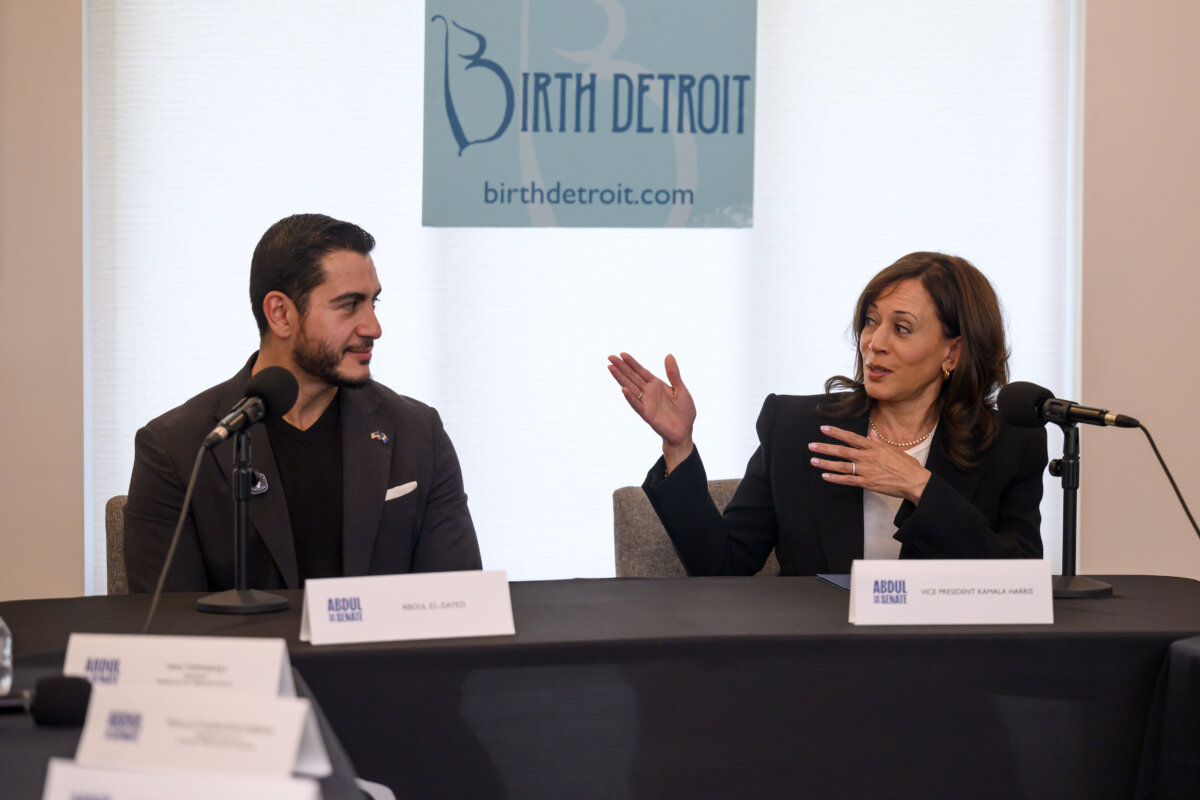

Former Vice President Kamala Harris stumped in Detroit on Sept. 22 for Senate candidate Abdul El-Sayed, hoping to boost the fellow Democrat’s chances of winning in November and the party’s odds of retaking the U.S. Senate.
The two appeared together Tuesday afternoon at a roundtable hosted by Birth Detroit, a black-led community birth center and maternal health provider that has endorsed El-Sayed in Michigan’s Senate race against former U.S. Rep. Mike Rogers, a Republican.
Harris told the panel that she was there to support El-Sayed, a former Wayne County Health director, because she knows he will “be a champion” for maternal healthcare, particularly for black Americans.
The former vice president highlighted how the United States has one of the highest maternal mortality rates in the developed world, and that black women are more than three times more likely to die in childbirth compared to white women.
“Here are the facts that highlight the stakes in this election and the need to have a United States senator from the state of Michigan walking those halls, understanding the issue, and having the character and personality to be a fighter for the people who deserve to be seen, recognized, and treated with dignity,” Harris told the panel.
She criticized the One Big Beautiful Bill Act—signed by President Donald Trump in July 2025—for funding tax breaks with cuts to Medicaid, the largest payer of maternal and prenatal healthcare in the United States. Harris also hit Rogers for supporting that legislation.
The Rogers campaign did not respond to a request for comment by publication time.
El-Sayed told the panel, “We need to make Medicaid whole again.”
“Yes, we need to replace the [Affordable Care Act] subsidies, but we need everybody to have the healthcare that they need and deserve,” El-Sayed said, referring to mothers.
El-Sayed has been making his pitch to Michigan voters with less than 50 days to go before the November election, appearing at rallies throughout the state, including a voter town hall in Saginaw on Saturday.
Harris endorsed El-Sayed almost immediately after he won the August primary against Rep. Haley Stevens (D-Mich.), writing in a statement that “El-Sayed understands that the power is with the people, and that the stakes couldn’t be higher in this election.”
The progressive populist Democrat was also one of eight members of then-candidate Joe Biden’s 2020 Unity Task Force for Healthcare, a joint effort with Sen. Bernie Sanders (I-Vt.) after the latter lost to Biden in that year’s presidential primary.
El-Sayed was also an early supporter of the “uncommitted” movement that withheld support for Biden during the 2024 presidential primary over the former president’s record on Israel and Gaza.
However, he publicly endorsed Harris one day after Biden dropped out of the race and had made it clear months prior that his support for the “uncommitted” movement was strictly tied to the primary and was meant to send a message to the then-president, as Biden was overwhelmingly favored to clinch the nomination.
Tuesday’s roundtable appeared to be an effort at party unity by Harris and El-Sayed, particularly after August’s contentious primary ignited into an intra-party conflict when national lawmakers weighed in on the contest and political action committees, including the American Israel Public Affairs Committee, spent tens of millions in support of Stevens.
Democrats need to flip four seats to retake control of the U.S. Senate, but that number increases if they fail to hold onto any of the three races they’re defending on home turf: Michigan, New Hampshire, and Georgia.
In the latter, Democrats are hopeful that incumbent Sen. John Ossoff (D-Ga.), who continues to maintain a near 8-point lead in the RealClearPolitics polling average, will ultimately beat Rep. Mike Collins (R-Ga.) in November and keep the Georgia seat in hand.
But Michigan is different. Trump narrowly won the state in 2016, and a progressive populist Democrat has never won statewide in what is one of the most purple battlegrounds nationwide. El-Sayed also barely beat Stevens in this year’s primary, winning by less than one percentage point after polls had put him up by double digits.
Even so, El-Sayed is facing Rogers, the Republican who lost to Sen. Elissa Slotkin (D-Mich.) in the very same year (2024) when Trump managed to win statewide, and when Republicans enjoyed a favorable ballot advantage across the country.
Republicans also haven’t won a Michigan Senate race in more than 30 years, since then-Sen. Spencer Abraham (R-Mich.), won in 1994. Abraham lost his reelection bid to then-candidate Debbie Stabenow (D-Mich.) in 2000.
Currently, El-Sayed is leading Rogers by 2.8 percentage points in the RealClearPolitics polling average, while most surveys have given the progressive populist a slight advantage within the margin of error.
 Friends Read Free
Copy
Facebook
Tweet
Friends Read Free
Copy
Facebook
Tweet