


East Java, Indonesia, is home to a volcano known as Mount Ijen. Nestled within a 12-mile-wide caldera and home to the world’s highest acidic crater lake, it is known for eerie, ethereal blue sulfur gas fires that can be seen at night. The volcano spews a constant stream of sulfur gases through multiple vents, which condense in some areas to form solid sulfur.
Mount Ijen also hosts one of the last remaining volcanic sulfur-harvesting operations in the world. The operation isn’t a fancy, high-tech affair running smoothly via the use of the latest machines. Rather, men with baskets make the arduous climb down into the volcano, pile them high with sulfur amid the swirling, toxic gases, and then carry them back to the top.
I watched a video about this the other day, and the therapist in me was fascinated by watching a steady ant-line of workers carrying baskets of sulfur nearly as heavy as themselves up the side of the volcano crater. It was a tortuous, steep route, and I kept looking for them to be huffing and puffing and out of breath by the time they reached the top, but they weren’t. Hardworking, strong men, all of them, and not in small part due to the heavy carrying activities they perform every day.
Carrying exercises have perhaps the longest informal history of any exercise, and by far the most prolific distribution. Loaded or weighted carries don’t have a formal development history, and the reason is understandable: carrying things is one of the most basic human functions we perform outside of moving our bodies, and is especially rooted in the movements of nomadic tribes of the past. We carry things often, and always have.
Your Carrying Muscles
Carrying items involves a multitude of muscles:
Arms and Shoulders: The trapezius, rhomboids, and shoulder stabilizers play a major role in carrying. They keep the shoulders strong and locked, and prevent the weight from “hanging” on the shoulder capsule and ligaments.
Core: The rectus abdominis, transverse abdominis, obliques, and erector spinae muscles all co-contract to stabilize the trunk while carrying.
Hips and Legs: Carrying activities by definition involve moving things from one area to another, and the lower-body muscles perform this function. The glutes, quadriceps, hamstrings, and calf muscles such as the gastrocnemius, soleus, and tibialis anterior contribute to mobility and balance.
Nutshell: The arms provide the actual carrying, the core supports stability of the upper body, and the hip and leg muscles provide the balance and mobility to complete the item transport.
6 Fantastic Carries to Build Strength and Balance
The following five exercises can provide surprisingly effective strengthening through carrying, without subjecting your joints and muscles to excessive repetitive stress.
I use a variety of these exercises with my patients and perform them myself, but I suggest that you speak with your medical provider first to ensure that they are right for you. Also, unlike the small but fancy space available in our film studio, you’ll need to find someplace with plenty of room to walk.
1. Farmer’s Carry
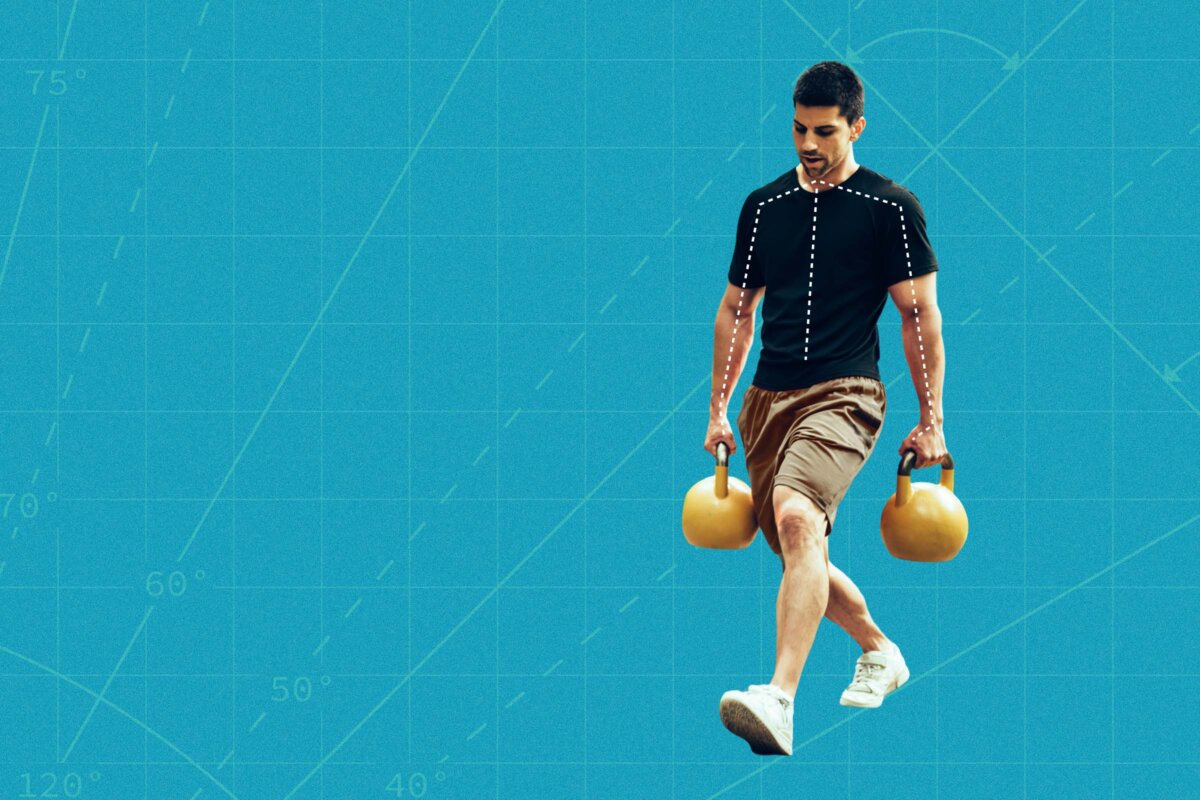
The classic farmer’s carry involves carrying something approximately the same weight in each hand at the same time. Your hands and forearms have to exert the power to hold, your shoulder muscles have to lock in to provide stability, and your hip and leg muscles have to coordinate to provide both mobility and balance.
Step 2: Walk about one step per second for several feet. Keep your core and shoulders engaged to maximize postural control and shoulder joint safety. Take well-controlled, shorter steps.
Step 3: Walk for one minute, which counts as one set; try performing three sets.
Modifications: Carry more or less weight based on your abilities or needs, and keep the weight the same on both sides. You can also increase or decrease how long you perform the task.
Why I Like It: The classic Farmer’s Carry is a great starting place—it’s symmetrical, easy to balance, and predictable: the perfect move to train your body in carries and prepare it for the other exercises.
2. Uneven Weighted Farmer’s Carry
Using different amounts of weight in your hands while performing the classic farmer’s carry introduces asymmetrical weight bearing to your trunk, forcing your core to compensate. This exercise is an excellent follow-on to the classic farmer’s carry.
Step 1: Stand holding a 2-pound weight in one hand and a 4 to 6 pound weight in the other, with your arms hanging straight down by your sides. You might feel more strain on one side of your trunk than another, but this is expected.
Step 2: Start walking, with a pace about one step per second. Keep your core and shoulders engaged to maximize postural control and shoulder joint safety. Take well-controlled, shorter steps.
Step 3: Walk for one minute before switching the weights around and performing another minute of walking, which counts as one set; try performing three sets.
Modifications: Carry more or less weight based on your abilities or needs, and keep the weight at least double the other on one side. You can also increase or decrease how long you perform the task.
Why I Like It: The differentially-weighted Farmer’s Carry is a great transition exercise—it’s asymmetrical and thus adds an extra challenge to your core musculature, which helps strengthen your postural stabilizers.
3. Suitcase Carry
While the classic carry focuses weight bearing on both sides, the Suitcase Carry focuses it on only one side. Asymmetrical weight bearing shifts focus to the nonweight-bearing side, as you need to increase muscular action there to counter the weight on the other side. The first exercise is easy to stabilize with your trunk. This one demands more from your trunk musculature, especially if you use a heavier weight.
Step 2: Maintain an upright posture and start walking as you would with the classic Farmer’s Carry.
Step 3: Walk for one minute, pacing your steps at approximately one step per second, then switch the weight to the other hand and walk another minute.
Step 4: Walking one minute with a weight in one hand, then the other, counts as one set. Try to perform three sets.
Modifications: Use more or less weight depending on your needs, or to increase the amount of challenge the exercise provides. You can either keep the empty hand by your side or hold it straight out to help counterbalance the weight.
Why I Like It: It adds an asymmetrical postural challenge to your core, which can yield greater core strength; it’s a natural transition exercise from the Farmer’s Carry.
4. Dumbbell Overhead Carry
For this exercise, you’re going to hold the weight overhead. This increases your trunk’s need to provide ongoing postural corrections and forces you to carefully control your balance as you walk.
Step 2: Hold this position and walk for one minute, taking about one step per second. Try not to speed up or slow down while walking; control your speed carefully, because you need to focus on your balance.
Step 3: Walking for one minute counts as one set. Try to perform three sets.
Modifications: If you can’t hold the weights straight up, hold them at shoulder level. This will bring the weights up high enough to provide a considerable functional challenge. Increase or decrease the amount of weight you use to increase or decrease the challenge. Want to challenge your balance even more? Try performing this exercise on grass, which is uneven enough to increase your balance challenge considerably.
Why I Like It: Holding the weight overhead makes your body work harder to balance, especially on grass or other uneven surfaces. Just be sure to use a weight that you can safely control. We want the exercise to be more challenging, not more dangerous.
[series_posts_list][/series_posts_list]
5. Goblet Carry
The Goblet Carry places the weight out in front of your balance midline, increasing the challenge for your spinal erectors and stabilizers; it also gives your biceps and shoulder muscles a nice workout.
Step 2: Walk as in the other carries, taking one step per second for one minute.
Step 3: Walking for one minute counts as one set. Try to perform three sets.
Modifications: Increase or decrease the amount of weight that you carry to make the exercise work best for you. I encourage you to use the heaviest weight you can comfortably control to maximize the exercise’s effectiveness.
Why I Like It: The Goblet Carry is excellent for gently increasing focus on your back muscles—a great way to strengthen them without exposing them to extraneous movement.
6. High-Low Farmer’s Carry
For this last one, we’ll try a different asymmetrical carry: one arm in the classic carry position and the other in the overhead carry position. This maximizes both the asymmetrical weight-bearing and balance components.
Step 2: Walk one step per second, maintaining an upright posture for one minute, then switch which arm is up and continue.
Step 3: Walking for one minute with each arm configuration counts as one set. Try to perform three total sets.
Modifications: Only use as much weight as you can comfortably control, especially for the arm that’s pushed up overhead. Be sure to carefully attend to your posture, without slumping or overextending your back. You can increase weight and walk times to best suit your needs.
Why I Like It: Once you try this exercise, you will see how challenging it can be. I like that it challenges you not only with weight, but with balance as well.
These exercises can significantly strengthen your muscles and improve your balance. You can rest assured that you’ll be performing the very same activities that your ancestors once performed, and you’ll be able to benefit as much from them as they did. I hope they work for you, and I wish you luck.
About the Fitness Model: Aerowenn Hunter is a health editor for The Epoch Times. She is an accredited yoga therapist with more than three decades of teaching experience.
Views expressed in this article are the opinions of the author and do not necessarily reflect the views of The Epoch Times. Epoch Health welcomes professional discussion and friendly debate. To submit an opinion piece, please follow these guidelines and submit through our form here.