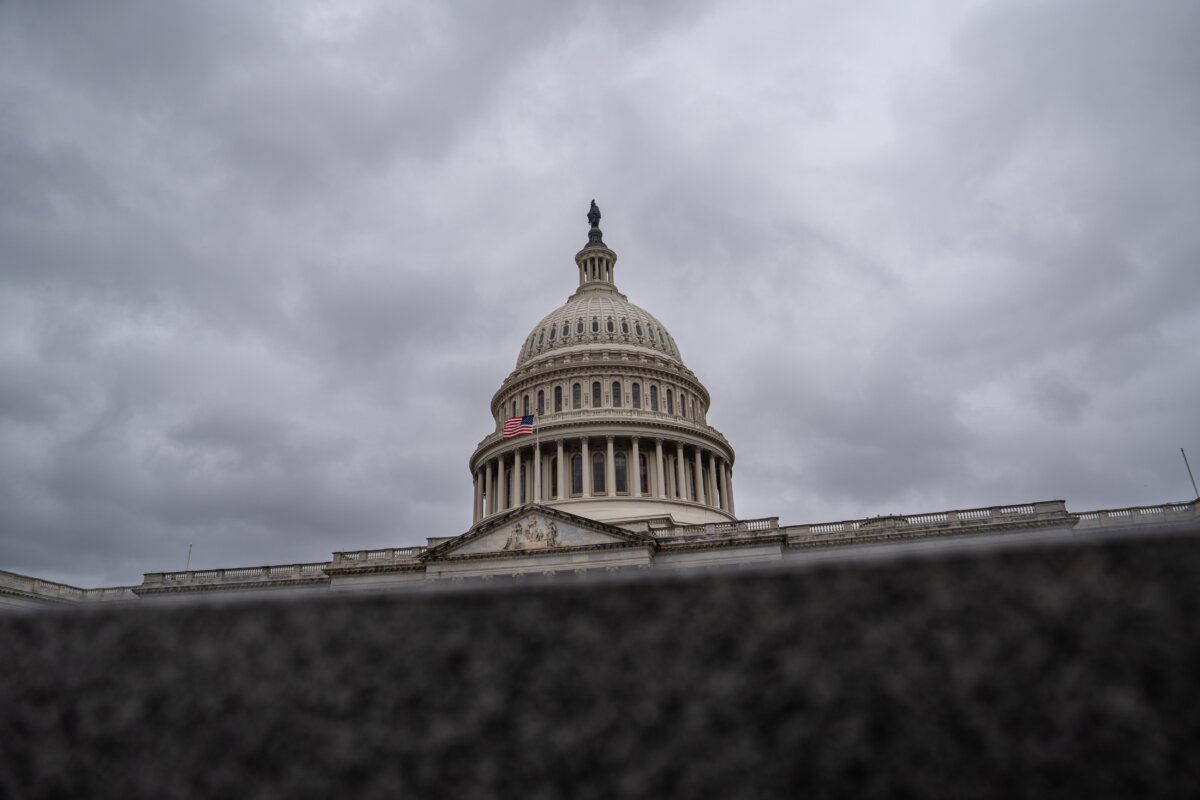

The federal government shutdown enters a third week as the Senate again failed to pass a continuing resolution to provide a temporary extension of funding, which expired on Sept. 30.
Democrats refuse to authorize additional funding until Republicans negotiate over their health care proposals.
Republicans say any negotiations should take place through the regular appropriations process, which can be completed once the government reopens.
Here’s the latest on the state of the shutdown.
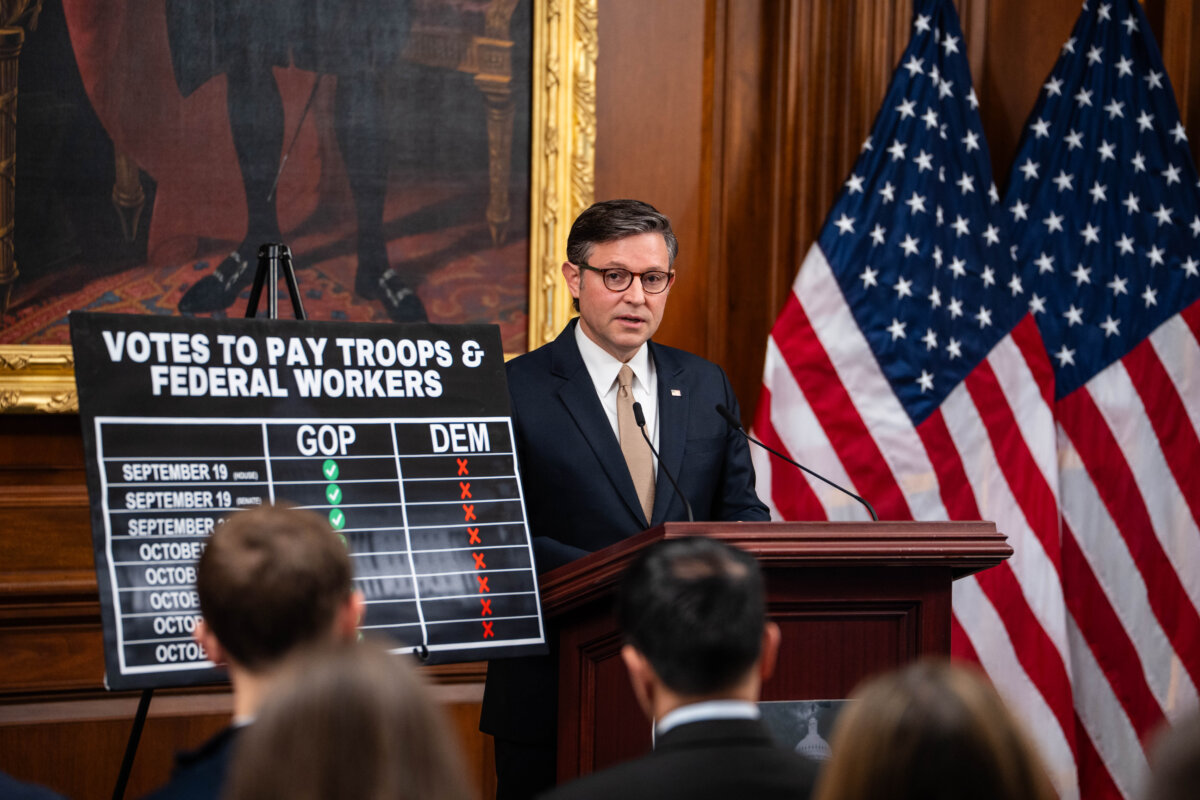
Troops Get Paid
Some 1.3 million active-duty service members received a paycheck on Oct. 15 after Trump ordered that certain unspent federal funds be used to issue one-time pay.
That may be the last paycheck that they receive until the shutdown ends, according to House Speaker Mike Johnson (R-La.).
Johnson said the administration would arrange pay for Capitol police as well, if a similar mechanism can be found.
Americans Feel Pain
Approximately 400,000 federal employees have been furloughed. Those workers received a partial paycheck on Oct. 14 but may not be paid again until the shutdown ends.
“We saw service members waiting hours in lines wrapped around the block at Georgia food pantries,” Johnson said on Oct. 15.
Noting that air traffic controllers, TSA agents, and border patrol officials are working without pay, Senate Majority Leader John Thune (R-S.D.) said, “Every day that this goes on, the problems are compounded for federal workers and for ordinary Americans.”
Democrats make a similar point on the potential impact of the year-end expiration of the Affordable Care Act’s enhanced subsidies. Democrats have proposed that those COVID-era subsidies be made permanent.
“Families are getting letters with their new health insurance rates,” Sen. Minority Leader Chuck Schumer (D-N.Y.) said on Oct. 15, indicating a letter received by a constituent showing that an insurance premium for a New York resident would increase by nearly $1,400 per month.
“Tens of millions of Americans are going to get these notices,” Schumer said.
Layoffs Blocked, Program Closures Coming
The Office of Management and Budget announced the layoff of about 4,000 federal employees on Oct. 10. Unlike furloughs, these layoffs are intended to be permanent.
“We are closing up Democrat programs that we think that we disagree with, and they’re never going to open again,” President Donald Trump told reporters on Oct. 14.
The administration is expected to release a list of terminated programs on Oct. 17.
However, a federal judge in California on Oct. 15 blocked the shutdown layoffs for two weeks, calling them “politically motivated,” and “arbitrary and capricious.”
The order came in response to a lawsuit filed by several federal labor unions challenging a memo from Office of Management and Budget Director Russell Vought that told agencies to prepare for layoffs ahead of the shutdown.
Johnson said the layoffs are an effort to manage government operations amid a lack of funding.
“They’re having to triage federal spending,” Johnson said on Oct. 15. He added that each party would likely evaluate the situation “with a different set of lenses.”
Schumer called the layoffs vindictive, saying: “No one is forcing Trump to fire scientists or doctors in the middle of this season. They’re doing it because they want to.”
No Sign of Compromise
Party leaders have so far made no indication that they are willing to compromise.
Asked if he saw any signs of movement, Sen. John Cornyn (R-Texas) told The Epoch Times: “Nope. Stay the course.”
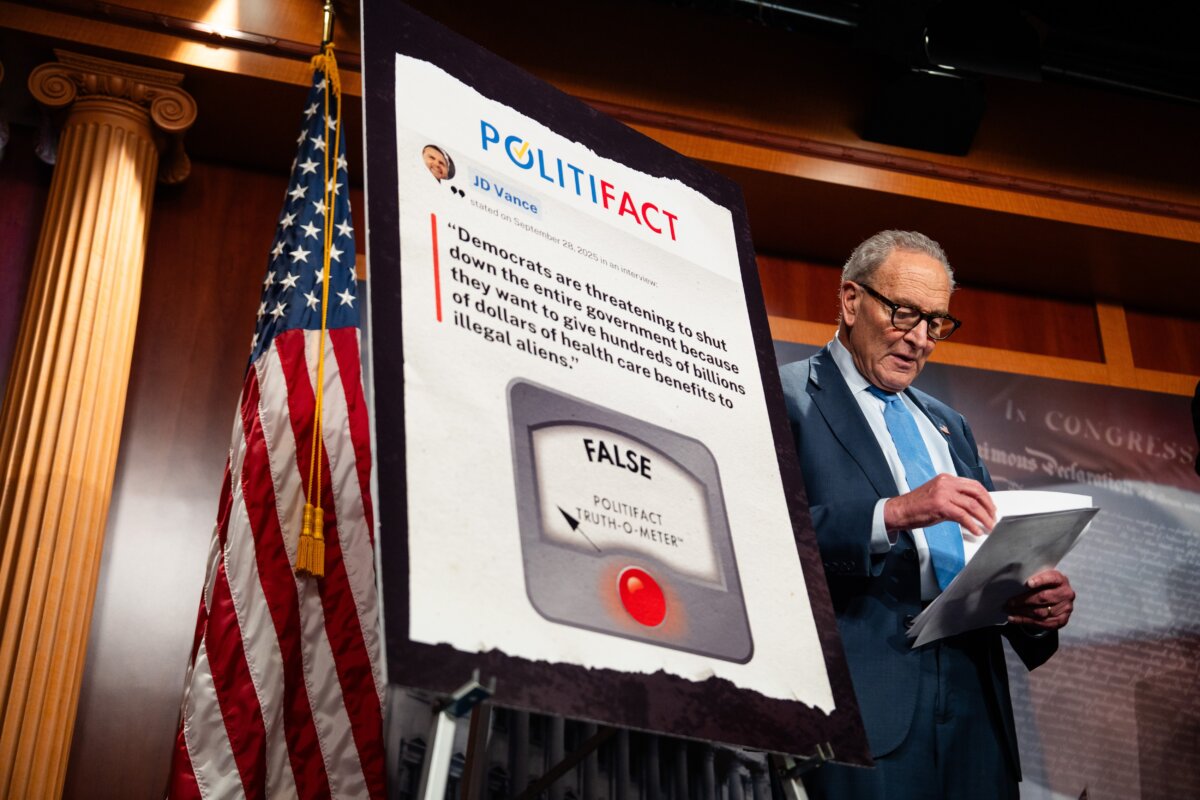
Democrats have said Republicans must negotiate over their health care proposals in order to reach a compromise and reopen the government. They said they are concerned that appropriated funds will not be used as directed.
Referring to the administration’s recent rescission, or cancellation, of certain unspent funds, Rep. Rosa DeLauro (D-Conn.) told The Epoch Times: “There needs to be a mechanism that prevents an unelected bureaucrat—first it was [the Department of Government Efficiency], now it’s Russ Vought—[from taking] the money from the American people.
“If we could sit down [with Republicans], we could really get to discussing it, but they don’t want to do it.”
Responding to Democrats’ demand for negotiation, Rep. Lisa McClain (R-Mich.) said: “There’s nothing to negotiate. We already passed [a continuing resolution].”
Sen. Markwayne Mullin (R-Okla.) told reporters on Oct. 15, “There’s no point in continuing the conversations until they open the government back up.”
Both Sides Look to No Kings Rallies
Some members of both parties said the No Kings protests planned for Oct. 18 in Washington and other places could move the other side to negotiate.
“[Democrats] care about one thing and one thing only: appeasing the radical left,” House Majority Whip Tom Emmer (R-Minn.) told reporters Oct. 15.
Johnson suggested that Schumer is continuing the shutdown to fend off “a primary challenge from his left wing.” The remark apparently referred to speculation that Rep. Alexandria Ocasio-Cortez (D-N.Y.) may challenge Schumer in the 2026 election.
Some in the GOP think that Democrats may be more willing to compromise after offering a show of strength.

“Is [Schumer] really going to hold the federal workers and the rest of American people hostage over his fear of a primary election because he doesn’t like the optics of what happens if he opens up for No Kings day?” Mullin told reporters on Oct. 15. “That’s what we come down to at this point.”
Schumer, when asked if he thought that progressive Democrats distorted the Democratic message, told reporters: “We’re fighting on the same side. We all believe that there’s a health care crisis, and we all believe that we have to address that.”
DeLauro said she hoped that the protests would motivate Republicans to negotiate.
“Public outcry is substantial,” she told The Epoch Times. “On the 18th, my hope is that some of my Republican colleagues will listen to their constituents.”
Rep. Jesús “Chuy” Garcia (D-Ill.) agreed. “On Saturday, we’ll see an expression of the disaffection with Trump’s agenda in the marches that will mobilize millions of people,” Garcia told The Epoch Times.
The shutdown began on Oct. 1. The longest previous shutdown took place during Trump’s first administration and lasted 35 days.
Nathan Worcester, Stacy Robinson, and Jack Phillips contributed to this report.
 Friends Read Free
Copy
Facebook
Tweet
Friends Read Free
Copy
Facebook
Tweet