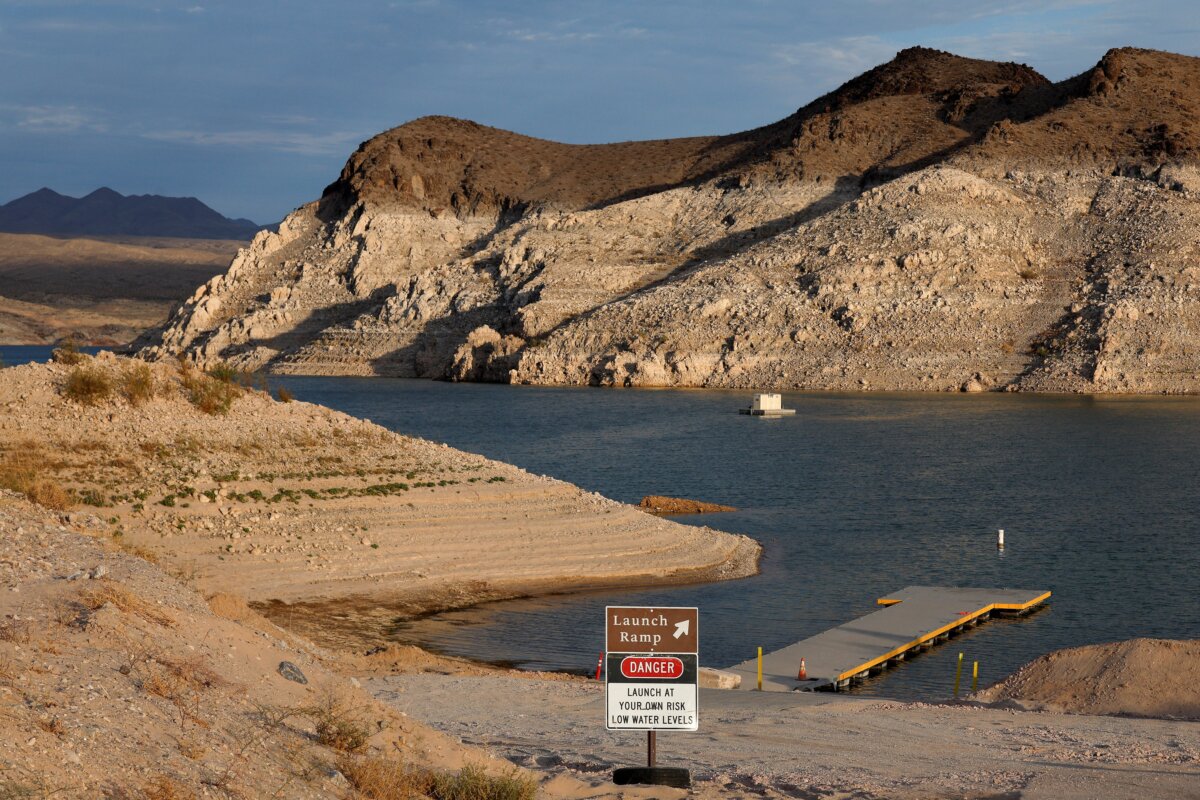

Lake Mead, the nation’s largest reservoir by storage capacity, has fallen to its lowest level on record as a drought throughout western states continues.
Bureau of Reclamation data indicate that the reservoir’s surface elevation rose to 1,040.50 feet above sea level on Thursday, below the previous low of 1,040.58 feet set in July 2022, when the lake first fell to a low following years of drought.
Hoover Dam forms Lake Mead along the Colorado River on the Nevada-Arizona border, and holds water for approximately 40 million people in seven Western states, as well as parts of Mexico. In addition, Lake Mead generates hydropower for customers in California, Arizona, and Nevada, which is threatened by the falling water levels.
The Colorado River Basin has been in a so-called megadrought for more than 20 years. In 1999, Lake Mead was near capacity, but by 2022 its surface had fallen by nearly 176 feet after a period that is the driest on record throughout many parts of the West.
Southern Nevada gets nearly 90 percent of its water from Lake Mead, and the Southern Nevada Water Authority has long viewed the Colorado River allotment as its largest and most critical resource, leading to conservation efforts over the years that have slashed per-person use going back to the early 2000s, and nearly all indoor water is recycled.
When Lake Mead first fell below 1,075 feet in 2021, federal officials declared a Level 1 shortage, and further declines prompted deeper cuts. Nevada’s share of the river has fallen by billions of gallons over the course of several years.
Hoover Dam also produces thousands of gigawatt-hours of electricity annually. At Glen Canyon Dam on Lake Powell, Lake Mead’s companion reservoir, the level was 3,521 feet on Thursday, down nearly 33 feet from a year ago. Electricity production becomes infeasible once the surface falls to 3,490 feet and below. Both lakes still operate despite being well below the elevation levels needed for reliable power and storage.
Population growth has also added to the pressure. Nevada ranked near the top of states for growth in recent years, and Southern Nevada is home to approximately 70 percent of the state’s residents.
Lake Mead National Recreation Area attracts millions of visitors each year for a range of activities, including boating, fishing and hiking. Low water has exposed once submerged features, such as the ruins of the town of St. Thomas. There is also a World War II-era B-29 bomber that was submerged in the lake after crashing almost 70 years ago.
 Friends Read Free
Copy
Facebook
Tweet
Friends Read Free
Copy
Facebook
Tweet