
Tennessee’s chapter of the NAACP filed suit, and others hinted at further legal challenges, on May 7 over Tennessee’s newly enacted congressional map, which redraws Memphis into three districts and ends what had been the state’s only majority-black and its only Democrat-held congressional seat.
Rep. Steve Cohen (D-Tenn.), the lone Democrat in Tennessee’s congressional delegation, also alluded to his own forthcoming legal challenges after the map passed, saying in a post on X that the “next stop” in Democratic pushback is in “the courts.”
The NAACP Tennessee State Conference filed its lawsuit the same day the redistricting-related bills were signed, asking judges to block the map under the Tennessee Constitution and state law before the August primaries.
In the suit, the state chapter and its president, Gloria Sweet-Love, claimed that the state and Republican Gov. Bill Lee engaged “in unlawful late-decade congressional redistricting in violation of clear and unambiguous Tennessee statutory law and the mandates of the Tennessee Constitution.”
On May 7, Lee signed the new districts into law after the Republican supermajority-led chambers of the General Assembly passed the redistricting bills in a special legislative session. The map redrew the Ninth Congressional District, which Cohen has represented since 2007.
During the special session, the General Assembly passed S.B. 7002, which repealed a state law prohibiting mid-decade redistricting.
The suit argues that the repeal itself was unconstitutional because Lee’s May 1 proclamation did not specifically mention Section 2-16-102 or its repeal.
The proclamation, signed on May 1 by Lee, authorized the General Assembly to consider “statutory changes that are necessary to effectuate changes to the composition of Tennessee’s congressional districts.”
NAACP then cites Article III, Section 9 of the Tennessee Constitution, which limits a special session to legislative business for which legislators “were specifically called together,” the petition states, arguing that the proclamation was not specific enough to meet that bar.
The suit also challenges a second bill, S.B. 7001, that suspended a one-year district residency requirement for congressional candidates—a provision the petition argues was likewise outside the proclamation’s scope. The petitioners are asking the court to declare both bills “void ab initio,” or invalid from the start, and to enjoin the state from holding elections under the new map.
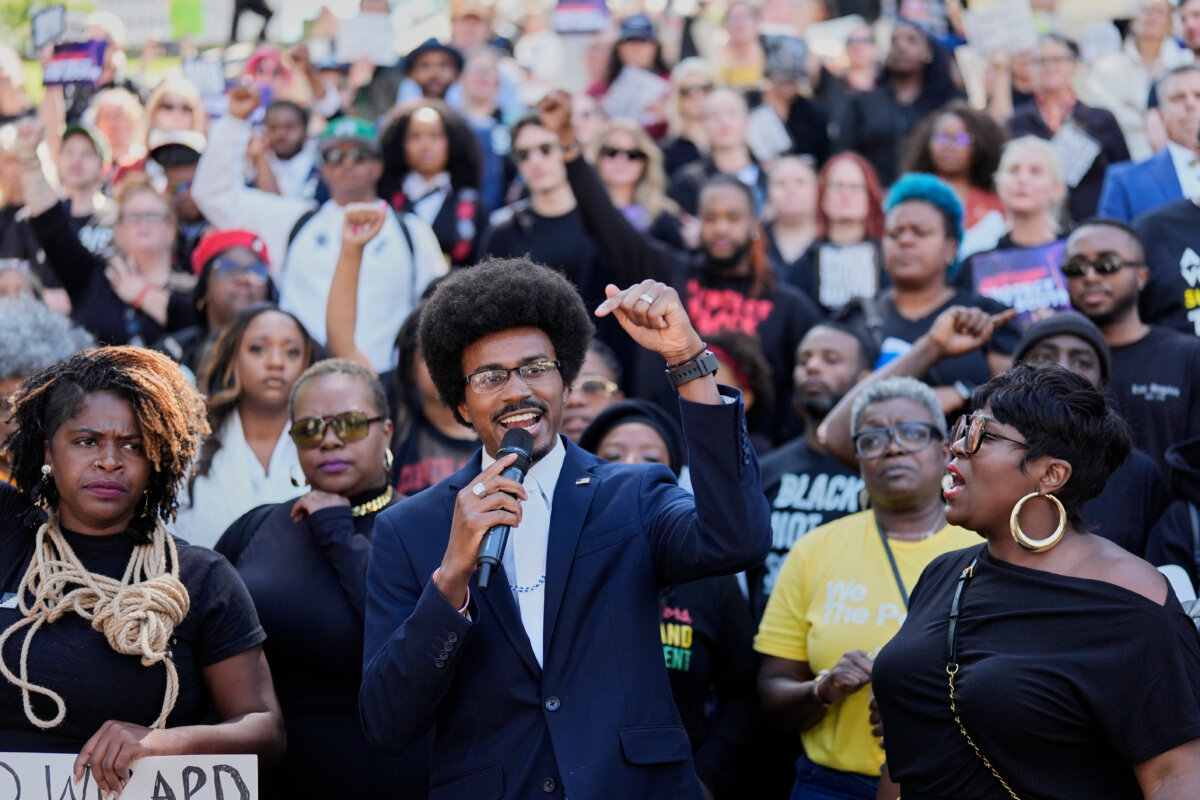
State Rep. Justin Pearson, a Democrat, who had been challenging Cohen for the seat, said during the floor debate on May 7 that the General Assembly was “eviscerating the only black-majority congressional district in [the] state because [it is] majority black.”
Kristen Clarke, the NAACP’s general counsel, said in the statement announcing the lawsuit: “It is a direct attack on our democracy and our Constitution to dismantle majority-black districts. A democracy without black representation is not a democracy.”
Sweet-Love said in the same release: “The Tennessee State Conference of the NAACP will fight this attempt to silence black voters through this unlawful redistricting process.”
National Democratic organizations responded immediately as well.
Reyna Walters-Morgan, the Democratic National Committee’s vice chair for civic engagement and voter participation, said Tennessee Republicans had carved up “the nation’s second-largest majority-black city into three districts stretching hundreds of miles to drown out the voices of Memphis voters.”
Rep. Suzan DelBene (D-Wash.), chairman of the Democratic Congressional Campaign Committee, called the map a “power grab” and predicted that Tennessee voters would respond at the polls.
“Democrats will always fight to keep the power in their hands, and will be poised to take back the majority in November,” she said.
Tennessee Democratic Party Chair Rachel Campbell said her party would challenge the map “at the polls, in the courts, and in the streets.”
Solomon Trapp, chairman of the Tennessee Democratic Party Black Caucus, called the redistricting “a modern-day revival of Jim Crow” in a separate statement.
Republican leaders defended the new map.
State House Speaker Cameron Sexton, a Republican, wrote on X on May 6 that the U.S. Supreme Court had “opined that redistricting, like the judicial system, should be color-blind” and that the same court had indicated that “states can redistrict based off partisan politics.”
He said Tennessee was joining “other red and blue states in redrawing their congressional maps.”
Tennessee Lt. Gov. Randy McNally, a Republican, said in a Facebook post after the bill’s passage that the General Assembly had “passed a fair and legal congressional map that reflects the longstanding conservative character of Tennessee.”
He said the new districts would help send representatives to Washington who back “strong borders, safe communities and fiscal responsibility.”
The legal challenges follow a U.S. Supreme Court ruling in Louisiana v. Callais that limits redistricting based on race.
Democrats and voting rights advocates say the ruling essentially “guts” the Voting Rights Act, weakens federal protections for minority voting power, and gives Republican-led states grounds to revisit majority-minority districts.
 Friends Read Free
Copy
Facebook
Tweet
Friends Read Free
Copy
Facebook
Tweet