
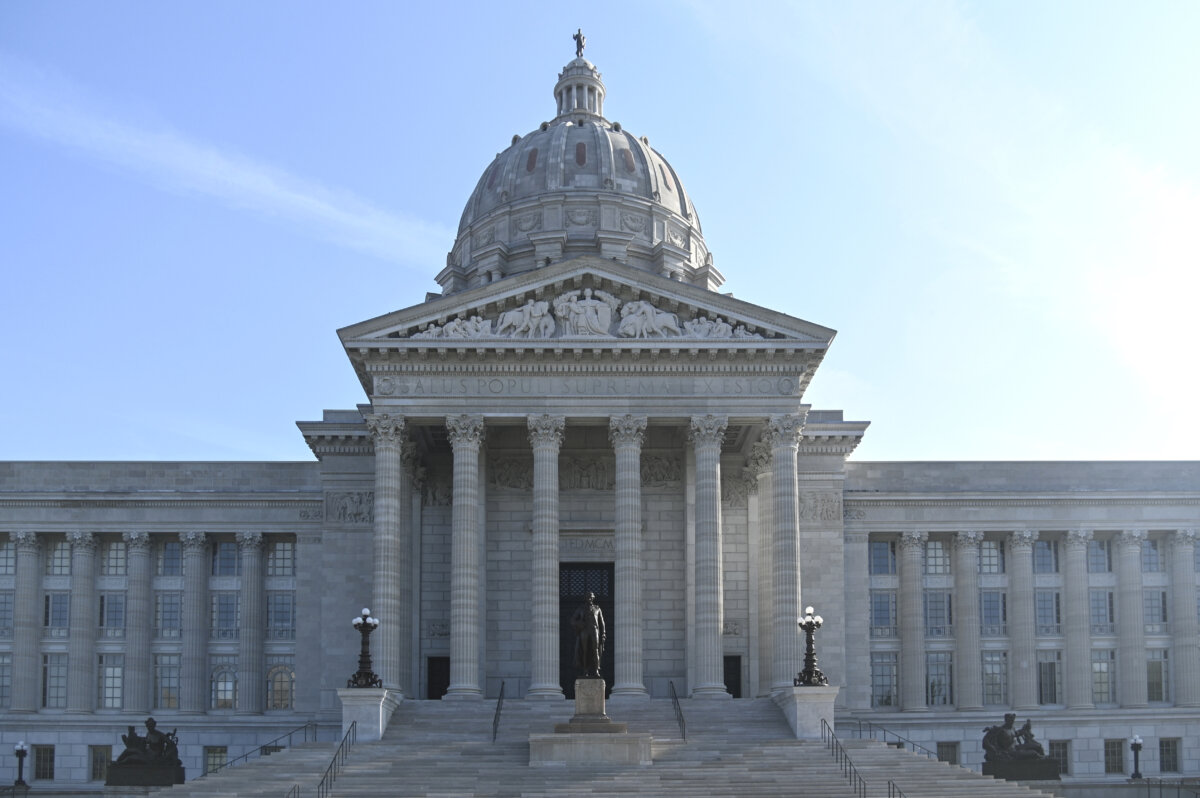

The Missouri Supreme Court on May 12 upheld the state’s 2025 redistricting map, possibly flipping one more seat from Democrat to Republican.
“Drawing maps establishing congressional districts is a political process, involving policy decisions that are political in nature, best left to elected representatives and the citizens of this state, not judges,” the court’s unanimous ruling says.
“Courts are tasked with deciding only the legality, not the prudence, of a congressional district map.”
The state Legislature redrew its districts in September amid the ongoing redistricting battle between the Democratic and Republican parties. The map, which potentially gives Republicans an extra seat by breaking up Democratic Rep. Emanuel Cleaver’s District 5, was hit with two lawsuits. Cleaver has occupied that seat for more than 21 years.
In one suit, a group of 16 plaintiffs argued that the new map violated Article III, Section 45 of Missouri’s constitution, which says “districts shall be composed of contiguous territory as compact and as nearly equal in population as may be.”
The new districts were not sufficiently compact, they argued. But lower courts found in favor of the state, which argued that the new map was statistically as compact as, or even more compact than, previous state maps.
In appealing to the state’s Supreme Court, the plaintiffs said the lower courts erred by crediting that analysis, because it rested on average compactness across Missouri, instead of paying attention to individual districts.
Missouri’s Supreme Court disagreed, saying the state had “considered the totality of the evidence, including expert testimony, county and municipal splits, and population density.”
Arguments that the map should be struck because it split the Jackson County area of Kansas City were also dismissed. Previous maps had also split Kansas City, just in a different way, Chief Justice W. Brent Powell wrote.
“Here, the circuit court properly found the 2025 Map satisfies the constitutional principles of compactness, and because of this, the subjective policy preferences of the legislature and Appellants related to population density are irrelevant,” he wrote.
In another suit, plaintiffs said use of the map should have been suspended until voters in the state approved its use by referendum.
A group of organizers submitted 691 boxes of signatures calling for that referendum in December 2025, but the question has still not been put to a vote. The plaintiffs argued that, under the state constitution, the new map should be paused until that happens.
In a separate unanimous ruling on May 12, the Missouri Supreme Court said there was no such language in the constitution.
“Had the drafters intended a referendum petition filing to automatically suspend any act of the General Assembly at issue in the referendum petition, they would have so stated,” Judge Ginger Gooch wrote.
 Friends Read Free
Copy
Facebook
Tweet
Friends Read Free
Copy
Facebook
Tweet


























