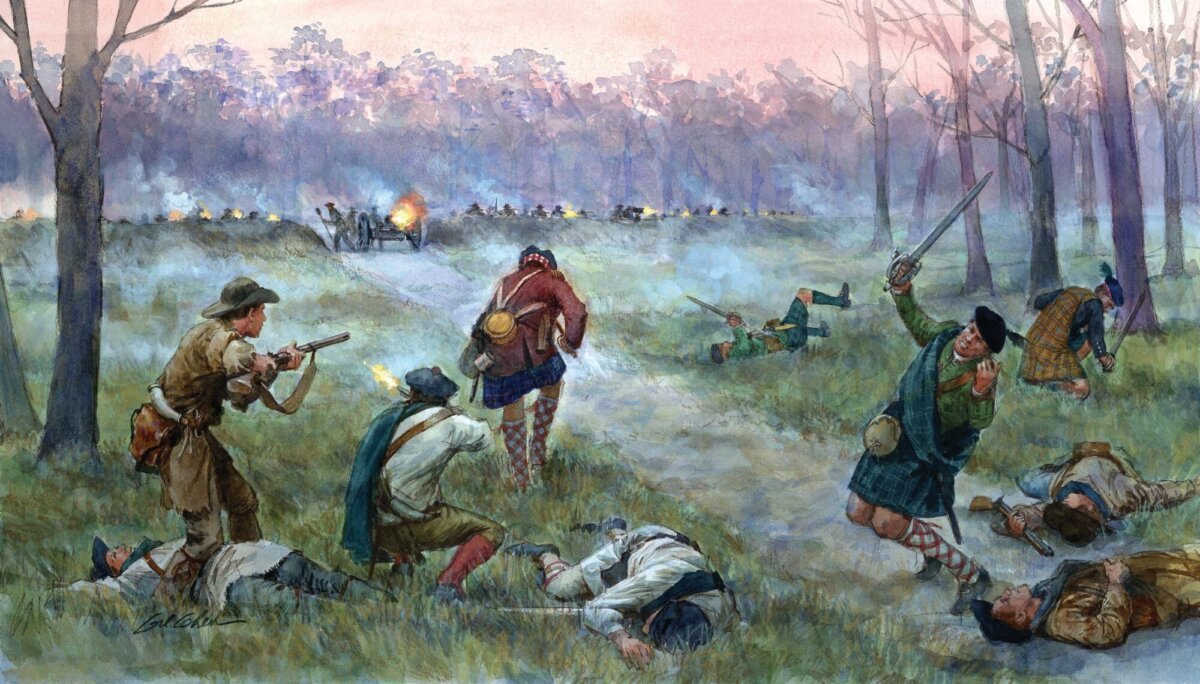
Loyalist militiamen crept silently in the cold, predawn hours of Feb. 27, 1776, hoping to seize a small bridge that spanned a narrow creek. Waiting for them were Patriot militiamen, hidden in the darkness, muskets ready. Both sides believed their cause was just.
North Carolina’s civil war—nested inside the larger Revolutionary War—was about to erupt over this vital chokepoint. The bridge itself was not the true prize. It was what lay beyond it: the coast and a British army waiting offshore.
If the Patriots succeeded, the Crown’s southern strategy would unravel. But if they failed and the two forces linked up, North Carolina would be dragged back under royal rule, and the emerging independence movement in the South would be crushed by spring.
The Plan
By February 1776, the war in the North had hardened into stalemate. Boston remained under British occupation, yet rebellion had spread well beyond Massachusetts Bay. In London, Britain’s senior ministers searched for a way to break the deadlock.
Gov. Josiah Martin of North Carolina believed he had the answer.
Writing from aboard the sloop HMS Cruizer, where he had taken refuge after fleeing the Patriot takeover of his colony, Martin assured Lord Dartmouth, Britain’s secretary of state for the colonies, that thousands of Loyalists stood ready to defend the Crown. Among those he cited as likely participants were former Regulators—still bitter over their defeat in the Regulator War—and Scottish Highlanders who had recently settled in North Carolina. If properly armed and supported, Martin argued, they would rise and fight.
Highland Scots were already highly sought after for their warrior spirit by both the Patriots and the British Army. The Continental Congress dispatched two Presbyterian ministers to persuade them to join the Patriot cause, but their inability to speak Gaelic doomed the mission from the outset.
As a precaution, Martin dispatched customs officer Alexander Schaw to London as his emissary to personally urge approval of the plan. The Privy Council favored the southern expedition, and the British Cabinet, with the backing of King George III, authorized it. A fleet under Sir Peter Parker would transport seven regiments from Ireland under Lord Charles Cornwallis. Gen. William Howe was instructed to detach a force of 2,000 men—led by Gen. Henry Clinton—from Boston and link up with Parker and Cornwallis.
The initial objective was Charles Town—present-day Charleston, South Carolina—a major rebel port and base of operations. But Schaw pressed for an alternative. North Carolina, he argued, should be taken first. With the support of a large Loyalist militia, the colony could be seized with relative ease, opening the interior to British control and making the capture of South Carolina far simpler. He persuaded the council that North Carolina was the key.
On Jan. 3, 1776, Martin received confirmation from Lord Dartmouth—who by then had been replaced by Lord George Germain—that a powerful British expeditionary force was being dispatched to North Carolina. A week later, Martin issued a proclamation calling on all loyal subjects to rally under the royal standard. Loyalists were authorized to recruit men, seize rebel arms, gather provisions, and march to the coast by mid-February, where British ships would meet them.
Even before the southern strategy was formally approved, Gen. Thomas Gage, in July 1775, sent two British officers of Scottish descent—Lt. Col. Donald MacDonald and Capt. Donald MacLeod, both wounded at Bunker Hill—to North Carolina to assist Martin with Loyalist recruitment and mobilization. Upon their arrival, New Bern’s Committee of Safety—a Patriot governing body—interrogated the two men. They claimed their wounds were too severe for further military service and that they merely wished to visit friends and family—MacDonald’s brother Allan lived in the colony—and consider settling there. Lacking evidence to detain them, the committee released them, a decision it would later regret.
The Mobilization
By early February, Loyalist leaders gathered at Cross Creek—present-day Fayetteville, North Carolina. Participation estimates swelled optimistically: 5,000 Regulators and 1,000 Highlanders were expected. Reality proved otherwise. Regulators had been disarmed in 1771 after the Regulator War, leaving only about 1,000 men available.
Still, on Feb. 15, approximately 3,500 Loyalists mustered. Confidence ran high. But as word spread that they might have to fight their way to the coast, enthusiasm faltered. By Feb. 18, when MacDonald and MacLeod—newly appointed brigadier general and lieutenant colonel, respectively—began marching toward the coast, only 1,400 to 1,600 remained.
Patriots witnessing the activity sounded the alarm. A dispatch rider carrying Martin’s urgent message for the Loyalists delivered it—not to its intended recipients—but intercepted it for the Patriots. As news spread, militia and Minutemen units throughout North Carolina rapidly mobilized. In Wilmington, women and children were evacuated as fortifications rose around the city.
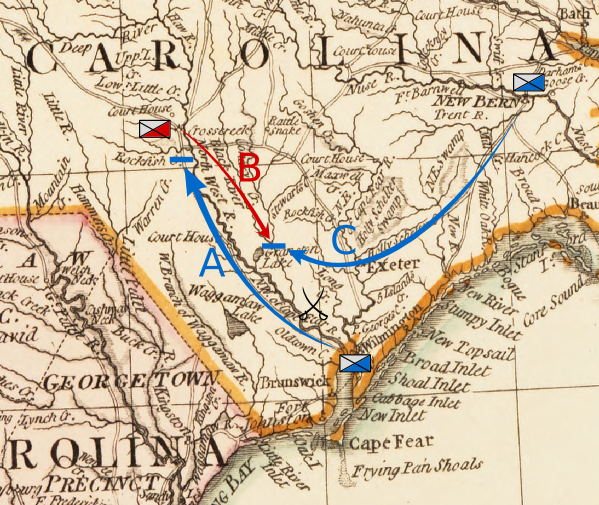
Col. James Moore led North Carolina’s 1st Continental Regiment from Wilmington to meet the growing threat. Accompanied by Col. Alexander Lillington and his militiamen, Moore reached Rockfish Creek—only 7 miles from MacDonald—and camped on the southern shore. He ordered militia units to converge and block all remaining paths to the coast. Among those responding was New Bern’s militia under Col. Richard Caswell.
When MacDonald learned of Moore’s blockade, he sent Moore a copy of Martin’s proclamation, instructing the Patriots to lay down their arms. Moore replied that MacDonald should surrender and accused him of lying under oath during his earlier detention at New Bern.
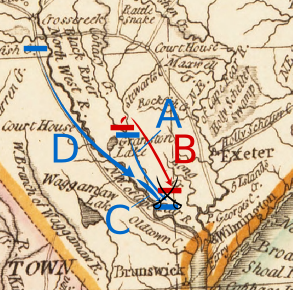
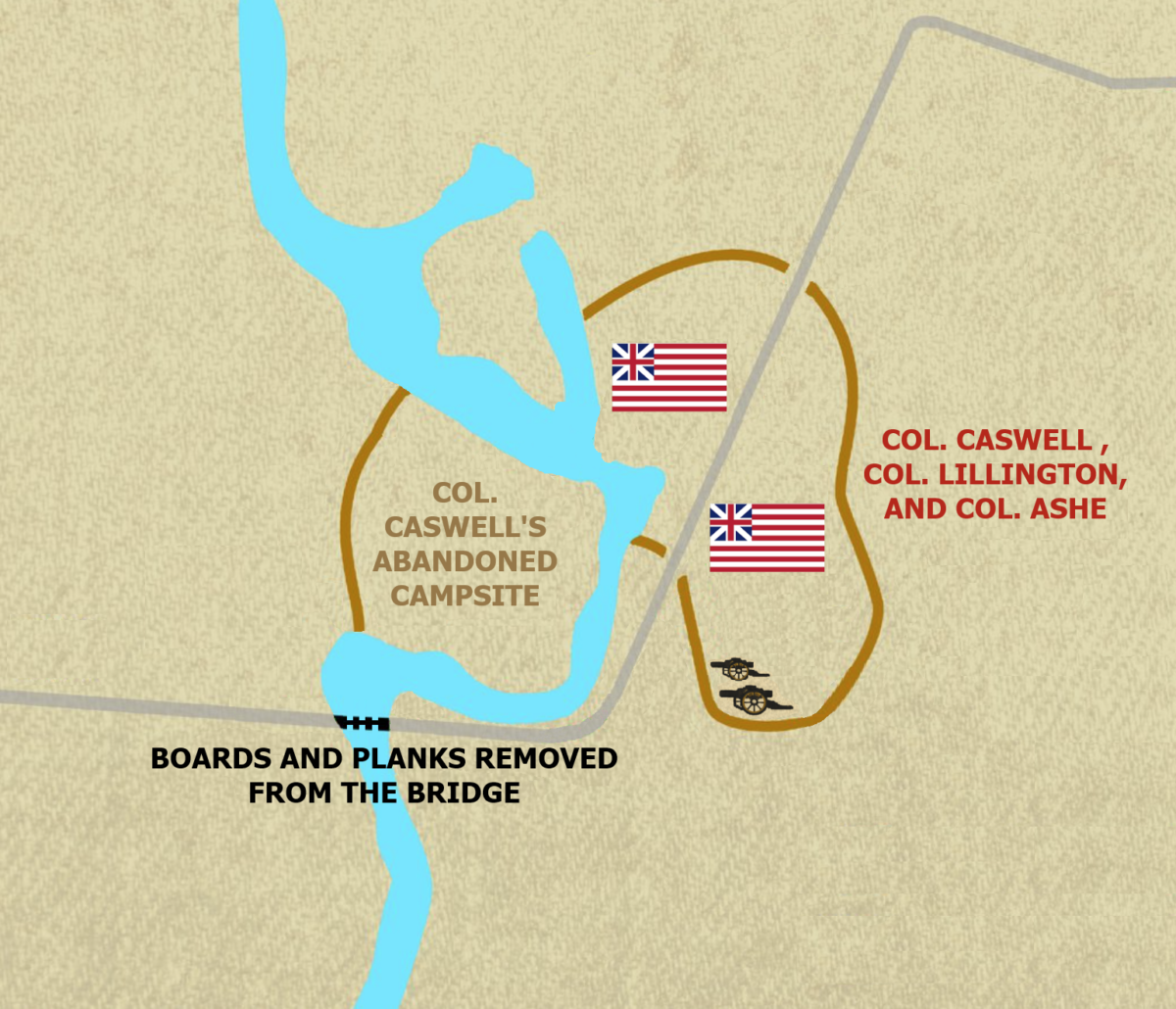
Wishing to avoid confrontation, MacDonald led his force across the Cape Fear River, destroyed the boats behind them, and marched toward Corbett’s Ferry on the Black River. Anticipating the move, Moore ordered Caswell to secure the ferry with his 800-man force and establish a blockade. He then directed Lillington and Col. John Ashe to rush 250 men to Moore’s Creek and secure Widow Moore’s Bridge—known today as Moore’s Creek Bridge. With the creek measuring 50 feet wide and 5 to 8 feet deep, the bridge was a crucial objective for both sides.
Scouts warned MacDonald that Patriot militias already occupied Corbett’s Ferry. Once again, he sought an alternate route, locating one with the help of an enslaved man. A rear guard approached the blockading militia and feigned a confrontation while the main body slipped across the river. Discovering the deception, Caswell rushed his men to Widow Moore’s Bridge. Finding Lillington and Ashe already settled on the east bank, Caswell camped on the west bank.
MacDonald sent a messenger to demand their surrender. After Caswell rejected the demand, the messenger reported that the Patriots appeared vulnerable with their backs to the creek. Although MacDonald advised against attacking, the other officers pressed for action. Ill and elderly, MacDonald turned command over to MacLeod.
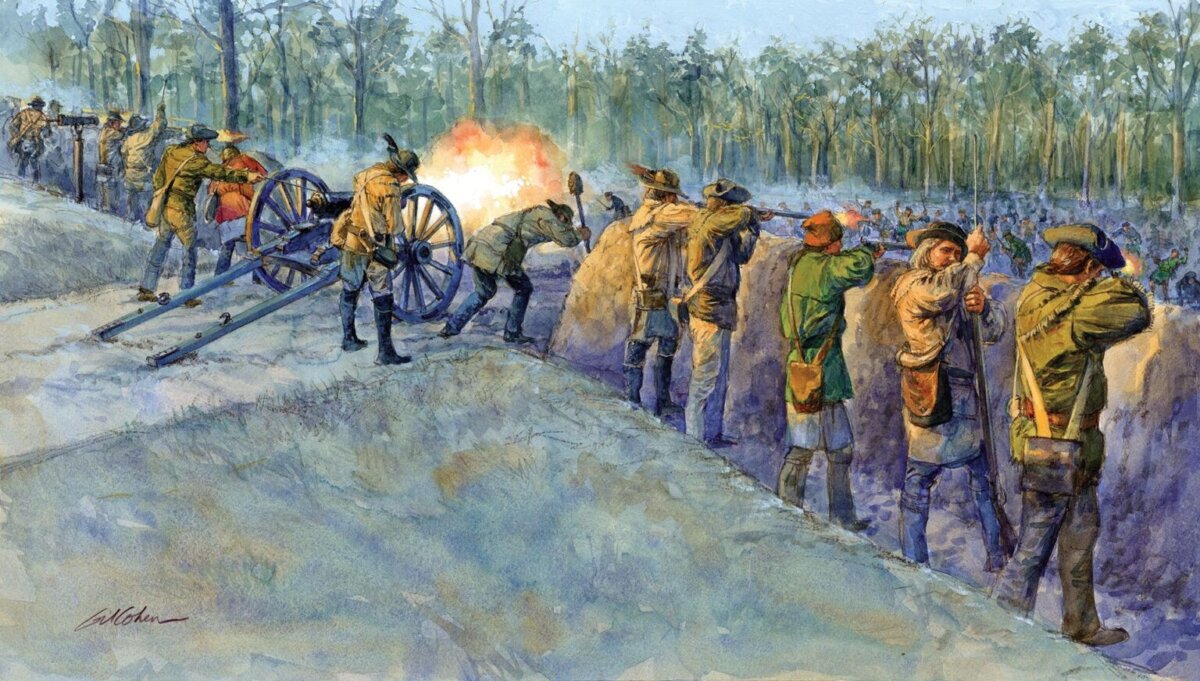
During the night, Caswell quietly withdrew his men across the creek to join Lillington behind a large earthwork. They removed the bridge planks and greased the remaining rails with tallow and soap.
The Battle
Before dawn on Feb. 27, Loyalists silently advanced, hoping to surprise Caswell’s camp. Instead, they found it empty. Moments later, a Patriot sentry fired his musket to sound the alarm.
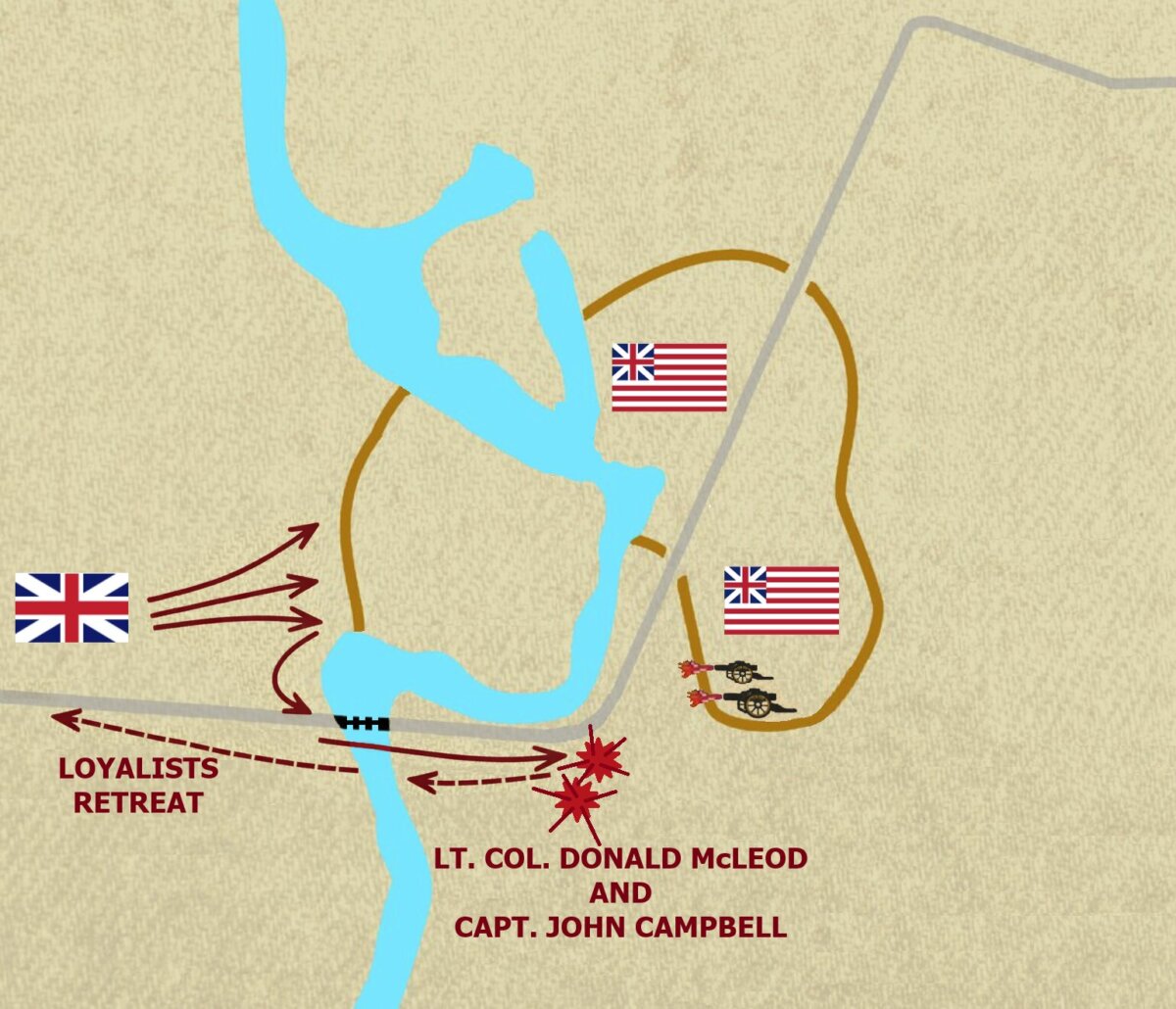
With drums, bagpipes, and the cry “King George and Broad Swords,” the Loyalists surged toward the bridge. Words were exchanged, then shots were fired. MacLeod and Capt. John Campbell led a company of broadsword-wielding Highlanders forward. They stepped between missing planks and advanced 30 paces beyond.
Then the Patriot line erupted with musket volleys and artillery fire. MacLeod and Campbell were instantly hit and mortally wounded. Those who crossed the bridge either fell or fled. An unknown number attempting to flee slipped from the bridge, tumbled into the creek and drowned.
Patriot militiamen quickly replaced the bridge planks and pursued the survivors.
The once-spirited charge collapsed into a catastrophic rout.
By the time Moore arrived, the outcome of the Battle of Moore’s Creek—and North Carolina’s civil war—had been decided in three minutes.
The Consequences
Britain’s southern strategy fizzled before the fleet even arrived. The Loyalist defeat at Moore’s Creek cost the British Army four crucial years before its return to the South in 1780.
In the days that followed, Patriot forces captured an estimated 850 Loyalists, including MacDonald. They seized approximately 1,800 muskets and rifles and 15,000 British pounds in Spanish gold. Patriot recruiting surged as control of the colony consolidated, while Loyalists—shaken by the disaster—refused future calls to arms.
The Maryland Gazette exulted: “This, we think, will effectually put a stop to the [Loyalists] in North Carolina.”
On April 12, 1776, the North Carolina Provincial Congress became the first colonial body to officially recommend independence from Great Britain.
But before the Patriots could celebrate, they still had to contend with the British, who departed Cape Fear at the end of May for their original target, South Carolina.
What arts and culture topics would you like us to cover? Please email ideas or feedback to features@epochtimes.nyc