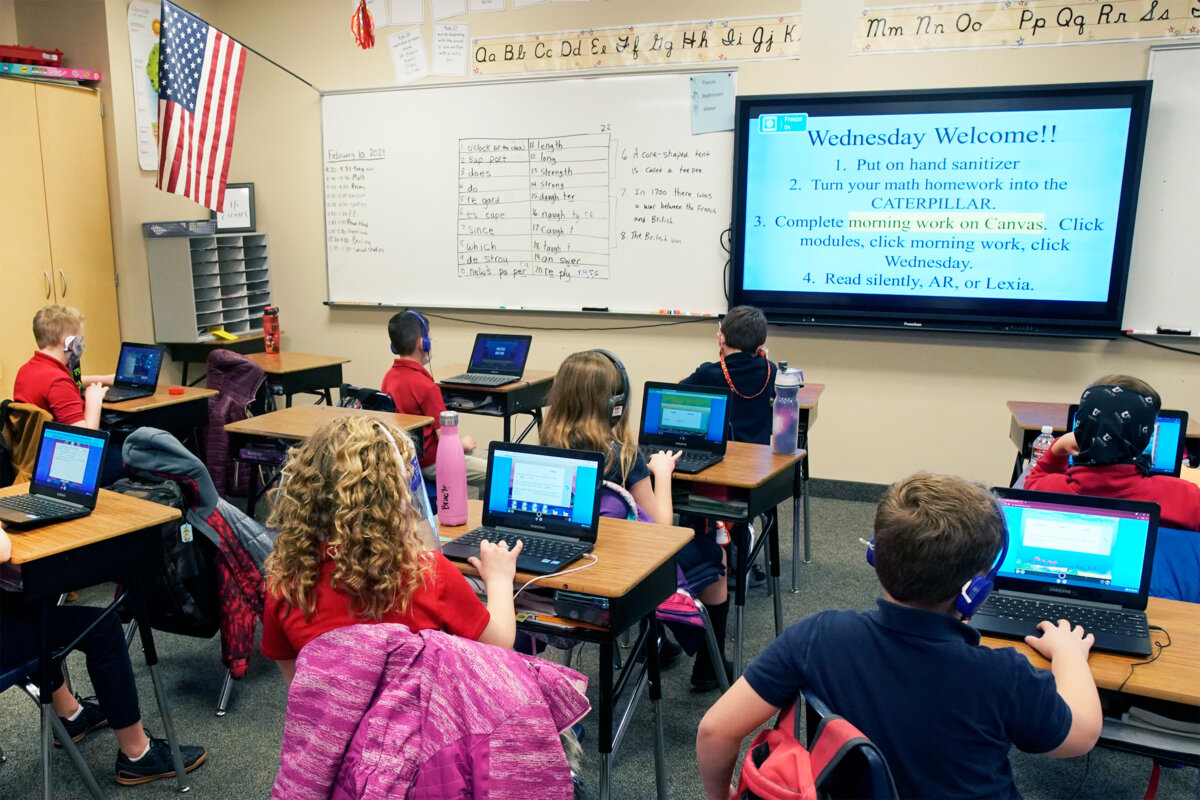

Ahead of the approaching academic year, several states are scaling back ubiquitous digital learning in public schools.
In Iowa, a 60-minute limit on screen-based instruction for elementary school students takes effect for the 2027–2028 school year. District leaders have all of this year to develop a plan before the measure is enforced.
Utah’s legislation goes even further and may eventually prohibit schools from providing laptops to every student in grades K-6 while allowing parents of students in higher grades to opt out of school-issued devices.
State legislature websites indicate that similar laws were passed in Tennessee and Alabama earlier this year, requiring individual districts to develop and later enforce regulations for elementary school children, though a 60-minute time limit won’t necessarily become the standard.
The Los Angeles Unified School District Board of Education decided on its own to implement limits across all grades and immediately ban YouTube in schools.
The Maine legislature tasked a policy research institute to study the harms of excessive screen-based learning and provide recommendations for alternatives.
Virginia’s new law requires classroom instruction on screentime addiction.
Vermont will now require districts to vet ed-tech tools and do more to safeguard student privacy.
Parent organizations and various groups concerned with digital classroom disruptions hope these ideas catch on across the nation in the months ahead, just as bell-to-bell phone bans did last year.
“Technology didn’t provide all the benefits they thought it would. It didn’t improve student outcomes,” Kim Whitman, co-lead of the Distraction-Free Schools Policy Project, told The Epoch Times.
“Nothing beats the actual teacher-student interaction.”
Whitman’s group and several others advocated getting phones out of classrooms before most states went on to pass related legislation. About half the states and Washington, D.C., mandate bell-to-bell smartphone bans in public schools.
“We saw phone-free schools as the first step,” she said, adding that in an era when professionals fear eventually being replaced by artificial intelligence, teachers might favor curbing technology in the name of job security.
Distraction-Free Schools provided model legislation to several states and individual districts across the nation. It also tracks districts that have taken steps to remove some ed-tech products.
Ahead of these laws, experts shared research with Congressional committees and education policy centers that indicated shorter attention spans, decreased academic performance, disciplinary problems, and negative outcomes associated with excessive screen-based instruction in schools, not to mention mental health issues linked to screen time addiction and youth social media use.
During a congressional committee hearing in January, Dr. Jared Cooney Horvath, a neuroscientist who specializes in adolescent brain development, told federal lawmakers that educators are designing instruction around digital tools, but the process should be the other way around.
Instead of using laptops to train novices to become experts, he said, incorporate the technology to enhance the traditional instruction that has already been applied—not replace it—“when you already know how to think.”
Emily Cherkin, a screentime consultant who works with schools, spoke of occupational therapists who teach toddlers how to turn pages in a book, elementary school children who fell out of their chairs because they lacked the core strength to sit for long periods of time, and a middle school boy who watched 13,000 YouTube videos on a school-issued laptop while in school over the course of three months.
Positive findings have already emerged from states that have restricted student phone use and may be considering additional steps to bolster connections between students and teachers, said Patricia Levesque, CEO of the ExcelinEd education policy center.
In Florida alone, where some districts first implemented a ban two years ago, test scores are increasing while the number of unexcused absences is decreasing.
“The kids say they have more time to complete their assignments when they’re not distracted by phones,” she told The Epoch Times. “It’s noisy in the hallways because kids are talking to each other again.”
Pushback against scaling back ed tech tools is expected, considering that many districts are bound to vendors by multi-year contracts or because the federal government already provided Chromebooks, software, and other technologies for every student in several states through federal COVID-relief grants.
By contrast, school leaders could be hesitant to take on added expenses for “analog” equipment and supplies—textbooks, paper, printers and toner cartridges, Whitman said.
“I think they are so embedded with technology. They’re not thinking about all of the infrastructure and support they’ll have to upgrade later on. But those [post-COVID grant] dollars are all gone, and districts need to re-evaluate the return on investment.”
Levesque cautions states and school districts to proceed carefully as they consider legislation equal measure with ed-tech purchases and contracts.
The average school district uses about 2,700 online applications, many of which put students’ personal information at risk or are less effective than personal instruction from teachers or pen-and-paper assignments.
Deciding what to maintain and what to discard is a monumental task requiring guidance from state leadership.
“There are some great tools out there that are interactive and provide students the repetition they need in math and reading,” she said.
“I think we need better guardrails, but we wouldn’t want to throw the baby out with the bathwater.”
In May, American Federation of Teachers union president Randi Weingarten called for a ban on digital learning environments for students in pre-kindergarten through second grade.
She said the change is needed to help younger children develop skills for critical thinking, problem-solving and applying knowledge instead of allowing “cognitive offloading” when so much information is just a prompt away.
“We are at a crossroads that will define the future of work and society,” she said.
 Friends Read Free
Copy
Facebook
Tweet
Friends Read Free
Copy
Facebook
Tweet