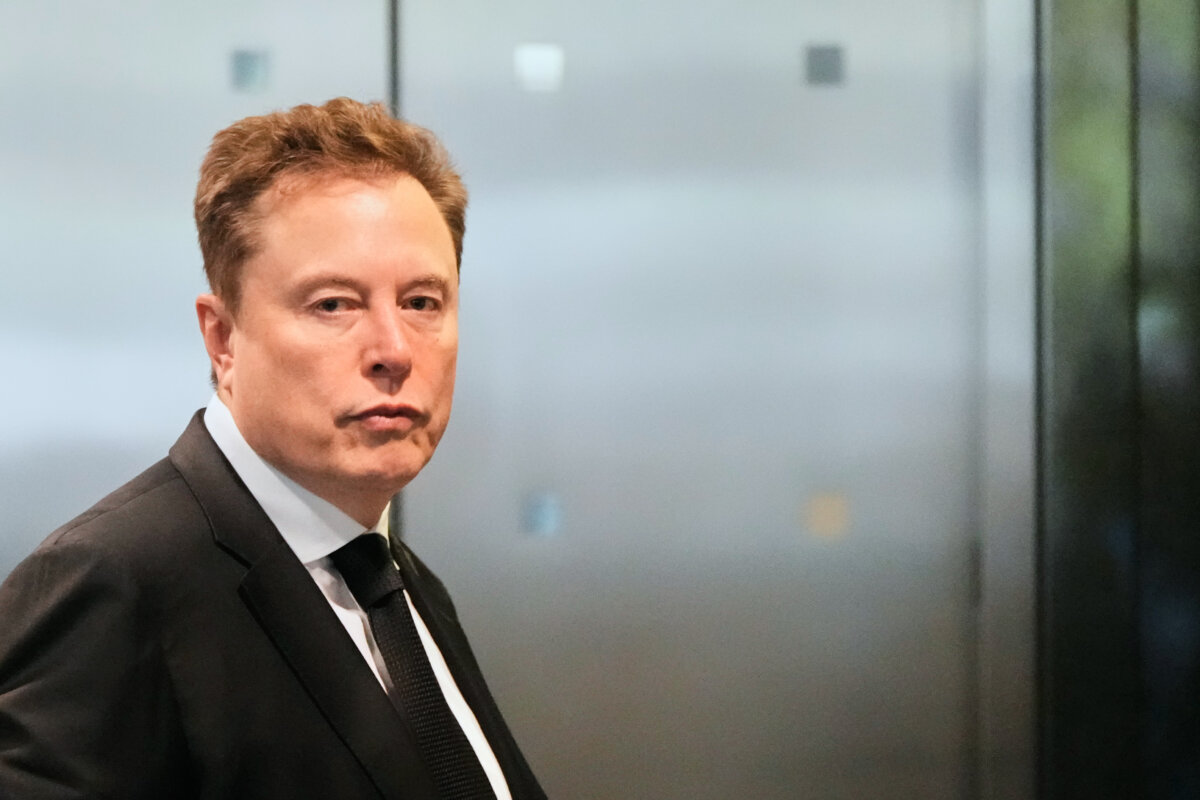
OAKLAND, Calif.—Tesla CEO Elon Musk took the stand on April 28 as the first witness in a federal civil jury trial in Oakland, California, accusing OpenAI CEO Sam Altman of defrauding him and betraying the company’s founding mission: to operate as an open-source nonprofit dedicated to advancing artificial intelligence for the benefit of humanity.
The lawsuit stems from a bitter feud between the two tech titans over the organization that they co-founded in 2015, which has since become one of the world’s most valuable and powerful players in the global artificial intelligence (AI) race.
“I think it’s not OK to steal a charity,” Musk told the court. A verdict in favor of the defendants, he ventured, would give license to “looting every charity in America.”
Musk alleges that Altman and others duped him into co-founding and funding OpenAI as an open-source nonprofit to counter the dangers of profit-driven AI advancement—then used its corporate conversion to illegally enrich themselves.
Attorneys for OpenAI on April 28 called the claims a “pageant of hypocrisy” in their opening statement, alleging that Musk supported a for-profit venture but abandoned the company when other founders rejected his bid to control it, only filing suit when the competition threatened his own artificial intelligence lab, xAI.
“When he found out OpenAI might be worth a lot of money, that’s when the sour grapes kicked in,” William Savitt, an attorney for the company, said.
After a few smaller investments, Musk said he became concerned when Microsoft invested $10 billion in OpenAI in 2022, which he argues allows it to control the company by licensing much of its intellectual property.
That same year, OpenAI introduced its chatbot, ChatGPT. The company is now valued at an estimated $852 billion and is gearing up for a public offering later this year.
Musk testified that he wasn’t opposed to OpenAI creating a small for-profit subsidiary to fund the charitable trust—“so long as the tail didn’t wag the dog”—but he claims that the company gutted its nonprofit, transferring most resources to a corporation that is no longer transparent or beholden to the public good.
Steven Molo, an attorney for Musk, likened the suggested model to a museum that opens a gift shop to subsidize its overhead.
“But the museum store can’t loot the museum, sell the Picassos and pocket the profits,” he said. “It’s got to fund the museum’s mission.”
By exclusively licensing its flagship product to Microsoft—which now owns a 27 percent stake in OpenAI—Molo said, the museum shop had “sold the Picassos and now they’re locked up where no one can see them.”
Musk is accusing Microsoft of aiding and abetting breach of charitable trust—which the company denies, arguing that it had nothing to do with the internal dispute over the direction of OpenAI, and didn’t knowingly violate any conditions set by Musk.
“It was only after the success of ChatGPT,” argued Russell Cohen, an attorney for Microsoft, that “suddenly Microsoft’s role in this board-approved, publicly announced partnership was somehow wrongful.”
Gene Roddenberry or James Cameron
While Musk’s lawsuit centers on specific claims about a single company, the case raises broader questions about the unregulated advancement of AI and prods the public’s already heightened anxieties about artificial general intelligence (AGI).
AGI is generally understood as the hypothetical point at which AI reaches or surpasses human cognitive abilities and can operate autonomously, which many experts warn poses an existential threat to humanity.
Outside the courtroom, a modest band of protesters waited in vain for Musk and Altman, who had already exited through a back door, with signs that read, “Stop the Nerd Reich,” “Stop AI Before It Stops Us,” and “Quit ChatGPT.”
Musk argued in his 2024 lawsuit that OpenAI’s GPT-4 was already an early version of AGI. On April 28, he warned again that AI has become “scary smart.”
“AI is getting to the point where it can do advanced mathematics, analysis based on physics and engineering. It hasn’t gotten to the point where it can invent radical new technologies, but I think it will be there next year,” he said.
Musk told the court that he has been a pied piper of the dangers of unregulated AI development for years, telling anyone who would listen—including the most powerful people in Silicon Valley, and briefly, former President Barack Obama—that someone needed to pay closer attention to AI safety before it was too late.
“I’ve had concerns for a very long time. The reason OpenAI exists is because I was very close friends with Larry Page—I’d stay at his house, talking many long hours about AI,” Musk said of Google’s co-founder.
At the time, Google’s DeepMind AI project was the most powerful AI contender. Musk said it became obvious that Page was not concerned enough about AI safety. A public disagreement about the threat of human extinction at the hands of superhuman AI, Musk said, was the impetus for starting a nonprofit to act as a counterweight to Google’s ambitions.
“I was concerned it would be a double-edged sword—it could go to a very good place, solve all of the diseases, make everyone wealthy, but it could also kill everyone,” Musk said.
“We don’t want to have a ‘Terminator outcome.’ I think we want to be in a Gene Roddenberry movie like ‘Star Trek,’” he said, referring to the television show’s screenwriter, “not so much a James Cameron movie.”
Musk’s lawyers argue that the evidence, including deposition testimony from two former OpenAI board members, will show that Altman deceived his nonprofit board about important issues related to safety.
Altman’s leadership has come under scrutiny in recent years following the dissolution of two OpenAI safety teams, as well as claims that he deceived executives and board members, and exhibited a “consistent pattern of lying” detailed in internal communications by the company’s former chief scientist Ilya Sutskever.
Leopold Aschenbrenner, who worked on Sutskever’s team, was fired from OpenAI in April 2024 after raising alarms about the company’s “egregiously insufficient” security against Chinese Communist Party espionage. He claims that human resources dismissed his concerns as “racist.”
Although Musk views open-source development as a competitive weapon against dangerous concentrations of superintelligence, whether from corporate monopolies or adversaries such as China, Aschenbrenner has not taken a position on whether OpenAI should operate as a for-profit or nonprofit entity—instead warning that failure to protect algorithmic secrets poses one of the greatest national security risks.
“The nation’s leading AI labs treat security as an afterthought,” Aschenbrenner wrote in June 2024, shortly after his firing. “Currently, they’re basically handing the key secrets for AGI to the CCP on a silver platter.”
In 2023, OpenAI’s board fired Altman, stating that it had lost confidence in him after he was “not consistently candid.” Musk alleges that Altman’s reinstatement days later, after a majority of board members resigned, was orchestrated by Microsoft.
Cohen denied claims that Microsoft was somehow “pulling the strings” behind Altman’s reinstatement.
“This was a chaotic time for Microsoft,” he said, noting the company had already invested $13 billion and wanted to prevent employees from fleeing to competitors. “Microsoft knew nothing about this in advance.”
That same year, Musk founded xAI and launched Grok to compete with OpenAI’s ChatGPT. In February 2025, he led an unsuccessful attempt to acquire OpenAI’s assets for $97.4 billion, which, according to OpenAI’s counterclaims, was a “sham bid” meant to disrupt the company’s fundraising and planned reorganization.
‘Financial Gun to the Head’
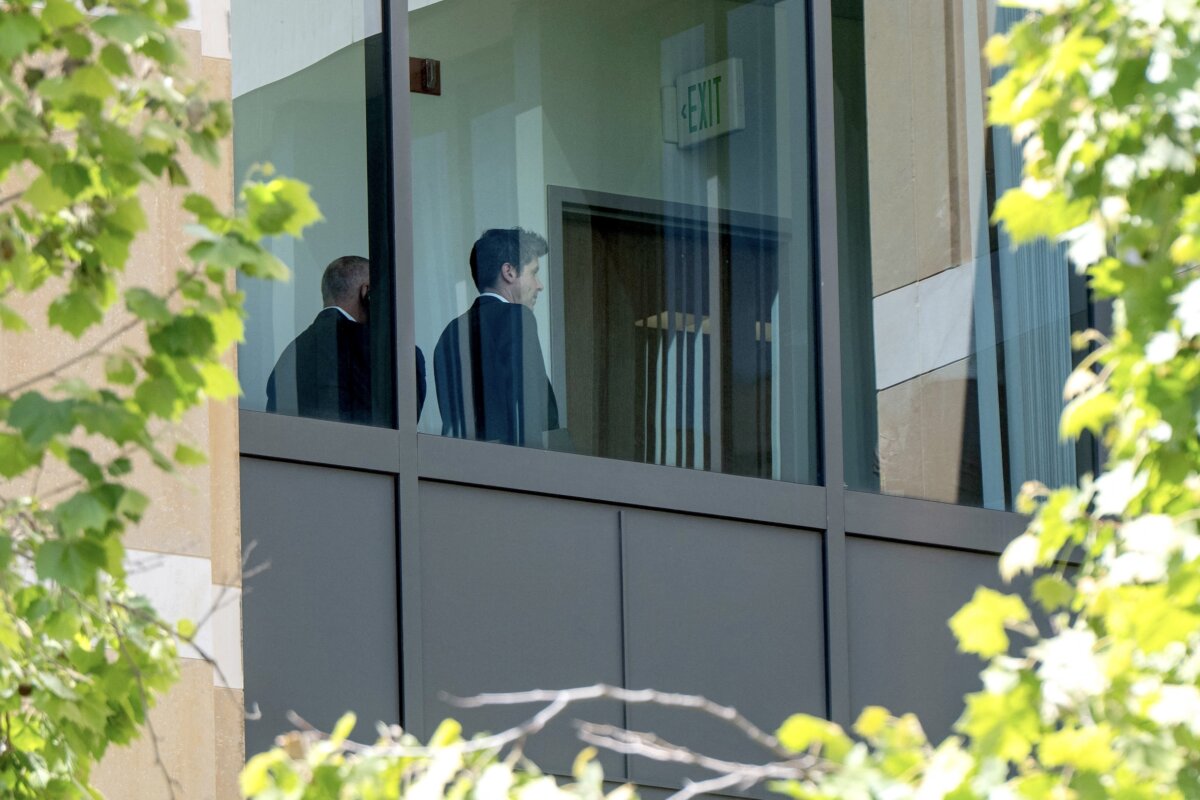
OpenAI’s attorneys say there is zero evidence that Altman and fellow defendant in the case OpenAI co-founder and current President Gregory Brockman promised to maintain the company as an open-source nonprofit indefinitely—and all parties agreed that they would need more serious funding to be competitive.
Musk initially pledged to donate $1 billion, Savitt said, but ended up giving only about $38 million, leaving co-founders with few options after he discontinued his $5 million quarterly payments.
“He put a financial gun to the head of his fellow founders,” Savitt said.
Musk resigned from OpenAI’s board in 2018. The company created a for-profit subsidiary in 2019 and then, as part of a 2025 restructuring, moved its intellectual property and employees to the for-profit venture. The OpenAI Foundation, the company’s nonprofit arm, retains a 26 percent stake and “continues to control” the corporation, according to OpenAI.
After Musk’s exit, Savitt said, Altman “was fundraising like mad to keep the nonprofit alive,” ultimately raising $90 million.
In 2019, OpenAI struck a deal with Microsoft to become an anchor investor; the company invested $1 billion, then $2 billion in 2021, and $10 billion in 2023.
All of these were approved by OpenAI’s board, Savitt said.
“They needed to get the money from somewhere or else the project collapsed,” he said.
Defense attorneys said evidence will prove that Musk knew about Microsoft’s investments in 2019 and 2020 before they happened. In 2018, Altman sent Musk a fundraising plan previewing a larger round of for-profit fundraising.
OpenAI’s attorneys also argue that Musk’s claims are barred by a statute of limitations.
“He didn’t bring a lawsuit then, he only brought it when he was a competitor, years later,” they said.
Musk argued that he would have formed an open-source nonprofit dedicated to advancing AI for the good of humanity with or without Altman and Brockman, and that he did so by leveraging his deep resources in Silicon Valley—including to poach Sutskever from Google, and getting Nvidia CEO Jensen Huang to give him one of the first AI supercomputers.
“I specifically came up with the idea, the name, recruited key people, taught [them] everything I know, provided the original funding. … It was specifically for a charity that did not benefit any individual person. I could’ve started it as a for-profit, and I chose not to,” Musk said.
Defense attorneys contested the plaintiff’s claims that the company’s name referred to “open source,” per Musk’s preference that its technology’s source code remain freely available to the public.
Judge Yvonne Gonzalez Rogers of the U.S. District Court for the Northern District of California admonished OpenAI on the subject.
“Mr. Musk’s testimony today is consistent with representations OpenAI made to me in a different case,” Rogers said after she dismissed the jury for the day.
“You seemed to suggest it didn’t refer to ‘open source,’” she told the company’s attorneys. “I suggest you look at the prosecution history and that you do not take inconsistent positions in front of me.”
Musk is asking that the company be reverted to a nonprofit, that more than $100 billion in damages be returned to it, and that Altman and Brockman be removed from their leadership roles.
 Friends Read Free
Copy
Facebook
Tweet
Friends Read Free
Copy
Facebook
Tweet