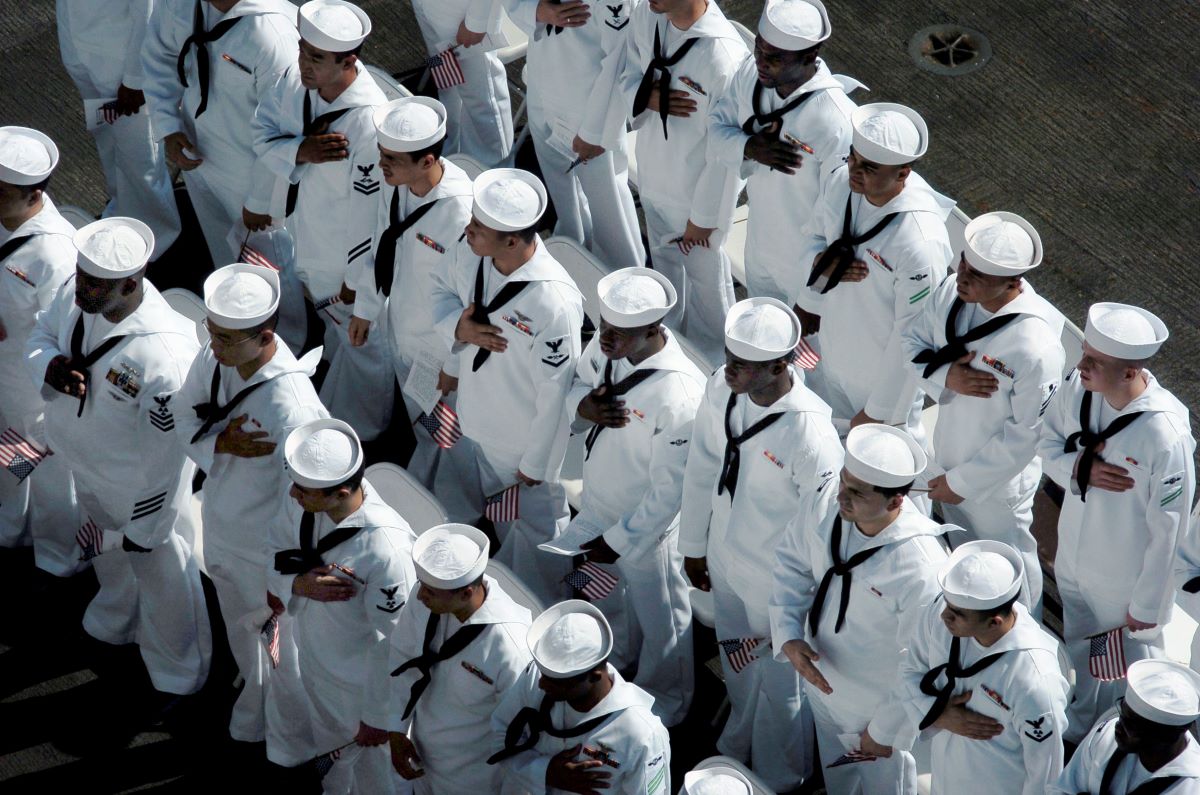

Acting Navy Secretary Hung Cao advised Navy sailors, Marines, and civilian employees on Aug. 19 to remove any content on social media linking them with the Navy and to report suspicious activity in response to emerging threats.
“Since the initiation of Operation EPIC FURY, the Department of the Navy’s (DON) personnel, assets, and our families face an evolving threat landscape,” Cao wrote in a notice published on Aug. 19. “U.S. military installations and personnel remain under increased vigilance due to recent uncrewed aircraft system (UAS) encounters, suspicious activities, cyber threats, and acts of violence.”
The Navy’s warning to military and civilian personnel comes as U.S. forces reinstated a naval blockade of Iranian ports on July 14, following the breakdown of a temporary ceasefire and memorandum of understanding between Washington and Tehran. As of Aug. 24, U.S. forces had redirected 71 commercial vessels, disabled three ships, and boarded two others to ensure compliance with the blockade, U.S. Central Command stated.
The acting Navy secretary said the Naval Criminal Investigative Service launched a force protection initiative to deter, detect, and mitigate threats against the Navy’s personnel and military installations. Cao said the initiative, known as Epic Vigilance, was launched in response to emerging threats as U.S. adversaries and hostile actors carried out a “coordinated, multi-domain campaign” against the Navy.
Cao said recent incidents around the world have shown a “clear growth” in the procedures, tactics, and techniques of U.S. adversaries. He warned that threats against the Navy were not isolated events but were part of a “deliberate effort to gather intelligence, test our defenses, disrupt our operations, and intimidate our force.”
The Navy stated that direct threats targeting the department’s personnel and their families include doxing, coordinated harassment campaigns intended to test personnel endurance and security responses, and surveillance efforts or suspicious activity near Navy installations and communities.
Other threats against department personnel include surveillance of Navy ships, critical infrastructure, and flight lines by unmanned aircraft systems and attempted physical attacks and probes against access control points, the Navy stated.
Sailors, Marines, and the Navy Department’s civilian employees were advised to harden both their personal and family security postures. The Navy encouraged them to make social media profiles private and remove any information that could identify their connection to the Navy Department or reveal life patterns. Cao noted that U.S. adversaries were actively mining such data on social media.
Navy Department personnel were also instructed to report suspicious activity, as a “seemingly minor observation” could play a critical role in identifying and mitigating threats. The department also urged sailors, Marines, and civilian employees to maintain situational awareness by observing any anomalies at their work, at their homes, and in their communities.
In the notice, the Navy stated that personnel should immediately report observations of possible surveillance, such as the photographing or filming of U.S. military bases and assets and targeting of personnel, such as individuals following, photographing, or confronting them off base.
Navy personnel were also instructed to report observations of uncrewed systems operating near Navy installations and other sensitive military locations; suspicious cyber activity, such as emails, social media messages, and fake social media accounts; and suspicious questioning from individuals seeking information on sensitive War Department or personal matters.
“Our greatest strength is our unity and our shared commitment to protect one another,” Cao said. “By embracing this heightened posture of vigilance, we will safeguard our force, protect our families, and ensure the unhindered execution of our national security mission.”
Former Navy Secretary John Phelan issued a similar notice to Navy Department personnel in April following the start of Operation Epic Fury on Feb. 28. At the time, Phelan said U.S. adversaries were targeting the department’s personnel and their families through spear phishing and social media contacts as part of a social engineering campaign.
The former Navy secretary said the social engineering campaign was being carried out in response to Operation Epic Fury.
A group of U.S. lawmakers previously urged the Pentagon to take steps to address concerns that foreign adversaries were exploiting location data to target U.S. military personnel in war zones.
“We write with serious concern that the Department of Defense (DoD) has not taken basic steps to protect U.S. military personnel from the serious counterintelligence and force protection threat posed by the collection and sale of personal information, including cell phone location data, by data brokers,” the lawmakers wrote. “DoD has known about this serious threat for over a decade, but has failed to adopt commonsense cyber defenses that are recommended by federal agencies.”
The Epoch Times reached out to the Navy and the Pentagon for comment but did not receive a response before publication time.
 Friends Read Free
Copy
Facebook
Tweet
Friends Read Free
Copy
Facebook
Tweet