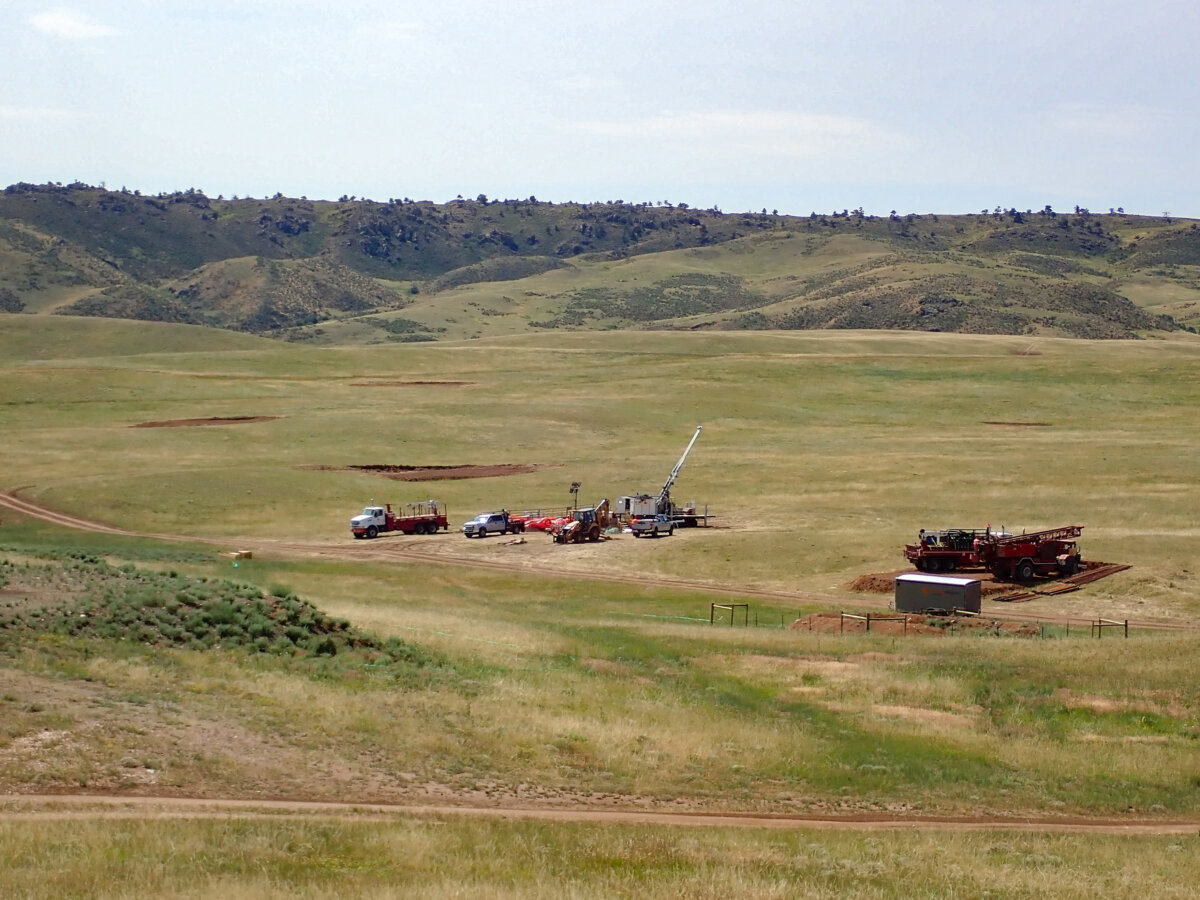
CHEYENNE, Wyo.—George Bee is prospecting for gold in folds of feldspar, granodiorite, and quartz exhumed from faults in the earth’s crust, hundreds of feet below a ridge-rimmed prairie vale on the eastern flanks of the Laramie Range.
He doesn’t need a pickaxe to muscle mineral from stone, or a stream-side sluice to sift river slag to find what he seeks. He doesn’t even need to be at the mine, a nondescript slit-trench gash amid waving buffalo grass and sagebrush-crested arroyos, to see its bonanza.
The gold is in decades of data, engineering reports, geologist analyses, and locked into the rocks on a conference table in Bee’s office on Capitol Avenue in downtown Cheyenne, three blocks from the Wyoming state Capitol building, the shimmering sunburst of its gold dome both testament and tease this bright July afternoon.
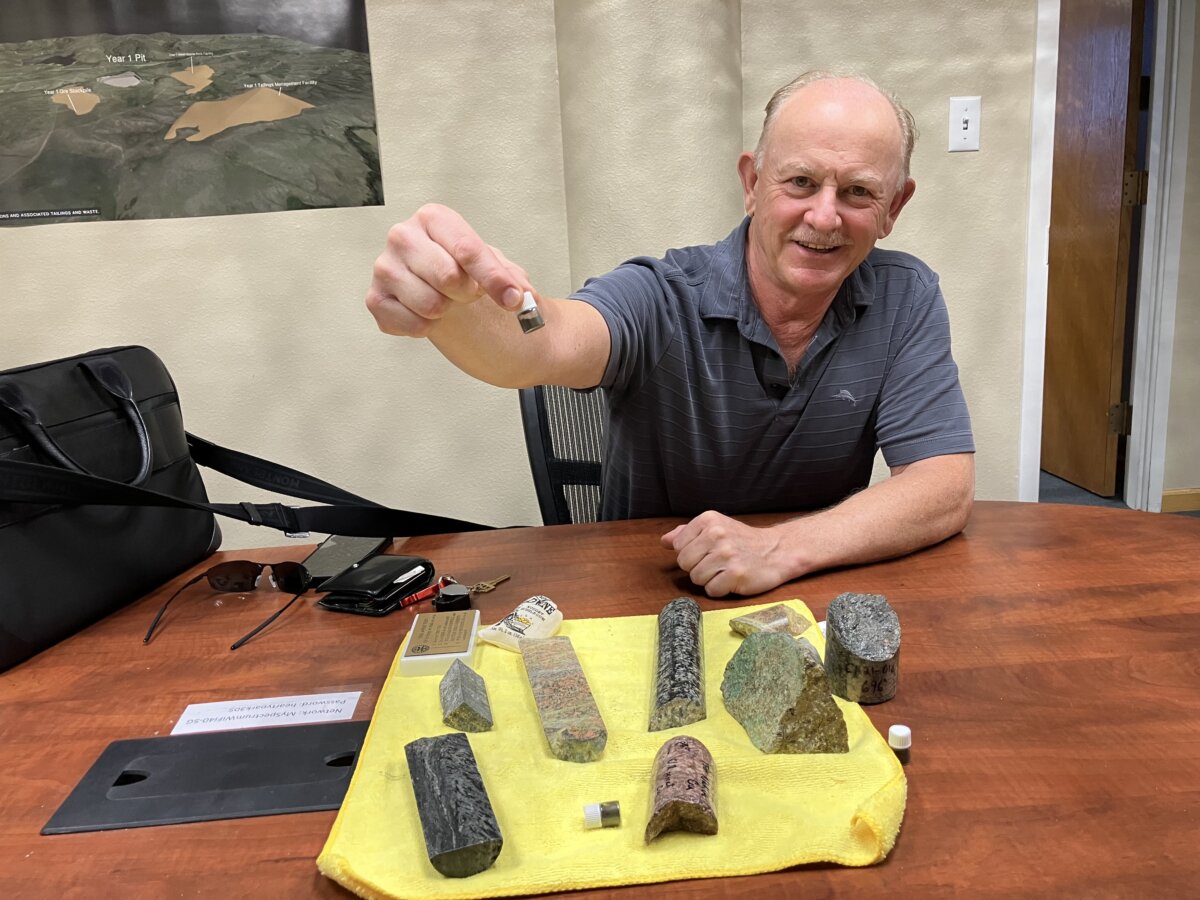
“Look at this,” he said, while holding a granite spar and pointing to dull bronze flecks in the stone. “It’s not pyrite, it’s chalcopyrite, a copper sulfide mineral,” often found where copper and gold deposits are formed.
“When you look at this,” he continued, waving the granite, “you’ve got to figure out how to get the gold and copper out of this right here.”
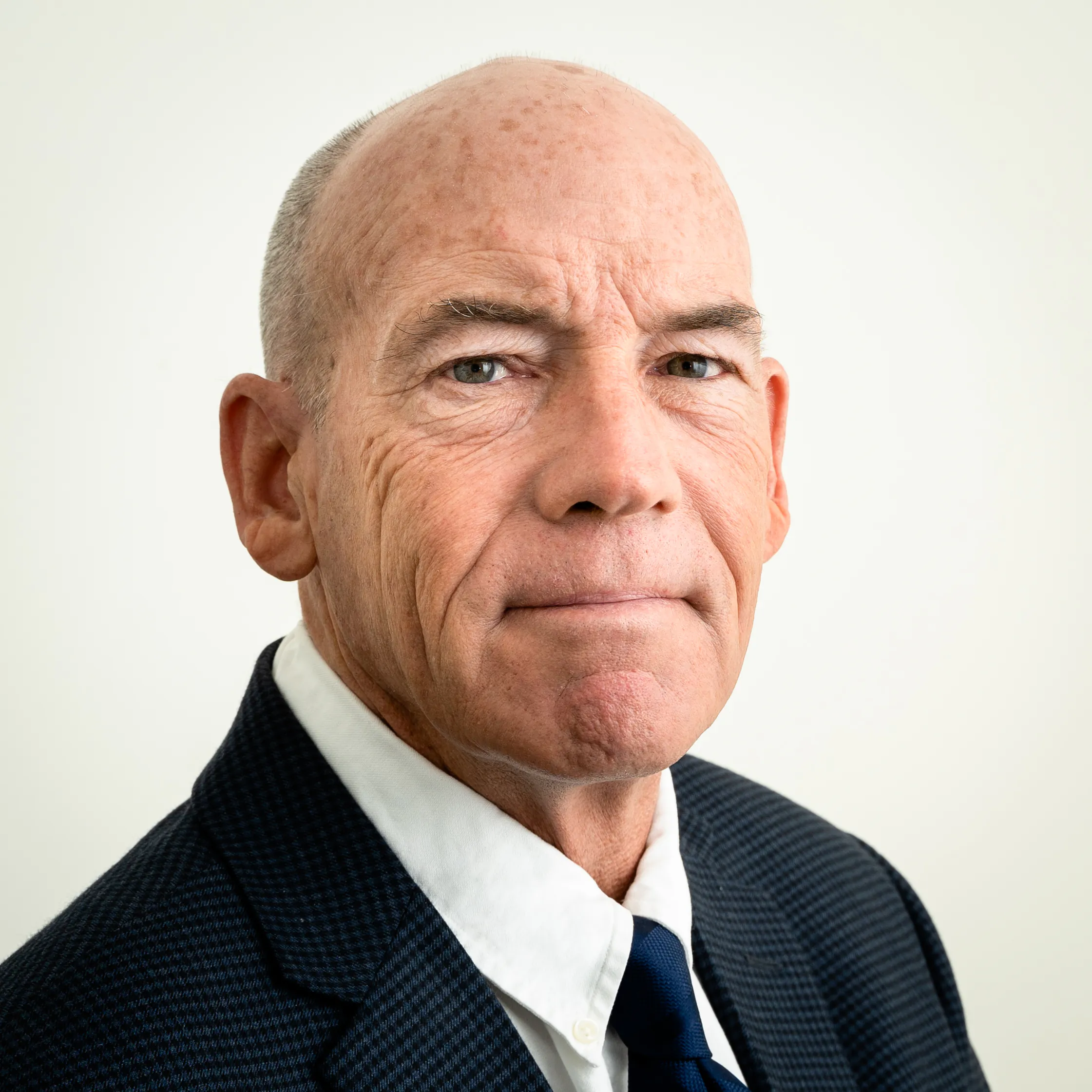
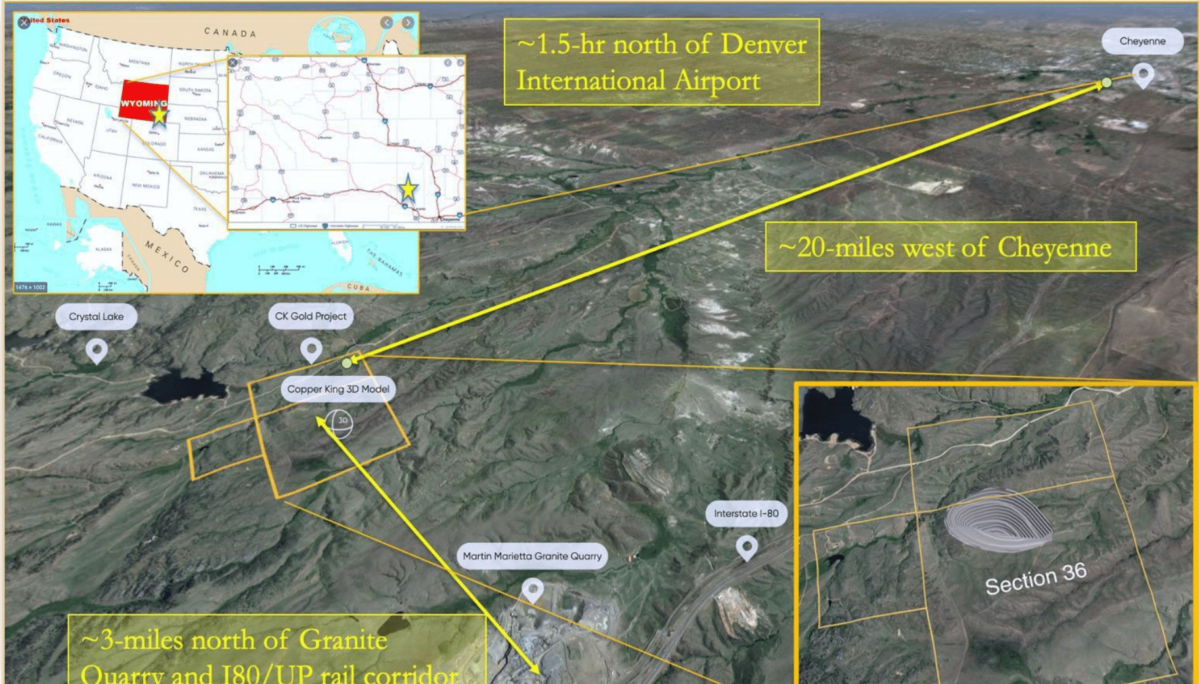
Bee, president and CEO of U.S. Gold Corp., told the Epoch Times he’s betting big that his company can do that with its CK Gold Project, a fully-permitted, shovel-ready 1,120-acre “advanced gold and copper development project” that will revive the 60-year-dead Copper King Mine in the Silver Crown Mining District, 20 miles west of Cheyenne.
A February preliminary feasibility study affirmed that enticing indicators, documented in previous assessments, remain evident in the mine, including an assessment by the U.S. Bureau of Mines, which determined in 2012 that Copper King had “low-grade, large-tonnage, bulk minable gold and copper.”
The Copper Coup
Domestic copper is “coming back,” Bee said, while rifling through a stack of newspapers. “I was just reading today. You know, [President Donald] Trump says he’s going to put a 50 percent tariff on imported copper. So he’s really pushing domestic copper.”
He shoved the papers aside and said, “How good is it that? We’ve got a gold mine project in southeast Wyoming, and we can start producing copper [within a year].”
According to the U.S. Geological Survey, the United States imported roughly half its copper in 2024.
Bee said the CK Gold Project, the expanded Rio Tinto mine in Arizona, and Twin Metals’ proposed mine near the Boundary Waters Canoe Area Wilderness in Minnesota could significantly narrow that gap.
“They’re trying to restart these copper mines, but since the Chinese own the market, they keep flooding the market, causing prices to go down,” he said.
Tariffs are one way to counter that, Bee said, and he’s ready to help.
“Whether you believe in electrification or not, or whether you believe in solar or wind or whatever, the fact of the matter is, we need lots more energy because of all this AI, all these data centers,” he said.
“And that should be done with domestic copper in the U.S., create U.S. jobs, and, you know, there’s no sanctions on that.”
But it helps to have more than one ore to lean on. Gold does that pretty well.
Froth Flotation
Bee said he envisions “a little 10-year mining project” involving underground blasting to produce 270 million pounds of copper, and more than 100 million ounces of gold using a froth flotation process, rather than cyanide leaching, to separate minerals.
Froth flotation separates the minerals, such as gold and copper, from waste rock by grinding the ore, adding water and chemicals, and employing an aeration process.
If all goes to plan, investors in publicly traded U.S. Gold Corp. could reap at least $323 million in profit. The company is raising $277 million in estimated capital costs to break ground in the first quarter of 2026.
According to U.S. Gold, the project will create 2,600 jobs during construction, and generate 325 mining jobs and 1,000 indirect jobs. It’s projected to pay nearly $80 million in local and state taxes.
“It’s going to provide a nice bump for our economy,” Cheyenne Mayor Patrick Collins said, noting that U.S. Gold isn’t making new discoveries, but rather is discovering new ways to develop resources.
“For more than 100 years, we’ve known there’s gold there, but the technology to get that gold out in an affordable way has eluded people,” he told The Epoch Times. “But George had the vision, and I think they proved the concept.”
Froth flotation may be the finesse, but brute earth-moving, rock-breaking force will be CK Gold Project’s backbone.
“We’ve got big earth-moving equipment, and we can take a lot of rock, and we can crush it down to a really fine gray powder,” Bee said, holding a vial of concentrate. “And it’s because we’ve got the technology and the power and the will of the authorities to make it happen.”
Be Careful What You Ask For
Bee spent five decades managing corporate mining operations across three continents. A UK native, Bee graduated from the Camborne School of Mines in the Cornwall region of England in 1979. He has worked in South African open-pit copper and gold mines, on projects across Canada, and in gold mines in Peru, Chile, Argentina, and Nevada.
“I’ve worked a mile underground in South Africa, and I’ve worked up in the Andes, pulling gold out of mines up in the mountains at 14,000 [feet] to 15,000 feet,” he said.
Bee said he was “essentially semi-retired” in 2019 when U.S. Gold asked him to look at the project because it was considering selling it.
“I took a look at it. I said, ‘You’d be crazy to sell this. This is a good little project,’” he said.
Bee joined U.S. Gold as president in 2020, and has since added CEO and director to his executive functions.
“You know what happens when you open your big mouth? You get handed the keys,” he said. “But, you know, it’s a lot of fun. And I tell you … it’s really nice to be creating opportunities locally.”
The CK Gold Project is one of three U.S. Gold ventures. The company is also developing the Challis Gold Project in Idaho and the Keystone Project in Nevada, where it controls exclusive mineral rights to an “entire prospective gold Cortez Trend district.”
But with Bee’s ascent, he said, the CK Gold Project has become U.S. Gold’s top all-in priority because it was “ripe for fast-track development,” and could deliver on “near-term development potential” the soonest.
Permit Paradise
The company moved its headquarters from Park City, Utah, to Cheyenne, where Bee could herd the proposal through permitting hoops.
The project is on a state-owned section within the Silver Crown Mining District, a key asset. “It’s a mining state, and we’re on state ground,” he said.
The state section is surrounded by privately owned parcels amid the checkerboard pattern of public-private lands across the West.
“We don’t have to deal with the federal government,” Bee said. “The state is our regulatory agency and its Department of Environmental Quality—these guys are good at their job. They’re no pushovers. They don’t give you a free pass—but, essentially, they know where their bread is buttered, right? So, they want to make things happen.”
The project began in 2020 “from zero,” requiring “two years of baseline environmental work—the fauna, the flora, the subsurface water, the surface water, the air conditions,” he said.
After building a two-year database, Bee said, the company looked at what it needed “to actually get this concentrate out of the ground,” before submitting permits in September 2022.
It received its final permit in November 2024, making the CK Gold Project Wyoming’s first new “fully permitted, shovel-ready” gold and copper mine in more than 50 years.
On state land, the company “got fully permitted in little over four years,” Bee said.
On federal land, it’s a different story, he said. “There are projects, it takes eight, minimum, 15, probably, years, and maybe never, to get permitted,” Bee said.
He praised the Trump administration’s deregulatory energy policies, especially in “trying to streamline all the permits and make things happen.”
As in most intermountain states, mining is key to Wyoming’s economy, producing 25 percent of its gross product, according to U.S. Gold’s Cheyenne lobbyist, Jason Begger.
Advancing the CK Gold Project through the Wyoming state legislature showed him that the state is eager to develop mineral resources.
“Wyoming is a mining state,” Begger said. “It’s been a long time since there’s been a hard rock mine. Mining is coming back.”
Bee said he expects financing to be secured “hopefully by Christmas,” with the project breaking ground before April 1, 2026.
“We’ve done a lot of engineering. We’re just finalizing, dotting the i’s and crossing the t’s because if somebody’s going to lend you $300 million, they want to go into the weeds,” he said. “There are people looking to give us the money.”
Bee said prospective investors routinely ask, “What are your gold reserves? And you say, ‘Well, we got a million, just over a million, ounces of gold.’”
“‘And what are your copper reserves?’ And you just say, ‘Well, heck, 272.6 million pounds of copper.
“So let me just work this out,” he said, calculating with pen and paper, “a million ounces of gold at $3,331 (July 9) per ounce amounts to nearly $3.5 billion, and 270 million pounds of copper at almost $5.55 a pound (July 9), “that’s another billion dollars.”
Total: roughly $4.5 billion.
“Holy mackerel,” Bee said. “That’s a good little project.”
 Friends Read Free
Copy
Facebook
Tweet
Friends Read Free
Copy
Facebook
Tweet