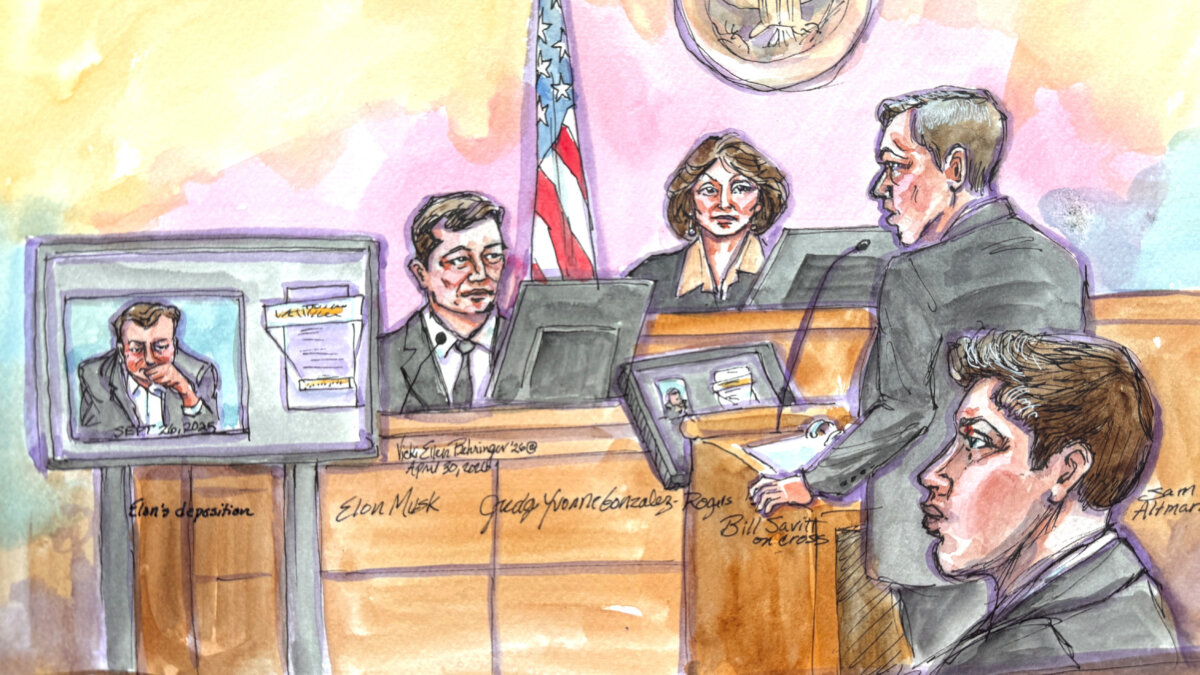
OAKLAND, Calif.—Attorneys representing OpenAI on April 29 pushed back against allegations in federal court that the company’s CEO Sam Altman defrauded Tesla CEO Elon Musk and betrayed a founding mission to operate as an open-source, nonprofit lab dedicated to advancing artificial intelligence for the benefit of humanity.
Musk continued testifying on the second day of the high-profile civil trial, asking a jury to find Altman and others liable for claims that they took tens of millions of dollars in charitable donations from Musk—then converted OpenAI to a for-profit venture in order to enrich themselves.
William Savitt, an attorney for OpenAI, sought to impeach Musk’s central claim that he had conceived of the lab as a nonprofit counterweight to existential dangers posed by profit-driven AI advancement.
“The truth is you were never really committed to OpenAI being a nonprofit, were you, Mr. Musk?” Savitt asked, pointing to email records from 2015, the year the company was founded, showing that Musk suggested that the project might best be structured as a C corp with a parallel nonprofit.
“No,” countered Musk, who frequently took issue with the premise of Savitt’s questioning. “What you’re saying is false.”
“Your questions are not simple,” Musk said when the litigator pressed him to affirm yes-or-no queries. “They’re designed to trick me.”
Musk on April 28 had told the jury that the outcome of his case could have profound implications—both for the AI industry and for the future of humanity, as technology developers aim toward artificial general intelligence (AGI), or the point at which digital intelligence is expected to become commensurate with, or superior to, human cognitive abilities.
On April 29, attorneys for both sides offered competing narratives of a bitter feud between Musk and Altman over the organization they cofounded in 2015, which has since become one of the world’s most valuable and powerful players in the global AI race.
In one version, Musk spearheaded a philanthropic mission to prevent superhuman digital intelligence from ending humanity, and gradually lost confidence in his cofounders as they conspired to loot the charity. In the other, Musk abandoned the startup after funding less than 5 percent of a $1 billion pledge and founded his own lab, and is now using the litigation as a way to hobble his competition.
Musk provided early funding, about $38 million, to the startup, which later created ChatGPT; the company is currently valued at more than $850 billion and expected to make an initial public offering later this year.
Savitt pointed to 2016 emails in which Musk expressed concerns that structuring the company as a nonprofit may have been the “wrong move,” as it would be unable to raise enough capital to keep up with Google’s DeepMind project.
Musk told the jury on April 28 that he started OpenAI because he realized that his close friend, Larry Page, founder of Google, was insufficiently worried about the dangers of AI advancement.
But in 2017, Savitt pointed out, Musk agreed with cofounders that a change of course was necessary, including introduction of a for-profit company in 2018.
Defense attorneys argue that Musk’s failed bid to take a majority stake in the planned for-profit arm of OpenAI was in fact the impetus for his departure from the company—not disillusionment with other cofounders’ divergence from a charitable mission.
Although Musk testified that the company could not have existed without his funding and support, Savitt painted a different picture—of a detached outsider who contributed little if any sweat equity, had fraught relationships with colleagues, and attempted to poach its employees for his other companies.
The defense pointed to internal communications showing that Musk agreed with cofounders in 2018 that the venture was in trouble, “burning cash” and unable to compete in the AGI race. The same year, he suggested in an email that the company’s chance of success was “zero” without billions of dollars in annual funding but decided to withdraw his financial support, Savitt noted.
According to defense attorneys, Musk was not trying to save humanity from runaway AGI—but vying to control AGI himself.
Cannot ‘Have Your Cake and Eat It Too’
Although nearly all tech companies are for-profit, Musk said under examination on April 29 that making OpenAI a nonprofit was important because “there is some value” in having digital superintelligence owned by the public.
“If you go nonprofit, you have the moral high ground—there’s sort of a halo effect, you’re doing it for the public good,” Musk said. “What you can’t do is have your cake and eat it too—saying it’s going to be a nonprofit and have all the good associations … but then turn it into a for-profit.”
Steve Molo, an attorney for Musk, guided the witness through a series of internal communications in 2017 and 2018 illustrating a prolonged discussion among the founders about how the company should be structured and funded.
After his cofounders rejected a proposal that Musk take an initial majority stake, to be diluted with additional investment, Musk gave them an ultimatum.
“If they want to get rich they should go do so as a for-profit, but what they should not do is have me continue to fund a nonprofit and get rich off of that,” Musk said.
He also said that he was a “fool” for giving OpenAI $38 billion in “free funding for a nonprofit which they then used to create an $800 billion for-profit company.”
While he grew increasingly uneasy about the direction of the project, Musk said, he received repeated assurances that Altman and other founders remained committed to OpenAI’s mission, and continued to fund the venture at a reduced rate through 2020.
In 2022, he learned that Microsoft had invested $10 billion in the company.
“There is no way Microsoft is giving that as a donation in any kind of charitable way,” he said. “That’s an amount of money that doesn’t make any sense.”
Seeing reports that OpenAI had a $20 billion valuation, Musk confronted Altman.
“Clearly, a nonprofit doesn’t have a valuation,” he said. “So something’s wrong here.”
Altman offered Musk equity in the company at that point, but Musk refused, he said.
“I don’t understand how you can have stock in a nonprofit,” he said. “Frankly, it felt like a bribe.”
Musk has repeatedly said he would not object to a parallel for-profit adjunct to fund the nonprofit—“so long as the tail didn’t wag the dog”—but claims that the company gutted its nonprofit, transferring most resources to a corporation that is no longer transparent or beholden to the public good.
OpenAI exclusively licensed its flagship product to Microsoft, which now owns an approximately 27 percent stake in the for-profit company; OpenAI’s nonprofit foundation maintains a 26 percent stake.
Musk is asking that the company be reverted to a nonprofit, that more than $100 billion in damages be returned to it, and that Altman and Greg Brockman, a cofounder and current president, be removed from their leadership roles.
‘Grandiose Proclamations’
Judge Yvonne Gonzalez Rogers of the U.S. District Court for the Northern District of California, who takes a famously blunt approach to managing her courtroom, on April 29 said she would allow defense attorneys to keep poking holes in Musk’s claims that OpenAI had a safety problem—and their cross-examination of his own safety practices at his company, xAI.
“You do not get to have grandiose proclamations on safety without some cross-examination,” Gonzalez Rogers said of Musk’s narrative.
Musk claimed on April 29 that removing caps on how much profit OpenAI investors could make from the company was in itself a safety concern.
“They’ve changed from capped profit to unlimited profit,” he said, but agreed that all for-profit AI companies, including xAI, share the same risk. “That’s a reduced focus on safety.”
At one point, Savitt questioned Musk’s concerns over AI safety issues by suggesting that he had done little to press the issue under the Trump administration, despite his access.
Without elaborating on how it related to President Donald Trump, Savitt asked whether there was a risk that AI could incorporate human prejudices.
“You testified it’s important to instill values of honesty, integrity, and caring,” he said. “So if material you train AI with is racist or sexist it might absorb those values?”
AI incorporating human prejudices, Musk said, is not the biggest risk.
“The biggest risk is that AI kills us all,” he said.
 Friends Read Free
Copy
Facebook
Tweet
Friends Read Free
Copy
Facebook
Tweet