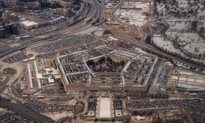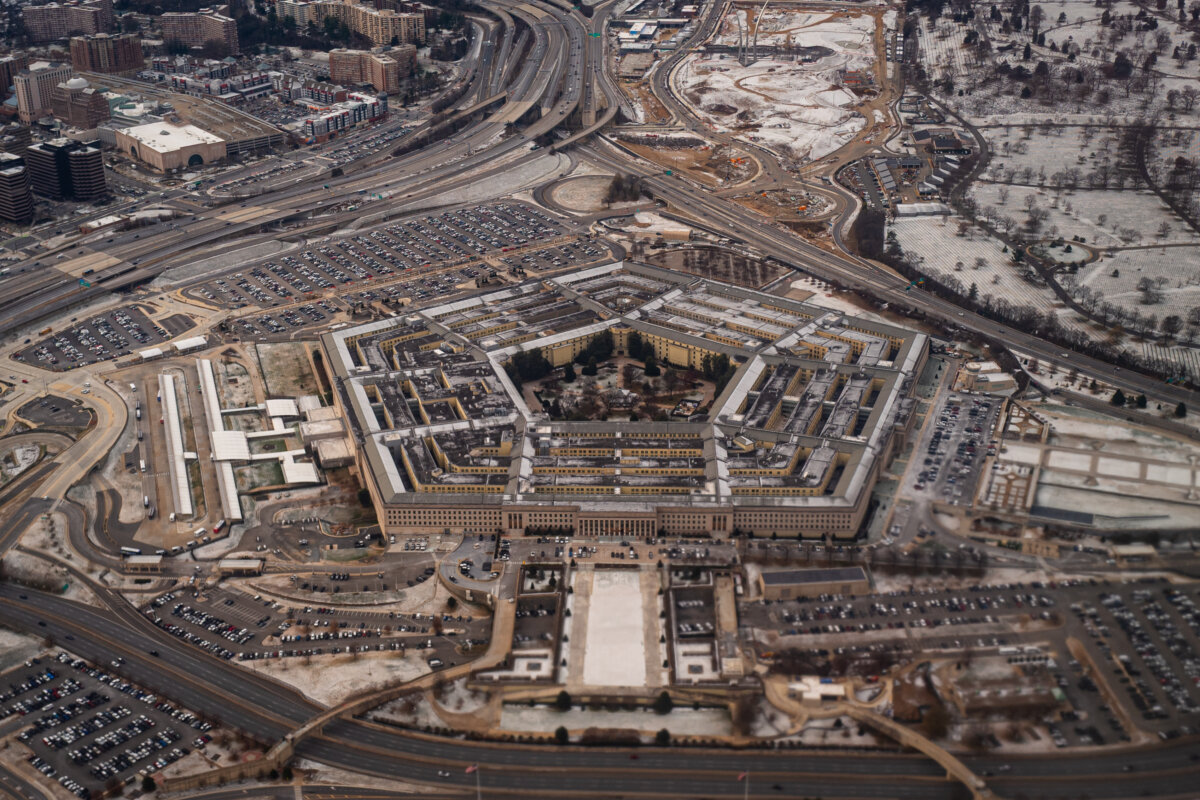

The Pentagon, on April 21, shared details about President Donald Trump’s $1.5 trillion military and defense budget for fiscal year 2027.
The new budget request amounts to a 42 percent increase over military spending for fiscal year 2026, which covered approximately $1.03 trillion in defense-related spending. Through this requested leap in funding, the administration is seeking to address several priority areas, including shipbuilding, drone technology, and missile defense.
“This is a generational investment in the United States military,” Jules Hurst, a Pentagon official performing the duties of the comptroller, told reporters at a press briefing on April 21.
Here are the key facets of Trump’s latest military budget request.
1. Largest-Ever Drone Warfare Investment
The president’s 2027 defense budget request calls for the largest-ever U.S. investment in drone warfare capabilities, tripling total drone-related spending.
In all, the budget request involves about $75 billion in drone-related spending.
Hurst said about $53.6 billion would go toward developing autonomous systems and methods for unmanned supply delivery in contested environments. He said another $21 billion would go toward counter-drone systems, munitions, and advanced drone development—including the Collaborative Combat Aircraft program and the MQ-25 Stingray. The former seeks to create unmanned fighter jets that fly with manned warplanes, and the MQ-25 is the Navy’s new carrier-based refueling drone.
2. Largest-Ever Space Capabilities Investment
Trump’s budget request also entails the largest-ever investment in U.S. space capabilities, at about $75 billion.
Much of the space funding boost is centered on increasing the budget for the youngest U.S. military branch, the U.S. Space Force, to about $71 billion—up from $40 billion.
Space Force Lt. Gen. Steven P. Whitney—who serves as the director of force structure, resources, and assessment on the Joint Chiefs of Staff—said the funding increase would cover 31 space launches this year, including two GPS satellites and their supporting infrastructure.
Whitney said $13 billion would go toward developing and deploying missile warning and tracking capabilities, $7.7 billion would go toward airborne moving target indication systems, $5.9 billion would go toward satellite communication systems, and $3.1 billion would go toward a next-generation space data network.
3. Missile Defense Funding
The Pentagon is set to continue investing in Trump’s “Golden Dome” missile defense system under the new budget request.
“In FY26, we began building Golden Dome by focusing on creating the infrastructure to build situational awareness and sense threats,” Hurst said. “In FY27, we will expand that sensing network and invest in next-generation interceptors.”
The military is seeking $17.9 billion for the development of new space-based sensors and interceptors, directed energy-based interception technology, a new generation of radars and defensive measures for detecting and stopping intercontinental ballistic missiles, and the development of capabilities for defending against hypersonic weapons.
The new budget request would also cover previously announced plans to expand procurement of existing missile interceptor systems, including terminal high-altitude air defense and Patriot missiles. U.S. forces have drawn heavily from stocks of these missile interceptors during recent fighting with Iran.
4. Biggest Shipbuilding Request Since 1962
Hurst said Trump’s 2027 budget proposal would cover the largest shipbuilding request since 1962.
In line with the president’s “Golden Fleet” initiative, the Navy is seeking $65.8 billion to fund the procurement of 18 new battle force ships and 16 more auxiliary ships.
The Navy said it’s seeking to purchase another Columbia-class submarine, two more Virginia-class submarines, its first FF(X)-class frigate, an Arleigh Burke-class destroyer, an America-class amphibious assault ship, a San Antonio-class amphibious transport dock, six medium landing ships, two John Lewis-class oilers, two submarine tender replacement vessels, and an ocean surveillance ship.
The request would also provide incremental funding for its third and fourth Gerald R. Ford-class aircraft carriers.
Whitney said the request would provide $427 million for three medium unmanned surface vessels.
Trump’s budget request also provides funding for the design and development of the Navy’s BB(X) guided-missile battleships program, also known as the Trump-class battleship.
Another $8.7 billion would go toward supporting the U.S. maritime industrial base.
5. Next Generation Aircraft
Trump’s fiscal year 2027 budget request calls for $102 billion in funding to support aircraft purchases, a 26 percent increase over 2026 figures.
The U.S. Air Force would stand to receive $5 billion for its new generation of stealth fighter, dubbed the F-47.
The Navy is set to receive $140 million for its next-generation strike fighter program, currently dubbed F/A-XX.
And $6.1 billion is set to go toward the B-21 Raider stealth bomber.
The U.S. Army stands to gain $2.2 billion in funding support for its new future long-range assault aircraft, which the service recently dubbed the MV-75 Cheyenne II. The MV-75 is a tiltrotor aircraft similar to the V-22 currently operated by the Air Force, Navy, and Marine Corps.
Trump’s new budget request also boosts procurement of the F-35 Lighting II stealth fighter to 85 airframes for the year, up from 47 in the previous budget. Procurement of the Air Force’s newest F-15 variant, the F-15EX Strike Eagle, will also receive a modest boost to 24 airframes for the year, compared with 22 in fiscal year 2026.
6. Troop Quality of Life Boosts
U.S. military personnel are set to see a number of quality-of-life boosts across Trump’s new budget request.
Pay increases for the year will depend on rank.
Enlisted personnel at the grade of E5 or below stand to see a 7 percent pay increase. Those at the grade of E6 to O3 stand to receive a 6 percent pay bump. Officers at the grade of O4 and above stand to receive a 5 percent pay bump.
Another $21.5 billion is set to go toward building new barracks and renovating existing ones. Another $4.4 billion will go toward base housing.
 Friends Read Free
Copy
Facebook
Tweet
Friends Read Free
Copy
Facebook
Tweet