
Although the COVID-19 pandemic has ended, some worry the accelerated academic decline it seems to have started is only getting worse.
The National Assessment of Educational Progress (NAEP) test for the 2022–23 school year indicates that 13-year-olds are poorer at reading and mathematics than during the 2019–20 school year.
The average reading score fell from 260 points to 256 points out of a possible 500. That meant the average dropped from a score of 52 percent to 51.2 percent.
The average math score went from 280 to 271. That means it declined from a score of 56 percent on the test to an average score of 54.2 percent, an NAEP analysis of test results shows.

These falls wipe out decades of educational improvement, putting reading scores one point above 1971 scores of 255 points and math scores five points above 1971’s scores of 266, according to the survey.
Matthew Lynch, founder of The Edvocate, told The Epoch Times that the pandemic likely caused these decreased scores. The Edvocate calls for change in education policies in the hopes of improving quality.
“For many students, they were not exposed to quality curriculum and instruction” during the pandemic when schools mostly were closed, Mr. Lynch said. “Most of the education that they received was via distance learning.”
And that was largely ineffective, he added.
Though scores have fallen faster since the pandemic began, educational scores have slowly been dropping since 2012, national test scores show.
“The ‘green shoots’ of academic recovery that we had hoped to see have not materialized, as we continue to see worrisome signs about student achievement and well-being more than two years after most students returned for in-person learning,” said Peggy G. Carr, commissioner of the National Center for Educational Statistics, in a written statement.
This decline probably is a result of the widespread use of Common Core curriculum implemented in 2010, said Alex Nester, political director for Parents Defending Education.
Common Core is a set of education standards developed in 2010 by the National Governors Association. The federal government encouraged states to adopt the standards by offering grants.
Common Core has been largely unpopular among parents, many of whom claim it dumbs down standards, uses a one-size-fits-all approach to teaching, and gives the federal government too much power over instruction.
Originally, 45 states adopted Common Core standards. Four since have abandoned them.
“I remember going to school and learning we had to know our math facts,” Ms. Nester told The Epoch Times. “You would do the flashcards, and you just had to—from sight—know those facts.”
But Common Core emphasizes a “skill-set focus” that doesn’t encourage the memorization of facts, she said.
This new emphasis has resulted in students learning less, Ms. Nester said.
In addition, increasing a classroom focus on radical gender ideology and racial issues in schools has taken time away from math and reading instruction, Ms. Nester said.
“You either spend that time in the classroom learning, or you don’t,” she said.
Students will only get back on track if the billions of dollars schools receive go toward good education programs, Ms. Nester said.
Student Slump
The decline in test scores hit all students, but it hit struggling students hardest, the survey results show.
Those in the Top 10 percentile saw average declines of three points in reading and seven points in math on the test.
Students scoring in the lowest 10 percent lost an average of seven points in reading and 15 in math.
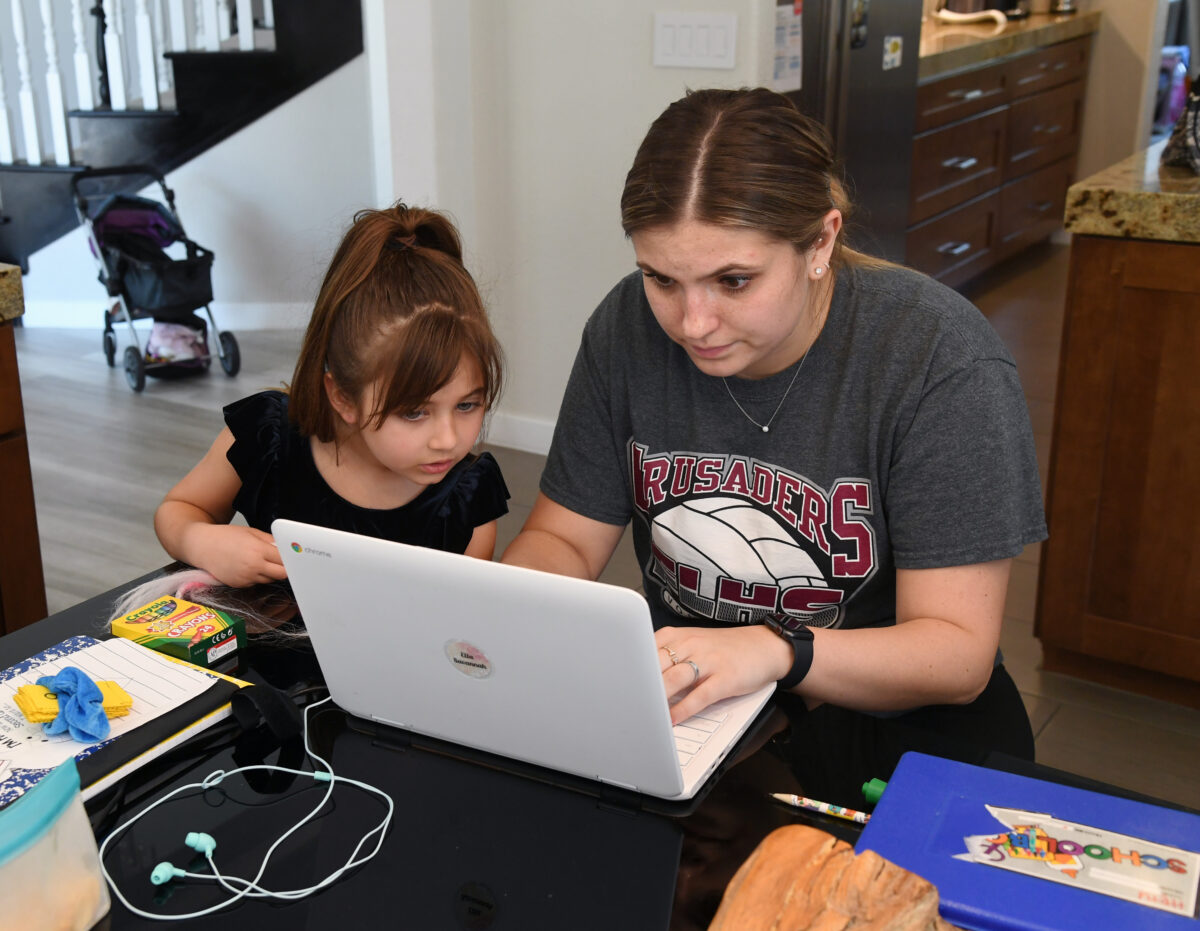
“It’s no coincidence that the lower-performing students tended to do the worst [during distance learning] because they needed the most help,” Mr. Lynch said. “They’re the ones that benefit the most from structured curriculum and instruction.”
Boys and girls of all races and in all regions experienced some decline in reading and math scores, the study shows.
The least-impacted region was the South, with only a two-point drop in reading and a seven-point drop in math on the tests since 2020.
More Education Dollars
At the same time, funding for public schools has increased.
In 2019, America spent an average of $13,187 on education per public school child, according to the latest U.S. Census figures. Some areas of the country spent far less on each student, others spent far more.

Teacher salaries, benefits, and other daily expenses made up 86 percent of the expenditure, Census figures show.
But little of this money likely goes to increasing teacher salaries, Mr. Lynch said.
In Florida, Gov. Ron DeSantis has promised $800 million in teacher raises. This amount will raise the starting salary for teachers by $7,000.
Although some other states have given teachers raises, the average teacher has received only a little more pay than they have in the past, Mr. Lynch said.
“I don’t see it reflecting in salaries for teachers,” he said.
In the 2021-2022 school year, teachers brought home $2,179 less yearly than they did a decade ago, considering adjustments for inflation, according to the National Education Association, the nation’s largest teachers’ union.
Low teacher salaries, technically in decline due to inflation, make it difficult to attract talent to the profession, Mr. Lynch said.
Because of a shortage of math teachers, he said, “it is extremely hard for a lot of districts to even find quality math teachers.”
Good Teachers Mean Good Schools
At the same time, teaching standards have eroded to the point that many people see school as a “babysitting service,” Mr. Lynch said.
While the technology used in teaching has evolved from blackboards and chalk to computer-manipulated smartboards, the most influential factor in the classroom is still the teacher, Mr. Lynch said.
No matter how much technology a classroom has, it won’t help students if the teacher is incompetent, he said.
“A good principal knows as long as that teacher has a decent amount of classroom supplies, a whiteboard, and some support, they can work miracles,” he said.

It seems the COVID-19 pandemic lifted the veil from parents’ eyes, Ms. Nester said.
“For far too long, parents just sent their kids to school and expected their kids to come out proficient in reading, writing, knowing science, and knowing history,” she said.
But now, parents no longer assume that schools are doing a good job, she said.
This increased attention has led to a surge in parental activism and interest in how schools are spending taxpayer dollars.
In the long run, the parental rights movement likely will hold schools accountable and lead to improved schooling, Ms. Nester said.
There’s a very important activity parents can do to further that improvement, she said.
“Be sure that you’re involved in asking kids questions and asking the district questions.”
 Friends Read Free
Copy
Facebook
Tweet
Friends Read Free
Copy
Facebook
Tweet