

At least four rare-earth elements, including two that China has placed export restrictions on in global metals and minerals markets it dominates, have been discovered in commercially viable quantities at a planned Alaska mine sitting on the nation’s largest known graphite deposit.
Graphite One, based in British Columbia, Canada, confirmed on Nov. 13 that its geologists have found neodymium, praseodymium, dysprosium, and terbium at its Graphite Creek mine under development on the Seward Peninsula, less than 40 miles north of Nome, Alaska.
“The presence of rare earths at Graphite Creek suggests that recovery as a by-product to our graphite production will maximize the value,” Graphite One President Anthony Huston said.
The Chinese Communist Party in April slapped export restrictions on seven rare earths, including terbium and dysprosium. It added five more elements to its export control list in October but has suspended implementation of those curbs.
Rare earths are a group of 17 elements that are not actually “rare.” They are commonly found in trace quantities in an array of ores but not in commercially viable deposits.
These elements are key components in magnets needed in modern technologies, including consumer electronics, medical devices, and defense applications.
An F-35, for instance, contains more than 900 pounds of rare earths, nearly all of which are imported by domestic defense contractors from China.
Rare earths are classified by the U.S. Geological Survey (USGS) as a single entry among 54 commodities deemed “essential to national security” on its 2025 Critical Mineral List.
U.S. manufacturers are 100 percent import-reliant for 12 of the 54 commodities and more than 50 percent import-reliant for 29 of them, including rare-earth elements. China-based processors control at least 75 percent of the global market for at least 30 minerals, including all rare-earth elements.
Already A Vital Project
Graphite, not produced in the United States for more than 70 years, is also classified by the USGS as a critical mineral that domestic manufacturers are 100 percent import-reliant on.
As the USGS has documented, 42 percent of the 60,000 tons imported by domestic manufacturers comes from China, which produced 78 percent of the graphite consumed worldwide in 2024.
Even before the rare-earths find, Graphite One’s Alaska mine was among projects garnering federal support to remedy the nation’s processed-mineral reliance on China, including a $37.5 million 2023 grant from the War Department under Title III of the Defense Production Act.
“The presence of two Defense Production Act Title III materials—graphite and [rare-earth elements]—in a single deposit further underscores Graphite Creek’s position as a truly generational deposit,” Huston said.
According to Graphite One, its graphite deposit spans about 10 miles along the flanks of the Kigluaik Mountains and incorporates 176 mining claims in the state of Alaska that cover 23,680 acres. The company stated that it is the highest-grade and largest known flake graphite deposit in the United States.
The Federal Permitting Improvement Steering Council qualified the “owner-operated year-round truck and shovel operation” for accelerated, relaxed FAST-41 permitting in June.
The mine will employ up to 200 workers year-round when production begins. A 2022 preliminary assessment confirmed in an April 2025 feasibility study projected that the mine’s ore contains up to 5.6 percent graphite, enough to extract 22.5 million tons of the critical mineral, or 2,740 tons per day.
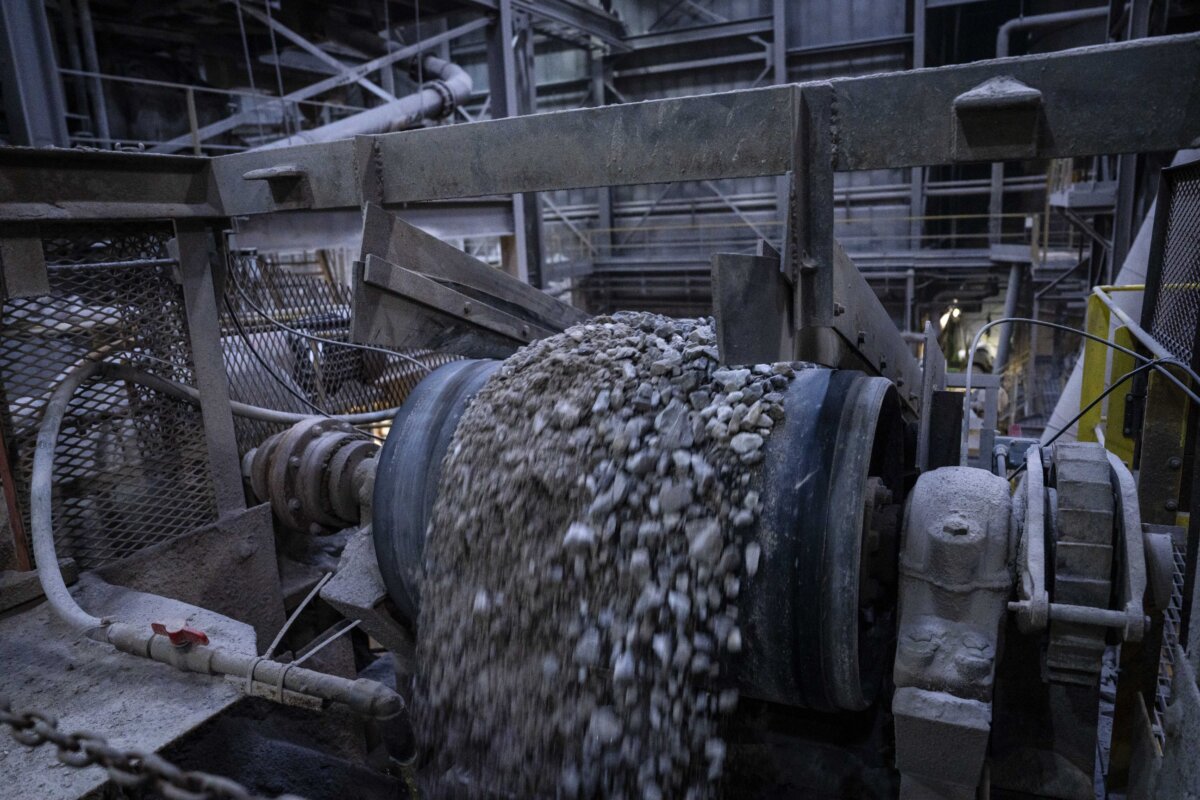
Graphite One is building a mill at the mine to produce 60,000 tons of graphite concentrate per year to be transported to Nome and shipped “on a seasonal schedule” to a plant in Ohio, where it will be processed to manufacturers’ specifications.
Graphite Creek is one of at least five graphite projects nationwide that have advanced since President Donald Trump issued his Energy Emergency and Unleashing American Energy executive orders to “ensure a more secure, predictable, affordable supply of critical minerals,” which were followed by a March executive order requiring federal agencies to streamline permitting.
 Friends Read Free
Copy
Facebook
Tweet
Friends Read Free
Copy
Facebook
Tweet