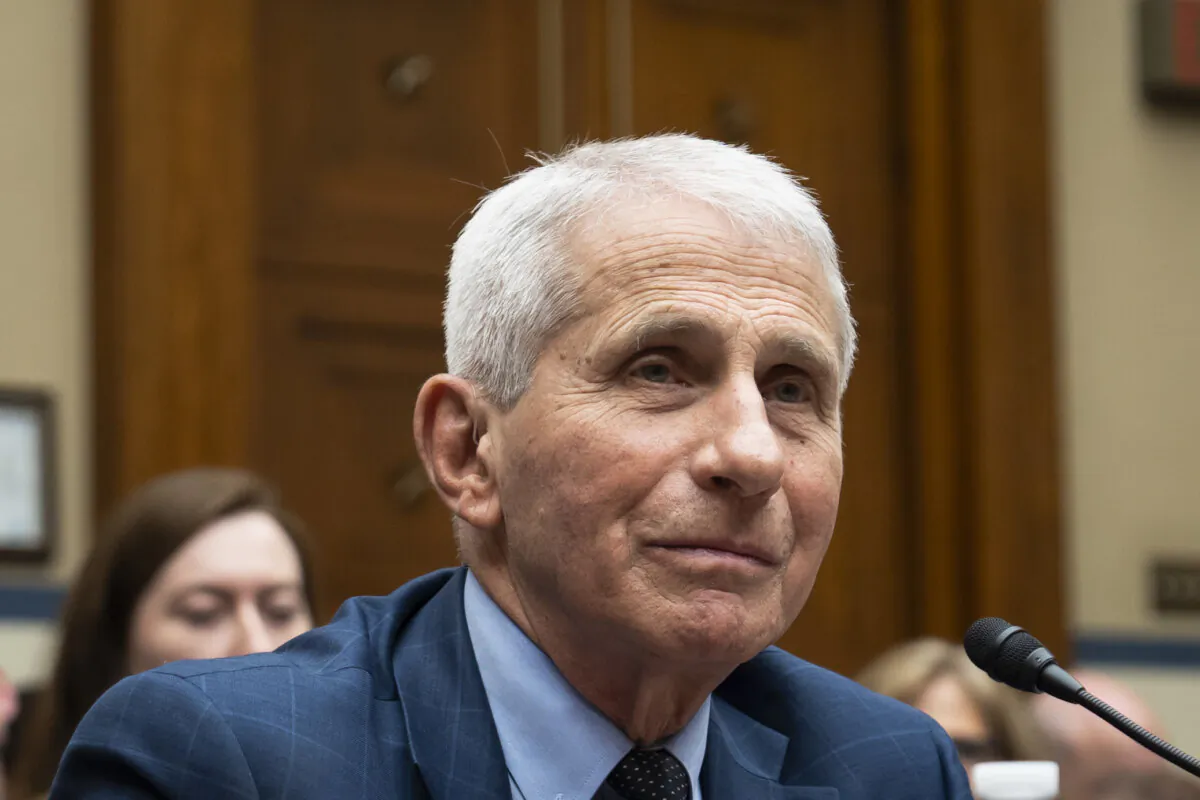

Scientists who have received funding from the National Institutes of Health (NIH), headed by Dr. Anthony Fauci, nominated Fauci for prizes before and during the COVID-19 pandemic, according to emails made public by the office of Sen. Rand Paul (R–Ky.), chairman of the U.S. Senate Committee on Homeland Security & Governmental Affairs, on July 24.
Charles Dinarello, a professor of medicine and immunology at the University of Colorado School of Medicine, nominated Fauci for a Dan David Prize in 2020, a $1 million award given by a foundation in Israel, the emails show.
Dinarello wrote in one email that Fauci and Greg Folkers, an aide who worked closely with Fauci, did “most of the work” on the submission.
The prize included $1 million, with $900,000 going to the winner. Fauci won the prize.
The Dan David Prize awards are based at Tel Aviv University but are an independent program because the prize’s owner, the Dan David Foundation, could opt to move it out of the university, according to an NIH review.
That means accepting the money would not violate the U.S. Constitution’s clauses against accepting foreign gifts, officials said. Tel Aviv University receives some funding from the NIH.
A former American law professor, E. Donald Elliott, disagreed, writing in an op-ed published by The American Spectator after it was announced that Fauci had been awarded the prize that because Tel Aviv receives a majority of its funding from the Israeli government, accepting the money would violate the Constitution.
In certain other instances, government ethics officials determined that Fauci could not take money for prizes, such as from the Georgia Institute of Technology, because the institute was a grantee of the NIH’s National Institute of Allergy and Infectious Diseases (NIAID), which Fauci headed from 1984 to 2022.
“Congratulations….you’re rich!” one NIAID employee told Fauci after the review for the Dan David prize was completed. “I want my 15%” Folkers wrote in a separate email.
NIAID provided millions to Dinarello for research from 1985 through 2020, and about $18 million after he nominated Fauci for the prize, records show.
Dinarello wrote to Folkers in 2021, asking whether Fauci had been asked by a committee to nominate someone for the Shaw Prize. Fauci told Folkers he thought he had been.
“If Charles wants me to nominate him for the Shaw Prize, I would be happy to do so,” Fauci wrote. “He would have to write the nomination as he has done in the past.”
Requested Nominations
Fauci requested nominations from Dr. Barton Haynes, a professor of medicine at the Duke University School of Medicine, on multiple occasions, according to the emails.
In 2018, Haynes nominated Fauci for the Shaw Prize in Life Science and Medicine, which Fauci did not want, according to the emails. Then Fauci asked Haynes to nominate him for the Heinz Award for the Human Condition after Fauci requested the nomination.
Fauci said that his team would handle the nomination papers.
“The only minor glitch is that in order to nominate me, you need to write to them, send your [curriculum vitae] and indicate that you want to serve as a nominator,” Fauci said.
“They do this because they do not want just anyone nominating anyone.”
“Yep, will do this straightaway,” Haynes said. “This is a good one, I think, for you.”
Fauci did not win a Heinz Award or The Shaw Prize.
Haynes also agreed to nominate Fauci for the Dan David Prize in 2019. Fauci later realized that the themes for that year were not related to science or medicine and said they would wait until the themes were scientific or medical, according to the emails.
“Thanks anyway,” he wrote.
Haynes, whose records show he had received more than $100 million in research funding from NIAID prior to 2019, received more than $100 million in additional research funding after nominating Fauci for the Heinz Award.
The NIH, Haynes, and Fauci did not respond to requests for comment by the time of publication.
“The records raise the obvious question of a quid pro quo given the large amount of prize money at hand,” Paul said in a statement.
 Friends Read Free
Copy
Facebook
Tweet
Friends Read Free
Copy
Facebook
Tweet