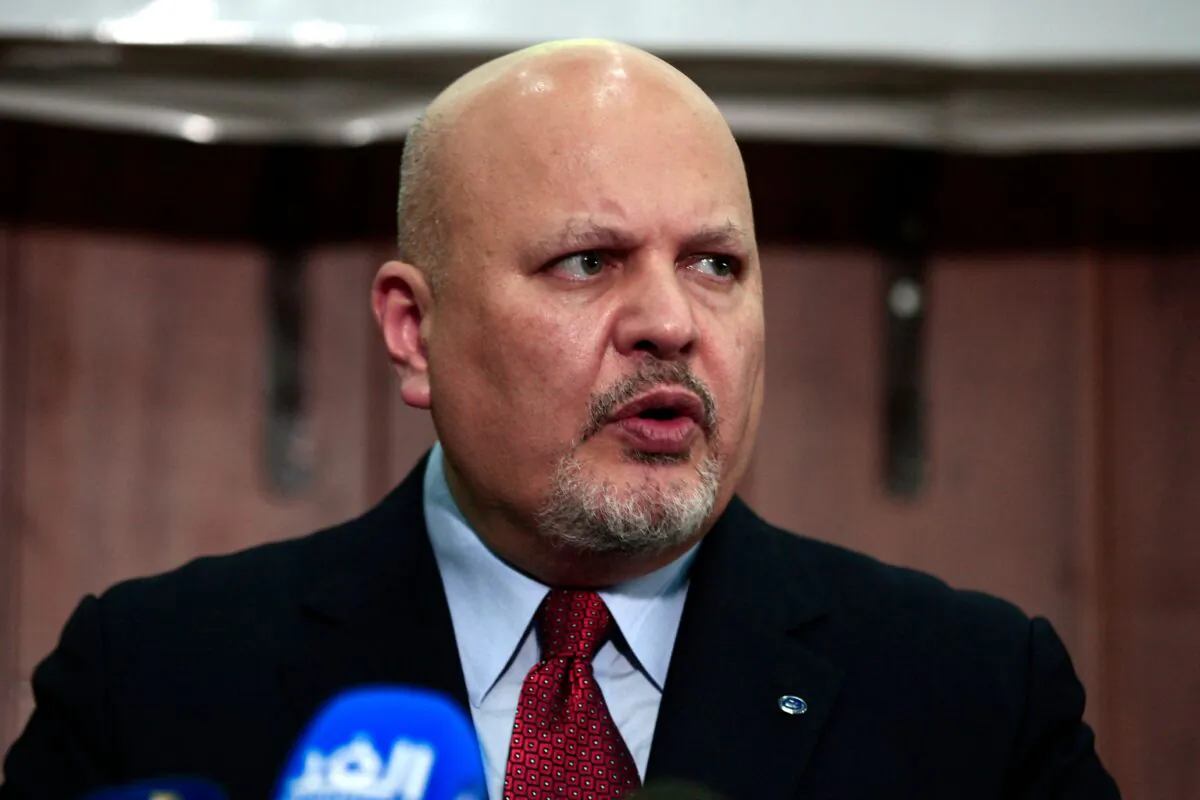

The International Criminal Court’s (ICC’s) chief prosecutor, Karim Khan, was removed from his post on July 24 after member states voted to remove him for “serious misconduct and serious breach of duty.”
“The Assembly adopted a decision, by secret ballot, by an absolute majority of 82 States Parties, finding that Mr. Karim Khan committed serious misconduct and serious breach of duty and removed him from office under article 46 of the Rome Statute,” the Assembly of States Parties to the Rome Statute, the organization’s legislative body, said in a July 24 statement from the ICC.
The ICC had announced an external probe into sexual misconduct allegations against Khan in November 2024. Khan was accused of trying to coerce a female aide into a sexual relationship for more than a year and also allegedly groped the woman against her will. At the time, Khan denied the allegations, claiming there was “no truth” in the sexual misconduct claims.
An investigation conducted by the United Nations’ Office of Internal Oversight Services (OIOS) found there was “evidence supporting the allegations of misconduct made by the victim and two other affected individuals,” the ICC said in another July 24 statement. While the ICC was set up as an independent organization, it cooperates with the United Nations on various issues.
In addition to the OIOS report on the matter, the decision against Khan was taken after considering the advice of a panel of judicial experts and the underlying evidentiary material, the ICC said.
Khan was elected as the ICC’s chief prosecutor in 2021 and was formerly an assistant secretary-general of the U.N. Khan issued arrest warrants in 2024 for Israeli Prime Minister Benjamin Netanyahu and then-Defense Minister Yoav Gallant over Israel’s actions in Gaza.
The Assembly of States Parties’ vote to remove Khan from his post came after he had taken a leave of absence from his office in May 2025 and was suspended from duty on June 8 this year, according to a July 24 ICC statement.
US Actions Against ICC
Tayab Ali, partner at Bindmans LLP, which is representing Khan, criticized the allegations to remove his client from the ICC.
The allegations against Khan “were investigated for more than a year by the United Nations Office of Internal Oversight Services. That investigation made 137 findings, none of which made adverse findings on the allegations. There is not a single finding of misconduct, including sexual misconduct, anywhere in the OIOS report,” Ali said in a statement shared in a July 24 post on X.
Ali said the material gathered by this investigation was reviewed by an independent Judicial Panel of three judges appointed by the ICC. In March, the panel released a report on the issue.
He said that in the report, the panel distinguished between evidence of a crime and findings of fact, clarifying that findings are a consequence of analyzing evidence. In this case, the panel said that the findings made by the OIOS “did not establish misconduct or breach of duty” by Khan under the relevant legal framework, he added.
This legal determination was disregarded when deciding on the case. In addition, Khan and his legal representatives were excluded from the session held by the Assembly of States Parties that decided on his removal, Ali said.
“The states that decided his fate did so without hearing from him or from anyone acting for him,” Ali wrote.
In February 2025, U.S. President Donald Trump signed an executive order imposing sanctions on individuals assisting the ICC in investigating the United States and its allies. Khan is one of the sanctioned ICC officials.
The United States is in direct conflict with the ICC over the court’s jurisdictional limits. In his February 2025 order, Trump said that the ICC has no jurisdiction over the United States or Israel “as neither country is party to the Rome Statute or a member of the ICC.”
The Rome Statute is an international treaty that founded the ICC and established the court’s jurisdiction over crimes against humanity, war crimes, genocide, and crimes of aggression.
In November 2024, the ICC justified Khan’s arrest warrants against Netanyahu and Gallant, arguing that the alleged conduct of these two individuals “falls within the jurisdiction of the Court.”
In a July 19 statement, Netanyahu’s office called the ICC a “kangaroo court” that has no jurisdiction over American or Israeli citizens.
“Its bogus arrest warrant against Prime Minister Netanyahu was issued by a disgraced former ICC Prosecutor, Karim Khan, a few days before allegations of sexual misconduct against him became public,” his office said.
Venezuelan interim leader Delcy Rodriguez announced last week that her country had formally initiated the process of withdrawal from the ICC, alleging bias against nations in the global south. In a July 25 post on X, the U.S. State Department welcomed the decision.
“The ICC is neither credible, independent, nor legitimate,” the department said. “It is time to dismantle the ICC. The U.S. calls on all members of the ICC to withdraw from the Rome Statute.”
The Associated Press contributed to this report.
 Friends Read Free
Copy
Facebook
Tweet
Friends Read Free
Copy
Facebook
Tweet