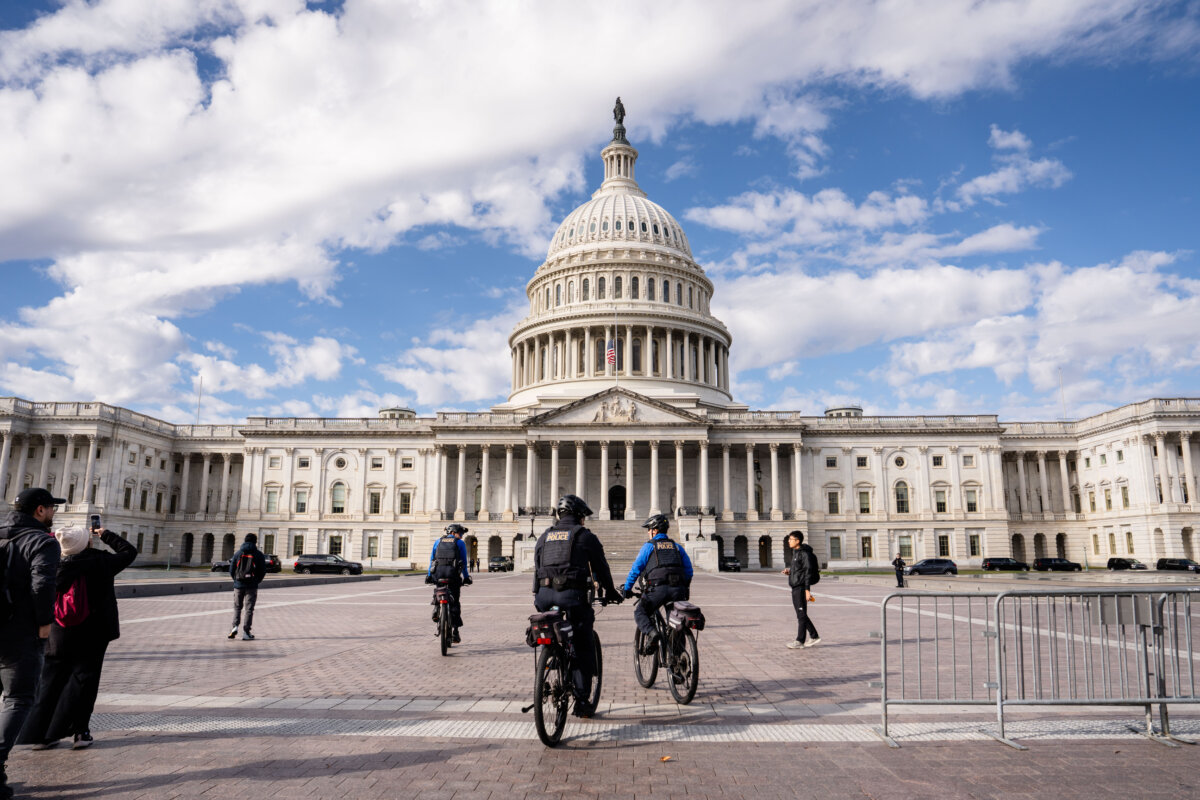


WASHINGTON—The U.S. Senate on Nov. 10 approved a legislative package to fund the government through January 2026 and provide full-year funding for key programs such as the Supplemental Nutritional Assistance Program (SNAP).
The upper chamber greenlit the package in a 60–40 vote, which included the support of eight Democrats.
Debate and voting on the package, which included a vote on an amendment requested by Sen. Rand Paul (R-Ky.) related to hemp-derived cannabis products, began on Monday around 5 p.m. ET and went for several hours, wrapping up late Monday evening.
The package includes two primary components: a “clean” stopgap funding bill to keep the government open through Jan. 30, 2026, and a three-bill “minibus” appropriations bill.
The latter includes full-year funding for the Department of Agriculture, which oversees SNAP and the related Women, Infants, and Children program. Funding for these nutrition assistance programs was affected by the shutdown, and millions of Americans still haven’t received full or partial benefits for November.
With its passage by the Senate, the bill will now head to the House, which is currently out of town but is expected to return as soon as possible this week to finalize the bill.
If passed by the House, the legislation will be sent to President Donald Trump’s desk for a final signature to end what has become the longest government shutdown in U.S. history.
Speaking to reporters in the White House as the bill was being considered in the Senate, Trump indicated support for the proposal.
Asked whether he approved of the deal, the president replied, “It depends on what deal we’re talking about, but if it’s the deal I heard about, I would say so.”
He said his attitude could change if further alterations are made.
The Senate vote series comes after the chamber voted the previous evening to advance a compromise proposal over the 60-vote filibuster threshold, all but guaranteeing its final passage during the Nov. 10 vote.
That milestone was achieved in a bare-minimum 60–40 vote with the backing of eight lawmakers from the other side of the aisle, including Sens. Dick Durbin (D-Ill.), Tim Kaine (D-Va.), Jeanne Shaheen (D-N.H.), Catherine Cortez Masto (D-Nev.), Jacky Rosen (D-Nev.), Maggie Hassan (D-N.H.), John Fetterman (D-Pa.), and Angus King (I-Maine), who caucuses with the Democrats.
Health Subsidies
These Democrats’ votes drew criticism from left-wing members of their party, who said the Senate should have held out on Democrats’ primary demands, including a one-year extension of Affordable Care Act (ACA) tax credits.
If the tax credits—which were extended until the end of 2025 by the Inflation Reduction Act—were to expire, some analyses have suggested that many Americans could see their insurance premiums double in price, while some could see even higher bumps.
Other experts told The Epoch Times while analysis shows that underlying costs for ACA coverage are rising rapidly, they were skeptical about the warnings of catastrophic rate increases for millions of Americans.
As part of the compromise that led to the vote, Senate Majority Leader John Thune (R-S.D.) promised that the Senate would vote on the ACA subsidies in December.
However, that promise didn’t impress prominent Democrats, including Senate Minority Leader Chuck Schumer (D-N.Y.), House Minority Leader Hakeem Jeffries (D-N.Y.), and Sen. Bernie Sanders (I-Vt.), who also caucuses with Democrats.
Speaking on the Senate floor on Nov. 9 ahead of the vote to end the filibuster on the bill, Sanders expressed skepticism that any ACA extension passed by the Senate would be taken up in the House or signed by Trump.
“If this vote succeeds, over 20 million Americans are going to see at least a doubling in their premiums,” Sanders said. “For certain groups of people, it will be a tripling and a quadrupling of their premiums.”
During a press conference on the evening of Nov. 9, Shaheen—one of the Democrats who joined Republicans to advance the bill—said the Democratic defectors would consider shutting down the government in January if ACA subsidy extensions aren’t taken up and passed.
Ahead of the Nov. 10 vote, Shaheen told reporters that she had confidence that several Senate Republicans had “a fair amount of common ground on subsidies.”
Sen. Richard Blumenthal (D-Conn.) told reporters that Democrats ought to be unified in demanding a vote on the issue, saying that if the vote isn’t taken or fails, “Republicans will be to blame and they will be held accountable.”
Hemp Issue
One Republican, Sen. Rand Paul (R-Ky.) initially delayed moving forward with the bill on Nov. 10, objecting to a provision included by Sen. Mitch McConnell (R-Ky.) related to hemp-derived cannabis products.
“There is extraneous language in this package that has nothing to do with reopening the government and would harm Kentucky’s hemp farmers and small businesses,” Paul said of the bill’s hemp-related provisions. “Standing up for Kentucky jobs is part of my job.”
Specifically, Paul was referencing a bid by McConnell to reverse a section of the 2018 Farm Bill that effectively legalized psychoactive cannabis products derived from hemp nationwide.
While Delta-9 THC—the active ingredient most commonly associated with the psychoactive effects of marijuana—remains a Schedule I drug, the bill effectively legalized the production and sale of other types of THC produced from hemp products.
Paul sought a vote on an amendment to strike McConnell’s language from the bill, returning the issue to the status quo ante, and declined to let the funding measure move forward under unanimous consent until he received a commitment to such an amendment.
Leadership agreed, and a vote on the amendment was put on the floor ahead of the vote to fund the government.
The Senate voted to table the motion, with 24 senators voting in favor of moving forward with the measure.
Sen. Mike Rounds (R-S.D.) told reporters ahead of the vote that he would oppose Paul’s amendment, challenging Paul’s argument that the provision wasn’t relevant to the matter at hand.
Sen. Rick Scott (R-Fla.) told The Epoch Times ahead of the vote that he wouldn’t support Paul’s amendment either, citing consultation with local sheriffs who opposed the de facto cannabis legalization included in the 2018 legislation.
 Friends Read Free
Copy
Facebook
Tweet
Friends Read Free
Copy
Facebook
Tweet