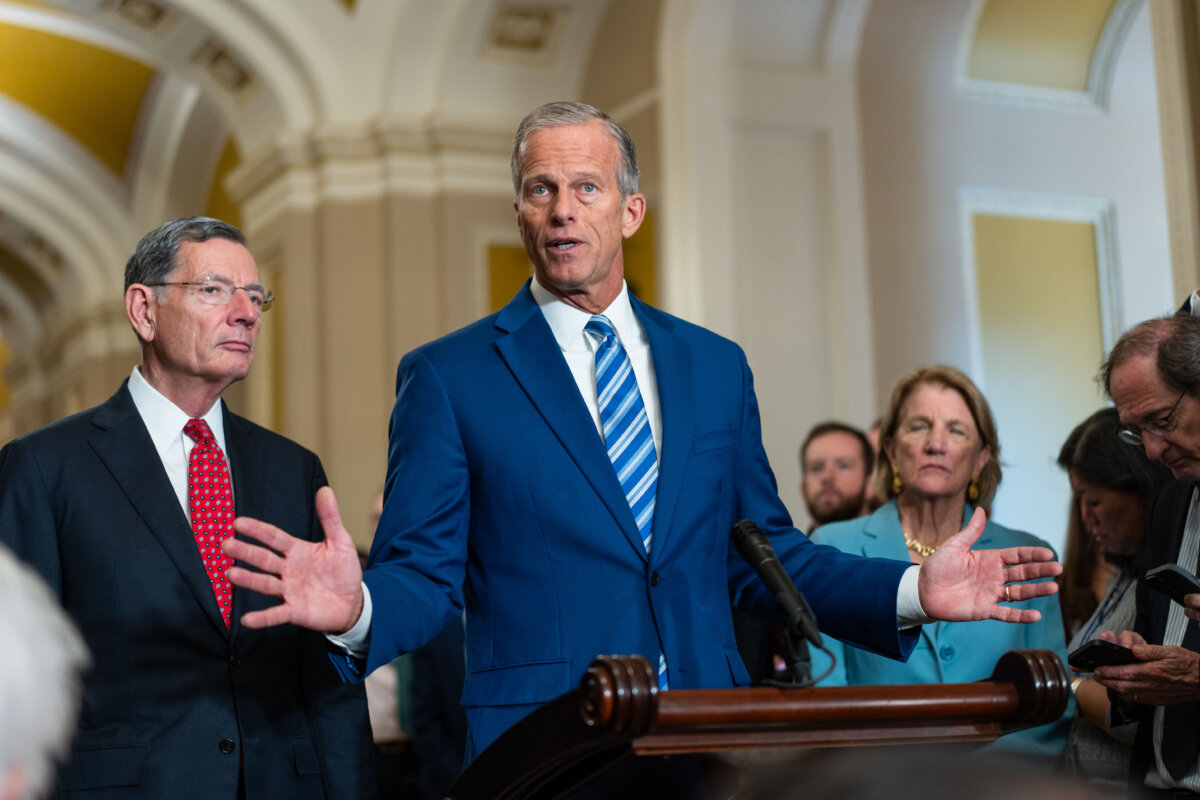

The U.S. Senate will soon vote on a bill to grant President Donald Trump the authority to impose sweeping secondary sanctions on countries that buy Russian oil, announced Senate Majority Leader John Thune (R-S.D.) on Oct. 16.
A bill to grant such authority—the “Sanctioning Russia Act of 2025” sponsored by Sen. Lindsey Graham (R-S.C.)—was introduced on April 1 and currently has the support of 84 other senators as co-sponsors.
The bill would require the imposition of new tariffs at the rate of 500 percent on all Russian goods and services, as well as on other countries that purchase Russian uranium and petroleum products.
Thune said the legislation would be revised by Graham and reintroduced in the Senate, and a vote on the bill is expected in the near future.
“I don’t want to commit to a hard deadline, but it will be soon,” he said.
Thune’s announcement comes the same day that Trump spoke with President Vladimir Putin of Russia regarding the country’s ongoing war with Ukraine, which has been a major foreign policy event for the United States since its outbreak in 2022.
Trump announced that a new round of talks with Russian negotiators, led by U.S. Secretary of State Marco Rubio, would begin, and Trump and Putin would meet in the future in Budapest, Hungary, hosted by Hungarian Prime Minister Viktor Orban. This would be the second such summit, following their meeting in Anchorage, Alaska, in August.
Russia has long been reliant on petroleum exports for its state revenues. The country has the world’s largest reserves of natural gas, which it exports to Europe and Asia. Many countries, despite their opposition to Russia during its war with Ukraine, have continued to accept and pay for Russian gas, citing its necessity to their economies. Trump has repeatedly urged these countries to stop buying Russian fuel.
In August, Trump raised the tariff rate on Indian goods entering the United States to 50 percent, citing India’s continued purchases of Russian oil as justification. Trump has since announced that India has pledged to stop purchasing oil from Russia.
Apart from the new tariffs, the U.S. bill would impose a bevy of personal sanctions on individuals holding state offices in the Russian Federation, as well as other affiliated entities.
Trump will meet with President Volodymyr Zelenskyy of Ukraine on Oct. 17. Though Zelenskyy has enjoyed bipartisan support from Senate leaders, several Trump administration officials—such as Vice President JD Vance—have expressed hesitancy to continue aiding Ukraine’s military campaign, for which the United States is the largest contributor.
The proposed National Defense Authorization Act for Fiscal Year 2026, a bill that would raise and prolong several national security programs, includes $500 million in aid to a fund designed to support Ukraine until 2028.
The Associated Press contributed to this report.
 Friends Read Free
Copy
Facebook
Tweet
Friends Read Free
Copy
Facebook
Tweet