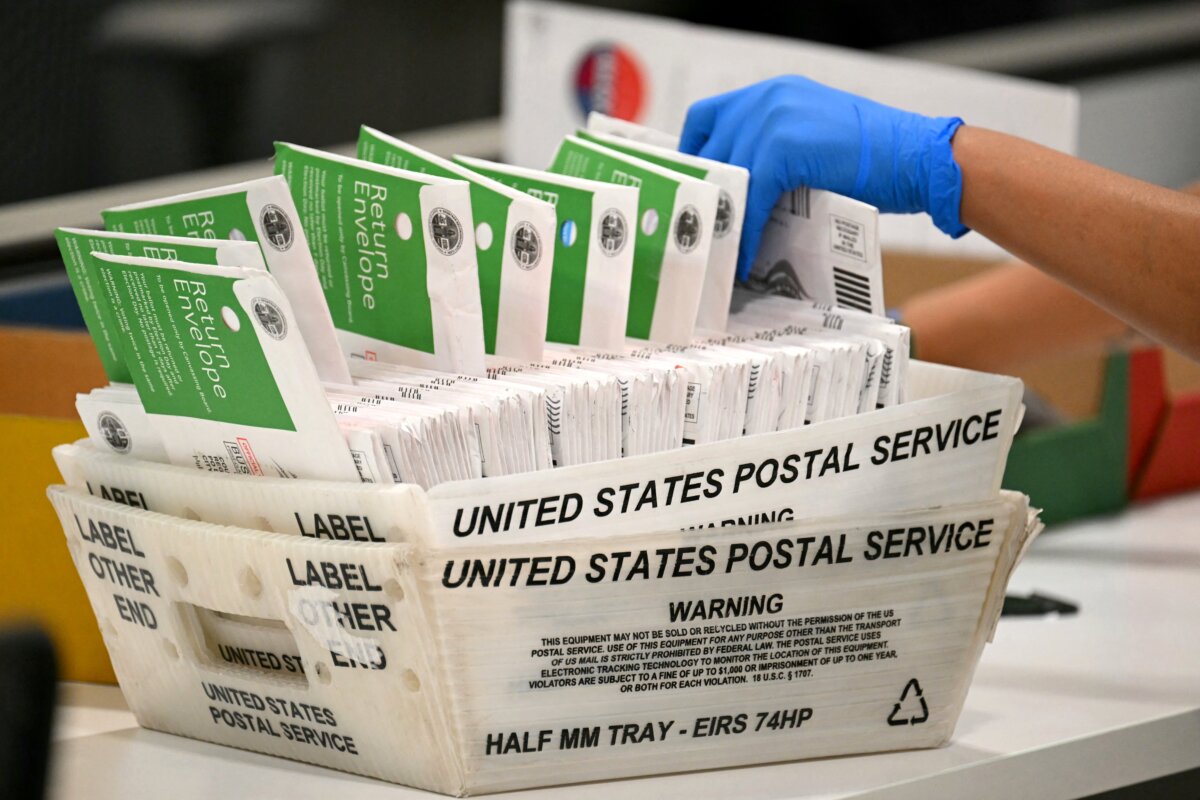

The Supreme Court late on Sept. 14 declined to lift a nationwide injunction blocking a United States Postal Service (USPS) rule on federal ballot mail, leaving it on hold for the 2026 midterms.
The ruling in USPS v. California took the form of an unsigned order.
“The Government is unlikely to succeed on the merits of its challenge to the District Court’s preliminary injunction,” the order said. “And the equitable factors applicable for obtaining emergency relief from this Court do not favor a stay.”
Justice Brett Kavanaugh filed a concurring opinion. Justice Samuel Alito filed a dissenting opinion, which was joined by Justice Clarence Thomas.
The Trump administration had filed an emergency application on Sept. 6, asking the justices to pause an injunction issued on Sept. 4 by U.S. District Judge Indira Talwani of Massachusetts. Her ruling extended a temporary restraining order she granted on Aug. 27.
The injunction blocked the mandatory parts of the Postal Service’s final rule published on Aug. 26 that implements Section 3 of President Donald Trump’s executive order 14399. That provision would assign federal agencies a larger role in who receives a mailed ballot and how those ballots are processed by the USPS.
The Trump administration previously said the executive order would help to keep federal elections honest. The Department of Justice argued that the USPS was imposing mailpiece design and data standards under its general authority to regulate the mail, not deciding who is eligible to vote; states are still free to set voter lists and count ballots.
Talwani had said the postal rule could disenfranchise voters, was probably unlawful, and likely violated the U.S. Constitution, which gives states authority to run federal elections taking place within their borders. The judge previously said the postal agency presented no evidence of fraudulent mail-in voting that would justify the new Postal Service rule.
The judge held at the time that the USPS lacked authority to enforce the rule, and that, as election officials have said, given existing time constraints, complying with the rule for the midterms was “likely impossible.”
Talwani said Congress never agreed to delegate its powers under the Constitution’s elections clause to the USPS, so the rule “clashes with Congress’s statutory scheme, and is unconstitutional where it intrudes not only on … [those] powers but also that power left to the States.”
The judge added that even a small glitch in the new system would be problematic and could mean that ballots never go out, that eligible voters would almost certainly lose the chance to vote by mail, and that the disenfranchisement of plaintiff groups, such as the League of Women Voters of Massachusetts, was “practically inevitable.”
In his concurrence, Kavanaugh said there is “at least a fair prospect” that the USPS rule is legal, but it is too late to use it for the Nov. 3 midterm elections.
“State and local election officials do not have sufficient time to reasonably implement the rule before the elections,” he said.
In his dissenting opinion, Alito said the states’ lawsuit aiming to block the rule was the kind of “Hail Mary pass” that shouldn’t stop a rule that the USPS had the power to issue.
“The plaintiff States cannot claim the timing of the rule tilts the equities in their favor when they, and courts hearing their claims, are responsible for so much of the delay,” he said.
“Not only was the Government subject to months of premature litigation and a series of injunctions that this Court later determined were likely issued without jurisdiction, the Government had to wait nearly another full month for this Court to issue its decision so holding.”
The district court’s nationwide injunction was also based on claims from several plaintiff organizations that probably lacked standing—the right to bring a lawsuit—in the case, Alito said.
The justice did not identify the organizations.
Alito also said the government would probably succeed on the merits of its appeal.
Responding to the ruling, California Gov. Gavin Newsom said, “Today is a good day for democracy, the rule of law, and the American people looking to exercise their Constitutional right to vote.”
“The American people finally have certainty when it comes to our country’s electoral process: Voting is safe, vote-by-mail is accessible to any and all who need it,” the Democratic governor said in a post on X.
The Epoch Times reached out to the White House and the Justice Department for comment. No replies were received by publication time.
The postal rule may be blocked for now, but the legal fight over it continues in the lower courts.
 Friends Read Free
Copy
Facebook
Tweet
Friends Read Free
Copy
Facebook
Tweet