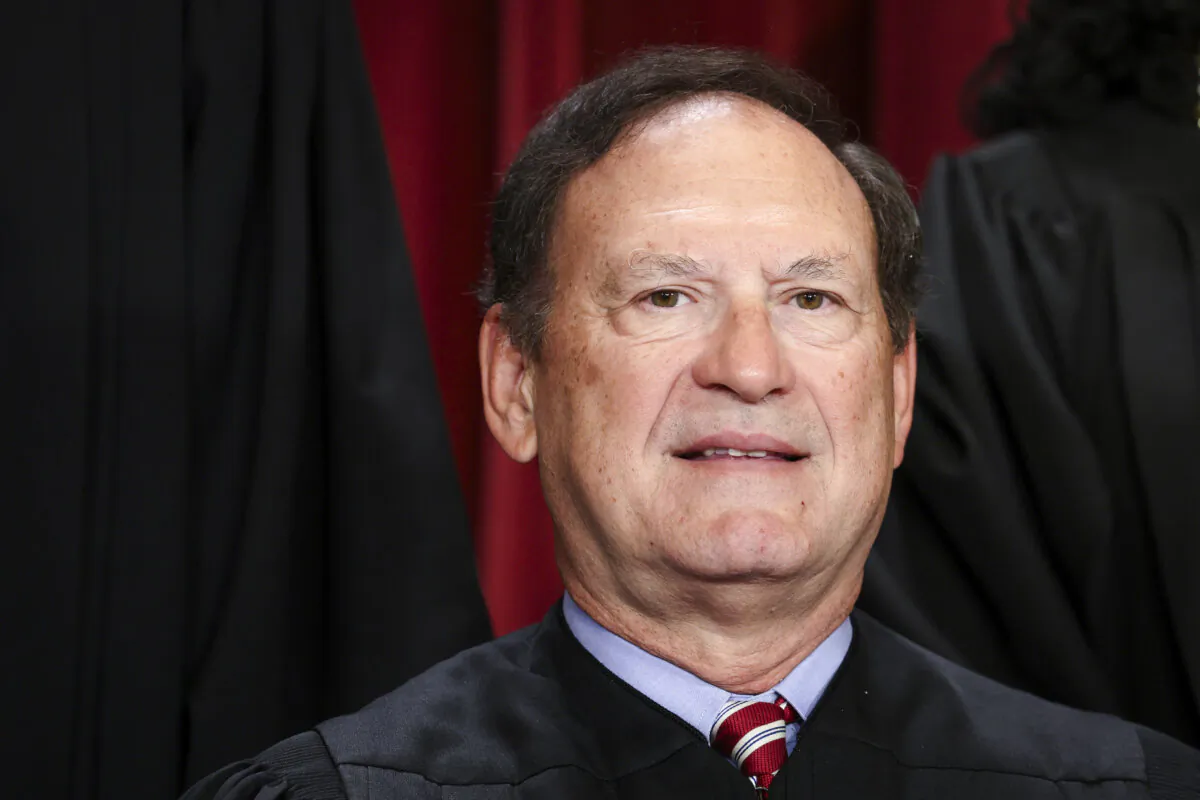

Justice Samuel Alito said he will be staying on the Supreme Court “for another term,” after a news bulletin weeks ago falsely reported his imminent retirement.
“Obviously I’m here for another term,” the 76-year-old justice said in an exclusive interview that The Wall Street Journal published on Aug. 7.
Alito was appointed by President George W. Bush in 2006 to fill the seat vacated by Justice Sandra Day O’Connor. He previously served as a judge on the U.S. Court of Appeals for the Third Circuit.
His comment comes after NPR retracted a June 30 report by reporter Nina Totenberg, 82, that incorrectly stated that Alito was retiring.
Totenberg’s 29-paragraph story outlined Alito’s history on the bench, focusing largely on his views on matters such as abortion and the death penalty. The conservative jurist authored the majority opinion in the 2022 decision that struck down Roe v. Wade, returning the regulation of abortion to the states. The leak of an early draft of that opinion was followed by widespread protests, including at the homes of conservative justices, and a foiled attempt to assassinate Justice Brett Kavanaugh.
Not long after publication, NPR removed the article, saying it had been “erroneously published” and that neither Alito nor court officials had announced his retirement.
“As soon as the error was realized, the story was retracted and removed from NPR’s website and an on-air correction was broadcast,” Tommy Evans, NPR’s editor-in-chief, said, explaining that the episode stemmed from “a misunderstanding.”
Totenberg also broadcast an on-air apology to Alito and described the error as “the worst professional mistake of my more than 50 years in journalism.”
In the new interview, Alito addressed suggestions by some conservatives that he should retire to give President Donald Trump, who has appointed three justices to the court, an opportunity to put a younger justice on the bench.
“It’s not pleasant, in the sense that it’s a reminder of mortality,” Alito said.
“It’s like, what are those vultures doing up there?” he added. “They are flying around. But it goes with life tenure.”
After Alito gave The Wall Street Journal another interview in July 2023, Sen. Sheldon Whitehouse (D-R.I.) called it “improper.”
Alito said in the 2023 interview, “No provision in the Constitution gives [Congress] the authority to regulate the Supreme Court—period.” The conversation took place as the newspaper gave the justice a chance to respond to a then-unpublished ProPublica report that a Republican donor had paid for his fishing trip to Alaska.
Whitehouse’s criticism came in June 2024 as congressional Democrats pressed Alito to recuse himself in two Trump-related election subversion cases the justices were then deliberating. At the time, Whitehouse was also spearheading legislation regulating the Supreme Court.
One case concerned whether Trump enjoyed presidential immunity for actions taken to dispute the 2020 presidential election. The other concerned whether an obstruction provision of an Enron-era accounting reform law could be used to prosecute people who allegedly participated in the security breach at the U.S. Capitol on Jan. 6, 2021, during lawmakers’ efforts to certify presidential election results.
In Trump v. United States, the Supreme Court ruled in July 2024 that former presidents have absolute immunity for core constitutional acts and at least presumptive immunity for other official acts.
In Fischer v. United States, the court narrowed Section 1512(c) of Title 18 of the U.S. Code, holding that the government must prove a defendant impaired or tried to impair the availability or integrity of records, documents, objects, or other things used in an official proceeding. The ruling led to many obstruction charges being dropped against Jan. 6 defendants.
Alito voted with the majority in both cases.
Whitehouse sponsored the proposed Supreme Court Ethics, Recusal, and Transparency Act, which would allow members of the public to file complaints against justices for engaging “in conduct that undermines the integrity” of the court. It would empower a panel of lower court judges to investigate complaints and order disciplinary actions.
The Senate Judiciary Committee approved the bill in a party-line vote in July 2023, but it was blocked in the Senate by Republicans.
The Supreme Court is currently in recess for the summer.
It will resume hearing oral arguments in October when its new term begins.
Zachary Stieber contributed to this report.
 Friends Read Free
Copy
Facebook
Tweet
Friends Read Free
Copy
Facebook
Tweet