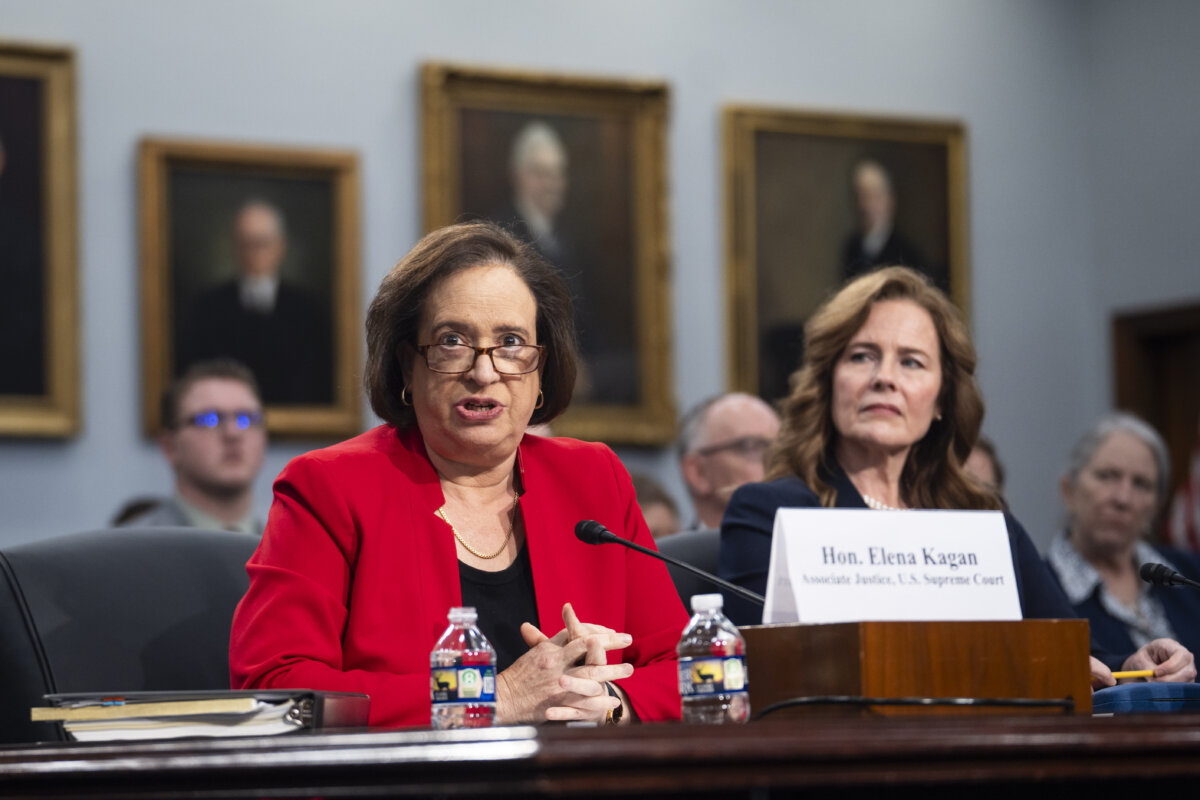

Supreme Court Justice Elena Kagan said on July 14 that leaks of confidential court deliberations endanger the justices and undermine the public trust that the court needs to function properly.
Kagan and Justice Amy Coney Barrett testified in the afternoon before a Senate Appropriations panel looking at the high court’s annual budget request to Congress. They said the court needs more money for security because of rising threats.
The two justices’ appearance marked the first time in seven years that any justice had testified before a congressional committee. Kagan and Justice Samuel Alito appeared in March 2019 before a House panel on the fiscal 2020 budget request.
The court is seeking a total of $228.4 million for the fiscal year that begins Oct. 1, a $20.6 million increase over the current year. Of that $20.6 million, $14.6 million is to boost security at the courthouse, while $2 million is to increase security at the justices’ homes.
At the hearing, the subcommittee chairman, Sen. Bill Hagerty (R-Tenn.), recounted leaks involving Supreme Court documentation.
He mentioned the unauthorized release of the draft opinion in the Dobbs case in 2022 that overturned Roe v. Wade. The leak was followed by protests at the homes of several justices and an attempt on the life of Justice Brett Kavanaugh.
At a hearing on the House side in the morning, Barrett described how protests directed at the court had affected her.
“Maybe I lack imagination, but I didn’t expect that performing this service was going to put me in the position of explaining to my children what a bulletproof vest was and why I had to wear one,” the justice said.
She also mentioned an incident from May when her teenage son was on his way out to meet friends, only to see police cars surrounding their house. Someone had called in a false report of “gun shots and raised voices” in the home, a practice known as “swatting.”
Barrett said her personal security team was able to resolve the situation without incident.
Sen. Susan Collins (R-Me.) said that charged rhetoric has led to growing threats against the judiciary.
“It is increasingly dangerous to be a Supreme Court justice these days,” she said, criticizing rhetoric from both sides of the aisle.
Without identifying Sen. Chuck Schumer (D-N.Y.), who made a speech at a pro-abortion rally outside the Supreme Court in March 2020, Collins said a senator stood in front of the court building and “called out two members by name, saying that they had released the whirlwind and that they will pay the price.”
In his oration, Schumer vowed unspecific retribution against Justice Neil Gorsuch and Kavanaugh if they voted to uphold a Louisiana law that imposed abortion restrictions.
“You won’t know what hit you if you go forward with these awful decisions,” Schumer said at the time.
Collins said “this overheated language … endangers the lives of the justices and erodes public trust in our system of government.”
History of Leaks
Hagerty said that in April of this year, there was a leak of old internal memorandums discussing an emergency docket request in 2016 to stay President Barack Obama’s Clean Power Plan. Ultimately, the justices blocked the plan.
Gorsuch said on “Fox News Sunday” in May that he was uneasy with such leaks because the justices need to be able to speak frankly when discussing cases without worrying that their behind-the-scenes deliberations may find their way to the public.
“We want some transparency, but we also have to leave room for candid conversations and deliberations with one another,” he said at the time.
Hagerty asked Kagan if “these sorts of leaks from the Supreme Court [were] acceptable?”
Kagan replied: “They’re not.”
“It dramatically increases security risks. It also dramatically changes the way we do our business internally, or at least has the potential to do so,” she said.
“The way we relate to each other depends so much on honest communication among the nine of us,” Kagan said.
“If the nine of us don’t have trust in one another and don’t have trust in … all the people who work for us, then those kinds of honest conversations that we need to do our business are not going to take place, or they’re at least going to be frustrated.”
Kagan said “every single one of the justices” has been frustrated by the leaks because they interfere with closed-door deliberations and affect security.
“It’s not the way a court can operate if it wants to have the kind of deliberations that are the backbone of what we do.”
Barrett said the court has introduced protocols to better track “who has access to documents, who’s touched documents, where they’re been printed.”
Employees have “always” been required to sign confidentiality agreements, but recently the court began requiring them to also sign non-disclosure agreements, or NDAs, she said.
“We’re hoping that driving the need for confidentiality home with these NDAs will just be an additional check on employees who are sharing information inappropriately and often illegally,” Barrett added.
Ethics Enforcement
Kagan and Barrett disagreed on how to enforce Supreme Court ethics rules.
The high court adopted an official code of conduct in November 2023 that relies on voluntary compliance by the justices. Democrats said at the time that it was a toothless gesture and that it wouldn’t fix what they describe as a court that is overly sympathetic to business interests and conservative causes.
Barrett told Sen. Jack Reed (D-R.I.) that “none of my colleagues, and certainly not I, think ourselves above the law or above ethics in any way.”
However, the justice said it is “tricky to figure out who would … enforce such a code.”
She said some have floated the idea of appointing an inspector general but such a person would probably come from the executive branch of government, and “that’s a problem” because the official should come from within the judicial branch.
Another proposal that would have lower court judges review ethics complaints against members of the nation’s highest court would lead to “awkwardness,” Barrett said.
Kagan agreed that it may be “awkward … to have policemen for the judges who are at the apex of the branch.”
But she said there is a need for “an enforcement mechanism … of the right kind.”
Having an enforceable ethics code would help the public perception of the court and allow justices to show that some charges leveled at them are “so much poppycock.”
“We can figure out a way around some of the complexities” that Barrett discussed, Kagan said.
A bill introduced by Sen. Sheldon Whitehouse (D-R.I.) in the previous Congress was known as the Supreme Court Ethics, Recusal, and Transparency Act (SCERT). It was approved by the Senate Judiciary Committee on a party line vote in July 2023 but was blocked on the Senate floor by Republicans who said it was unconstitutional.
The bill would have required the court to adopt a binding code of conduct that would be enforced by a panel of lower court judges empowered to investigate complaints against the justices and order disciplinary actions.
Rep. Hank Johnson (D-Ga.), who introduced a version of the bill in the House, told The Epoch Times after the hearings that “momentum is building for passage” of the measure.
People believe that the justices “should be bound to a code of conduct,” just as lower court judges are, he said.
Stacy Robinson, Nathan Worcester, and Reuters contributed to this report.
 Friends Read Free
Copy
Facebook
Tweet
Friends Read Free
Copy
Facebook
Tweet