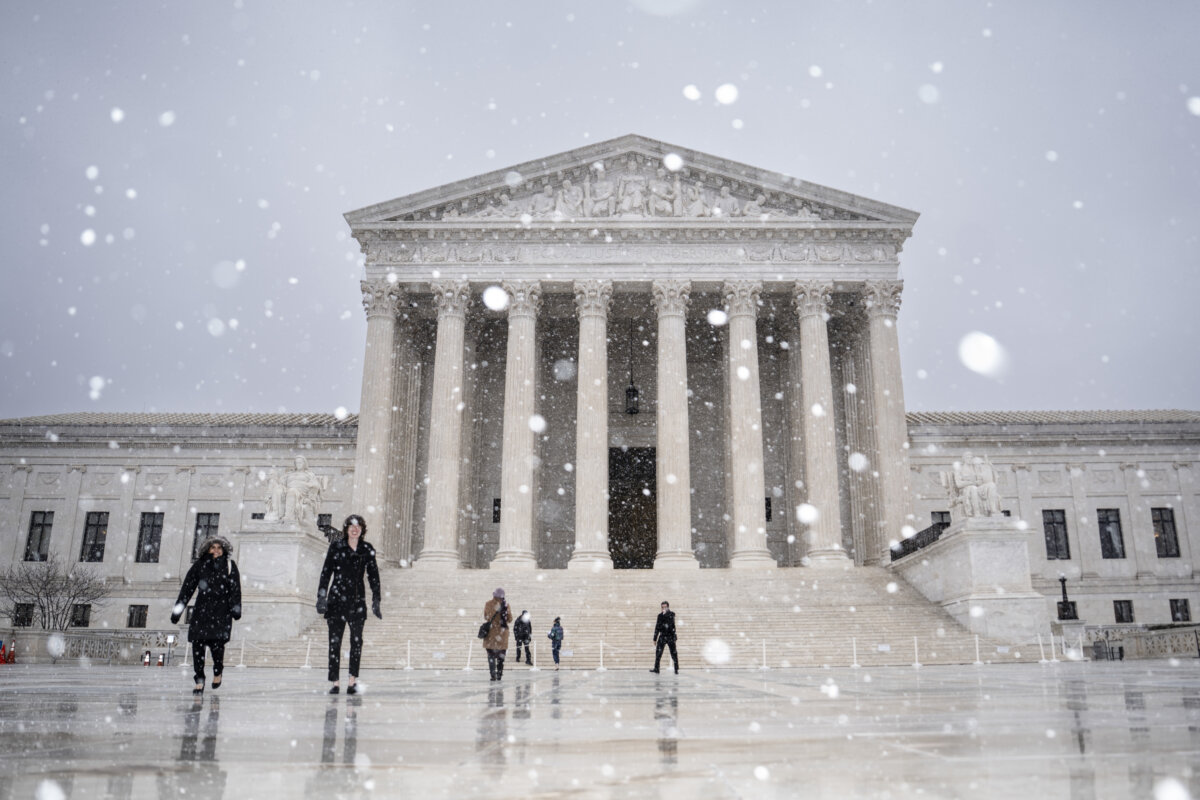

Most of the justices of the Supreme Court on March 2 seemed skeptical that the federal government can use the Gun Control Act to prohibit the ownership of firearms by those who regularly smoke marijuana, a controlled substance whose possession or use is a federal crime and that separately remains unlawful in some states.
The court heard oral arguments in United States v. Hemani, involving a challenge to federal law prohibiting unlawful drug users from owning firearms.
Justice Amy Coney Barrett asked whether the law in question could be applied to other commonly used controlled substances, such as sleep aids and Adderall.
“Is it the government’s position that if I unlawfully use Ambien or I unlawfully use Xanax, then I become dangerous?” she asked Justice Department lawyer Sarah Harris, who represented the government.
“The question is, would it violate the Second Amendment, and what is the government’s evidence that using marijuana a couple times a week makes someone dangerous?”
Harris said the law is meant to disarm citizens who use illegal substances that may affect a gun owner’s judgment, including cannabis.
“They’re illegal because Congress deemed their use dangerous at any level, and their dangers extend beyond their mind-altering effects to the risks of the illegal drug trade,” she said.
In 2023, the FBI searched the home of suspected drug dealer Ali Danial Hemani, where he lived with his parents, and found marijuana, a small amount of cocaine, and a Glock 9mm pistol.
He was later charged with violating a federal law that prohibits firearm possession by anyone who is “an unlawful user of, or addicted to any controlled substance.”
The Drug Enforcement Administration classifies drugs by groups called “schedules.” Marijuana is classified as Schedule I, a group of drugs that are considered addictive and do not have a currently accepted medical use; that group includes heroin and LSD.
Hemani, who admitted to smoking marijuana every other day, challenged his indictment, arguing that the wording of the statute was too vague and violated the Supreme Court’s interpretation of the Second Amendment.
A previous Supreme Court decision, New York State Rifle & Pistol Association v. Bruen, said laws that restrict the right to bear arms can be constitutional, but only when those laws are “consistent with the Nation’s historical tradition of firearm regulation.”
The government has argued that the law used to indict Hemani is “analogous to founding-era laws restricting the rights of drunkards.”
But Erin Murphy, arguing for Hemani, said those laws “applied only to habitual drunkards, not to habitual drinkers.”
“Indeed, the whole point of the doctrine was to distinguish those who consumed alcohol frequently, but mostly in moderation, from those who so habitually consumed alcohol to the point of intoxication as to impair their ability to function, even in whatever moments of sobriety they may have had,” she told the court.
Hemani’s case is being complicated by another issue: Marijuana has been decriminalized in many states, and President Donald Trump signed an executive order in December 2025 asking Attorney General Pam Bondi to reclassify it as a Schedule III controlled substance. That would put it in a category with less addictive drugs, including Tylenol with codeine and anabolic steroids.
Justice Neil Gorsuch, citing the drinking habits of former presidents, also questioned whether lawmakers from previous centuries would have a different standard of what it means to be a “habitual drunkard.”
“James Madison reportedly drank a pint of whiskey every day,” he told Harris.
“Thomas Jefferson said he wasn’t much of a user of alcohol—he only had three or four glasses of wine a night. … Are they all habitual drunkards who would be properly disarmed for life under your theory?”
Chief Justice John Roberts pushed back on Murphy’s reasoning, saying that standard could be used to justify gun ownership for users of other drugs, too.
“I mean, why doesn’t it apply to any drug, whether it’s PCP, methamphetamine, whatever?” Roberts asked her.
Correction: A previous version of this article misspelled the name of Ali Danial Hemani. The Epoch Times regrets the error.
 Friends Read Free
Copy
Facebook
Tweet
Friends Read Free
Copy
Facebook
Tweet