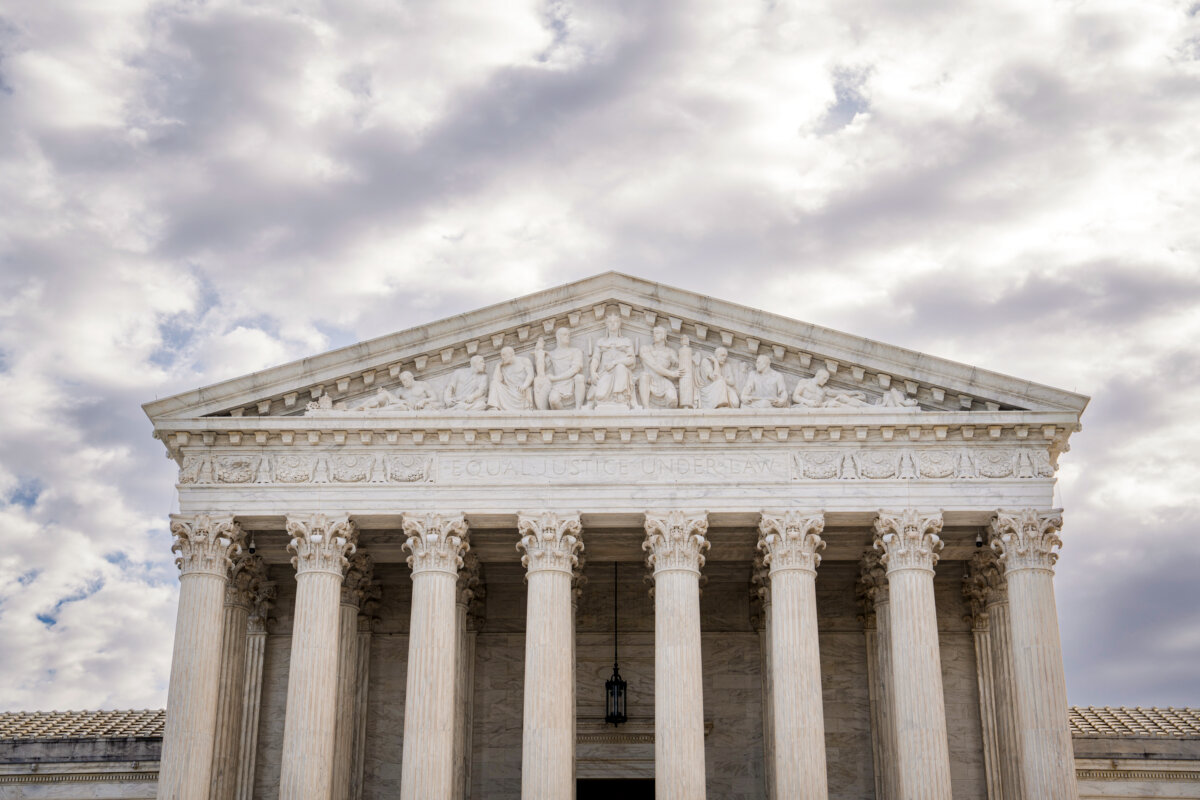

The U.S. Supreme Court voted 5–4 on May 28 to revive a black death row inmate’s challenge to his conviction.
The nation’s highest court found in Pitchford v. Cain that the trial judge didn’t properly handle claims that black jurors were excused on account of their race.
The highly technical case focused on whether defense attorneys did enough to object to the trial judge’s rulings and whether the Mississippi Supreme Court acted reasonably in finding they had failed to do so.
This is a procedural victory for Mississippi prisoner Terry Pitchford, but it does not overturn his conviction or death sentence. The ruling sends the case back to the lower courts for further consideration.
Justice Brett Kavanaugh wrote the majority opinion in the case, which sides with Pitchford, who received a sentence of death for his role in the murder of a grocery store owner.
Chief Justice John Roberts, along with Justices Sonia Sotomayor, Elena Kagan, and Ketanji Brown Jackson, joined the opinion.
Justice Neil Gorsuch wrote a dissenting opinion, which Justices Clarence Thomas, Samuel Alito, and Amy Coney Barrett joined.
The high court held that the Mississippi Supreme Court failed to reasonably apply Batson v. Kentucky (1986). In Batson, the U.S. Supreme Court held that the Equal Protection Clause bars a prosecutor from using a peremptory challenge to exclude jurors because of their race. A peremptory challenge allows an attorney to reject a certain number of jurors without providing a reason. In Batson, the court established a three-part test for trial judges to use when assessing claims of discrimination, holding that jurors cannot be excluded solely on the basis of their race.
Kavanaugh said the trial court “never conducted the essential third step of the Batson inquiry.”
In other words, the majority found that the state supreme court erred when it found that Pitchford gave up his opportunity to rebut the prosecutor’s supposedly race-neutral reasons for the peremptory strikes of four black prospective jurors.
The case goes back to 2004, when two black teenagers, Pitchford, then 18, and Eric Bullins, then 16, robbed a grocery store in Grenada, a small town in northern Mississippi. At the time, Grenada County was around 60 percent white and 40 percent black, according to the opinion.
While the robbery was in progress, Bullins fired three shots at the white store owner, killing him. Bullins signed a plea bargain and accepted a 20-year sentence. Pitchford also discharged a weapon, but whether he fired at the owner or at the store floor was disputed.
The opinion recounted that the state charged Pitchford with capital murder and pursued a death sentence. During the jury selection process, the prosecutor used peremptory strikes to remove four of the five potential jurors. Pitchford’s attorney invoked the Batson precedent, and the trial judge asked him to provide race-neutral reasons for eliminating each of the four black would-be jurors. The prosecutor said one was dismissed because he was late arriving at court, two had brothers who were convicted of violent offenses, and the fourth, like Pitchford, was a young, unmarried father.
The trial judge accepted that the strikes were race-neutral but did not give the defense counsel an opportunity to challenge them as pretextual, which in the words of a reviewing court, “full-stop ended its Batson analysis” at step two of the legal test—considering race-neutral reasons—without moving to step three—giving defense counsel an opportunity to rebut those reasons as pretextual.
When jury selection concluded, the defense raised Batson again, but the trial court cut the defense off twice, ending the inquiry before the legal team could attempt to rebut the race-neutral reasons provided by the prosecution, and ruled there was no Batson violation, the opinion said.
The jury that convicted Pitchford and gave him the death sentence had 11 white jurors and one black juror. Pitchford’s attorneys argued that the peremptory challenges were unlawful, but the trial court summarily dismissed the motion.
Pitchford appealed to the Mississippi Supreme Court, and a divided court found that he had waived his Batson objection by not arguing before the trial court that the prosecutor’s explanations for dismissing jurors were pretextual, according to the opinion.
A federal district court then ruled for Pitchford, finding the Mississippi Supreme Court had misapplied Batson. After that, the U.S. Court of Appeals for the Fifth Circuit reversed, finding that the state supreme court acted reasonably.
In his opinion, Kavanaugh said the Mississippi Supreme Court “unreasonably applied the clearly established Batson precedents and unreasonably determined that Pitchford waived his opportunity to rebut the prosecutor’s asserted race-neutral reasons for the peremptory strikes of four black prospective jurors.”
In its new decision, the U.S. Supreme Court reversed the Fifth Circuit, sending the case back to that court for a second look.
In his dissent, Gorsuch said that the record shows that the claim of Pitchford’s lawyers that they were “muzzled” by the trial court “is hard to square with the record.”
The attorneys were “more than capable of speaking up when they had something to say.”
After the trial judge accepted the prosecution’s reasons as race-neutral and the judge ordered that jury selection should continue, Pitchford’s legal team “did not object to that direction or otherwise seek to make a step three showing,” Gorsuch said.
It is unclear when the Fifth Circuit will convene to reconsider the case.
 Friends Read Free
Copy
Facebook
Tweet
Friends Read Free
Copy
Facebook
Tweet