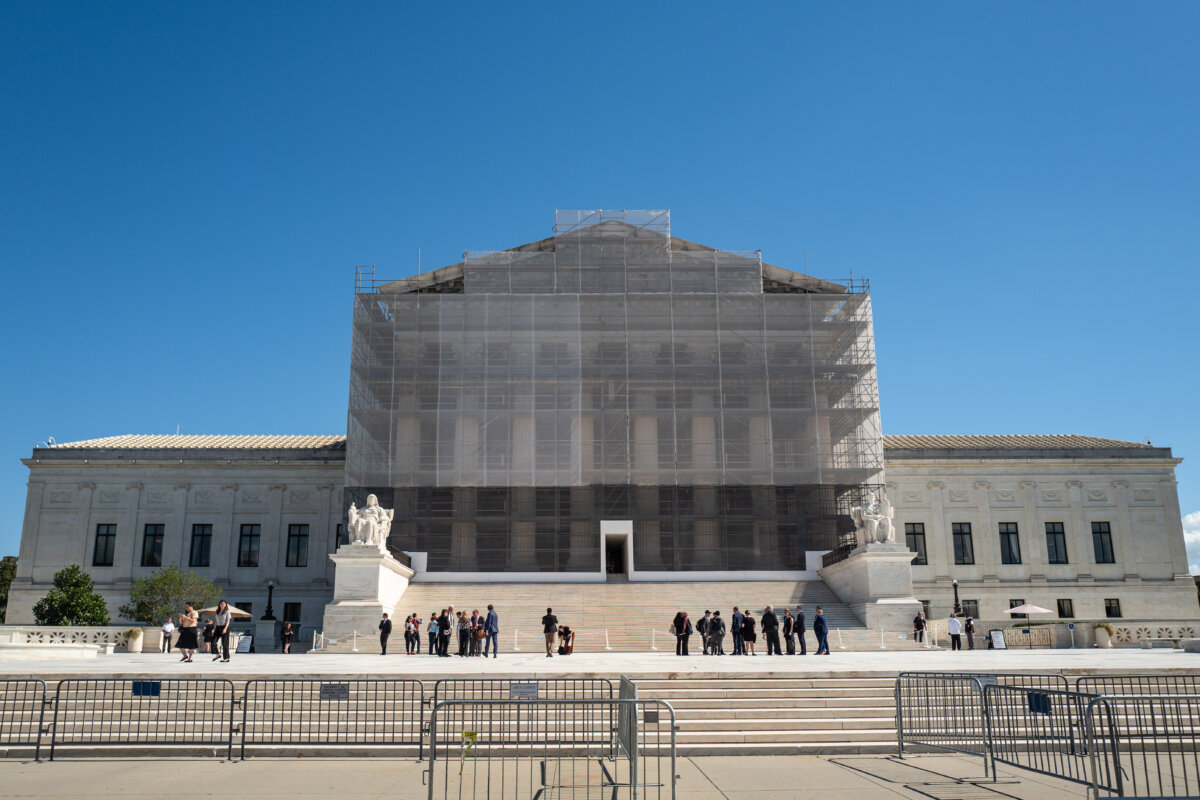
The Supreme Court is scheduled to consider on Oct. 7 a free speech case involving a Colorado law that bans therapists from providing so-called conversion therapy to minors experiencing same-sex attraction or gender dysphoria.
A therapist challenging the law argues that it violates her First Amendment rights. On the other side of the debate, Colorado contends that it has the right to regulate mental health treatments for minors that it deems harmful and ineffective. It is among more than 20 states with such bans.
Colorado’s Prohibit Conversion Therapy for a Minor law, passed in 2019, prohibits licensed therapists from trying to “change an individual’s sexual orientation, including efforts to change behaviors or gender expressions, or to eliminate or reduce sexual or romantic attraction or feelings toward individuals of the same sex.”
Therapists who violate the law could be stripped of their licenses and face fines of up to $5,000.
Colorado has stated that its regulation was enacted in response to “overwhelming” scientific evidence that conversion therapy for minors is unsafe and not effective in the long term.
A practitioner of such therapy told The Epoch Times that the therapist’s work focuses on mending psychological wounds and is not coercive or harmful.
Opponents of conversion therapy, including the American Medical Association, point to practices such as electric shock and negative feedback methods such as smelling salts or chemically induced nausea to create a psychological aversion to the unwanted behaviors or attractions.
However, according to licensed counselor Christopher Doyle of the Institute for Healthy Families, modern therapists avoid these methods and instead favor exploring clients’ attitudes on sexuality, trauma, self-perception, and relationships.
The Case
In 2022, Colorado therapist Kaley Chiles, a Christian, sued to overturn the state’s minor conversion therapy law, saying that it violates her First Amendment right to free speech because it prevents her from speaking freely with clients.
“A practicing Christian, Chiles believes that people flourish when they live consistently with God’s design, including their biological sex,” Chiles’s petition states.
“Many of her clients seek her counsel precisely because they believe that their faith and their relationship with God establishes the foundation upon which to understand their identity and desires. But Colorado bans these consensual conversations based on the viewpoints they express.”
The state argued that it was appropriate for it to regulate professional conduct to protect patients. It also argued that the law is viewpoint-neutral and only prevents therapists from setting unrealistic goals or promising to change clients’ sexual identity or gender expression.
Colorado contends that the law doesn’t stop Chiles from engaging with her clients and notes that it contains exemptions for religious ministers.
Judge Gordon Gallagher of the U.S. District Court for the District of Colorado ruled against Chiles, saying the law was a permissible regulation of her conduct as a licensed therapist and that any burden on her speech was incidental. An appeals court upheld that ruling.
Jonathan Scruggs, senior counsel at the Alliance Defending Freedom, which represents Chiles, said that Colorado’s law has a “chilling” effect on therapists.
If the lower courts’ rulings are upheld, Scruggs said, the government could violate First Amendment protections simply by saying that it was regulating “conduct.”
“It could label the activity of lawyers as conduct. It could label [the activity of] advertising professionals as conduct, fundraisers [or] engaging in conversation as conduct. There really is no limiting principle here,” he told The Epoch Times.
Scruggs also pushed back on assertions that the regulation was viewpoint-neutral, noting that the law permits therapists to actively affirm same-sex attraction or transgender ideology in minors.
Studies Not Conclusive
The American Medical Association states that trying to change a person’s sexual or gender identity is harmful.
It points to a study by the Williams Institute, which found that those who had undergone conversion therapy were nearly twice as likely to experience thoughts of suicide. Of those surveyed from 2016 to 2018, 77 percent reported other harms, including depression, sexual dysfunction, and anxiety.
A broader examination by Cornell University was less conclusive.
Out of 47 peer-reviewed studies on the topic, 12 found that the therapy was either ineffective or harmful, and one study found that a minority of subjects reported either improved mental health or a change in orientation.
The other 34 studies had unclear outcomes. Cornell University emphasized the difficulty of tracking these results because they are subjective and based on self-perception.
“All of the studies we identified rely on self-reports, and those who wish to change their sexual orientation enough to seek therapeutic intervention may be inclined toward a bias in assessing or reporting their own attractions,” Cornell stated.
Therapists Weigh In
The two therapists who spoke to The Epoch Times, Doyle and Julia Sadusky, are on opposite sides of the debate in the Chiles case, but their approach in dealing with their clients is similar: Both work to heal their clients’ psychological wounds, and they agree that forcing young people into conversion therapy is a bad idea.
Doyle, who has been working with clients for 15 years, said he isn’t trying to “convert” anyone; he objects to the term “conversion therapy” altogether.
The author of “The War on Psychotherapy: Politics, Gender Identity and Mental Health,” Doyle said he practices “sexual and gender identity affirming therapy.”
“I accept where a client is and how they identify themselves, and I work with their goals,” he told The Epoch Times. “I never let a parent set a goal. And if a client identifies as gay, lesbian, trans, or whatever, I say, ‘OK, I respect that.’”
Doyle said that when he is able to get at the heart of “underlying issues or traumas,” his patients sometimes experience a lessening of same-sex attraction or gender dysphoria.
The therapist said his work grew out of personal experience. As a teenager, he was attracted to other men. But as he grew into adulthood, those attractions went away. He wanted to find out why, and that search led to his current practice.
He encourages parents to love their children unconditionally, no matter their eventual sexual identity or gender expression.
Still, he said, the government should not prevent young people from seeking therapy to address these issues if they choose.
“What’s tragic is that political activists are trying to limit the choices of people who are having conflicts with their sexuality and gender identity, instead of allowing them to seek help with qualified practitioners who could really help them work through these issues,” he said.
Sadusky is a licensed psychologist in Colorado who joined an amicus brief supporting the state’s law.
She describes herself as a “theologically conservative Christian” and told The Epoch Times that some of her work is in dealing with the aftermath of patients who have experienced trauma as a result of conversion therapy.
For some youth, she said, their faith becomes a source of inner conflict, “and they often have a lot of anger and rage at God.”
“‘If God loved me, He would have changed my attractions. If God loved me, I wouldn’t have dysphoria,’” her clients sometimes feel, she said.
Sadusky also said that some of her clients have requested protocols to make them heterosexual.
“Then, I just educate them about the fact that we don’t have established treatment protocols that do that, and the evidence we have around conversion therapy shows harm,” she said.
Doyle said he respects his client’s goals, as many clients come to him seeking help to feel heterosexual. He said that although he never forces such change on anyone, he believes that a therapist should be allowed to help a client work toward that outcome, if it is what the client wants.
Other Cases
Colorado has been the launching point for two other highly publicized First Amendment battles that reached the high court.
In 2023, the court ruled for a Christian web designer who said a Colorado law requiring her to create websites for same-sex weddings violated her constitutional rights. In 2018, the Supreme Court similarly sided with a Christian baker who declined to design a cake for a gay wedding.
In its past term, the Supreme Court ruled in a First Amendment case in favor of parents who sought to opt their children out of readings of pro-LGBT books in school lessons.
In another case relating to gender, the court upheld the constitutionality of a Tennessee law banning puberty blockers, hormonal treatment, and gender-altering surgery for minors.
 Friends Read Free
Copy
Facebook
Tweet
Friends Read Free
Copy
Facebook
Tweet