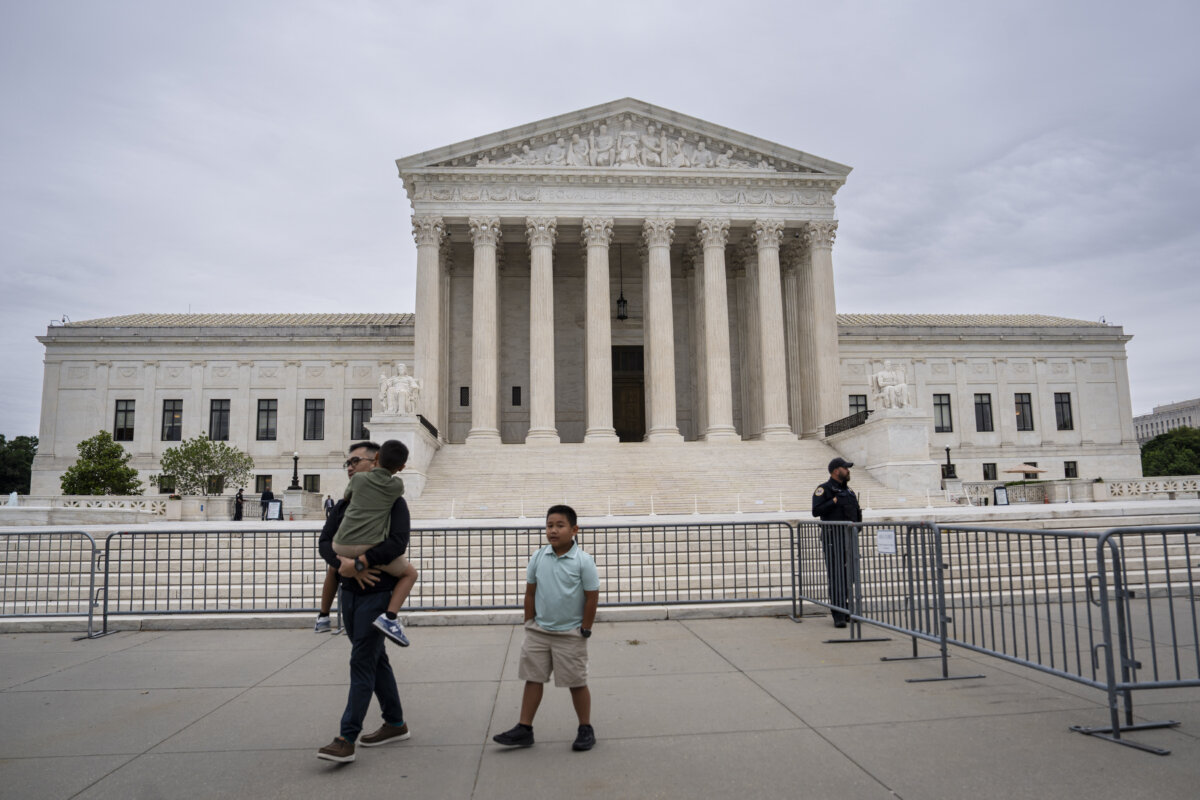

The U.S. Supreme Court on June 1 decided not to allow Florida to sue California over its business tax policy, which it claimed unfairly deprives it and other states of tax revenue.
California created “an unconstitutional business income apportionment scheme that rewards corporations that keep their operations in California and penalizes those that move out,” Florida said in its bill of complaint filed with the high court in October 2025. Florida had asked the court to declare the policy unconstitutional.
The new ruling was issued as an unsigned order. The court did not explain its decision.
The Constitution gives the Supreme Court original jurisdiction over disputes between states, or the authority to hear such disputes as a court of first impression.
In such cases, the court often appoints a judicial officer, a special master, to hear the case and issue a recommendation to the justices on how to rule. A state that wishes to sue another state must seek approval from the court before being allowed to proceed.
Justices Clarence Thomas and Samuel Alito dissented from the decision not to allow the case to move forward.
Florida had asked the nation’s highest court to review California’s rule requiring that businesses exclude proceeds from “substantial and occasional” sales from their state tax filings.
The California Franchise Tax Board rule that Florida objects to relies on a single-sales factor apportionment formula for multi-state corporations.
Apportionment refers to the method that states use to calculate how much of a multi-state corporation’s income is taxable in each state in which it operates. The rule means that a company’s taxable income in California is based mostly on the percentage of its sales that take place in the state.
The rule allows corporations to exclude proceeds from “substantial and occasional” sales of assets or property from the sales factor calculation. A sale is deemed substantial if excluding it reduces the sales factor by 5 percent or more.
Florida argued that excluding such large out-of-state sales from a corporation’s total nationwide sales permits California to tax profits earned outside its borders and violates the U.S. Constitution, including the commerce clause.
California urged the court to reject the case.
The state said in a brief that the case should not move forward because it is “not an appropriate case for the exercise of this Court’s original jurisdiction.”
Florida has not proven that it has standing to warrant Supreme Court intervention in the case, California stated.
“And Florida’s claims fail on the merits,” the brief from California reads. “As this Court has repeatedly emphasized, ‘States have wide latitude in the selection of apportionment formulas.’”
Thomas wrote a brief dissent, which Alito joined.
Thomas said he was dissenting for the same reasons he provided in Nebraska v. Colorado (2016).
In that case, the Supreme Court declined to allow Nebraska and Oklahoma to sue Colorado over the legalization of recreational marijuana. The two states claimed Colorado’s action violated the federal Controlled Substances Act.
“Federal law does not, on its face, give this Court discretion to decline to decide cases within its original jurisdiction,” Thomas wrote in that dissent 10 years ago.
“Because our discretionary approach to exercising our original jurisdiction is questionable, and because the plaintiff States have made a reasonable case that this dispute falls within our original and exclusive jurisdiction, I would grant the plaintiff States leave to file their complaint,” he added.
On May 26, the Supreme Court denied Florida permission to sue California and Washington state over their policy of ignoring federal rules regarding the issuance of commercial driver’s licenses.
Thomas and Alito again dissented.
“I doubt this Court has discretion to refuse to hear cases within its exclusive original jurisdiction,” Thomas said.
“This Court declines to even hear Florida’s claims, even though it has nowhere else to bring them.”
 Friends Read Free
Copy
Facebook
Tweet
Friends Read Free
Copy
Facebook
Tweet