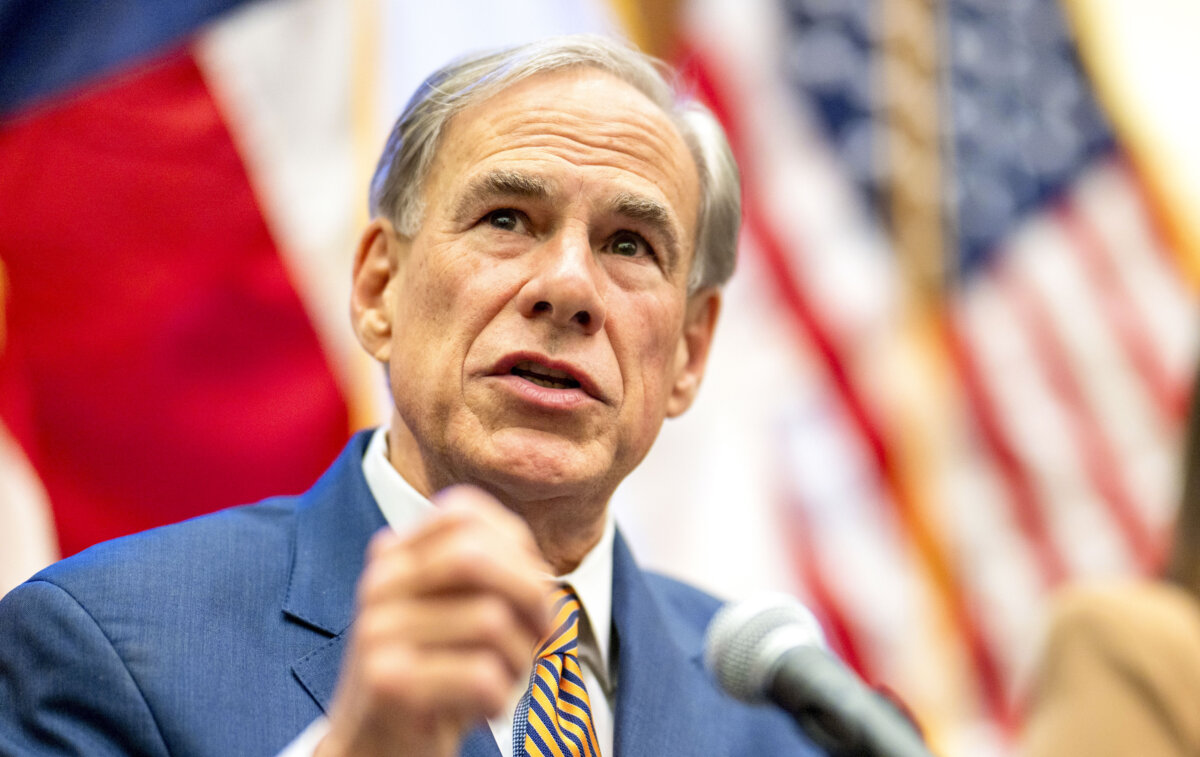

Texas Gov. Greg Abbott on Monday directed the Texas Water Development Board (TWDB) to punish data centers and other large water users that have failed to file required usage surveys, and to use its authority if they miss the same reports again.
The governor’s office said those operators “appear to have committed civil and criminal violations” by withholding information the board needs to write the state water plan.
The Texas Water Code requires recipients of a TWDB survey to complete and return it, and failure to do so could be treated as a crime. Failure to complete the surveys on time can result in a facility losing eligibility for Texas Commission on Environmental Quality (TCEQ) permits, amendments, or renewals under Chapter 11 of the Water Code.
Abbott told the board to enforce those remedies, including referring the matter to a county or district attorney and notifying the TCEQ that a permit might be barred.
“Data centers must share the duty to protect Texas water,” Abbott said. “The Texas Water Code requires a complete and accurate water use survey. I direct the Texas Water Development Board to use its enforcement authority to penalize past failures and to impose legal consequences for any future failure to comply.”
The letter was addressed to TWDB Chairwoman L’Oreal Stepney and Executive Administrator Bryan McMath. The board has to brief the governor’s office by Oct. 14 on enforcement work, then send regular updates, including when a related audit ordered in early August is finished.
The commission did not immediately return a request for comment.
This is not the first time Abbott has called for increased scrutiny of data centers. On Aug. 3, he ordered the Public Utility Commission of Texas (PUCT) and the Electric Reliability Council of Texas (ERCOT) to audit every data center along ERCOT’s interconnection queue. That review is intended to cover water consumption, where the water comes from, and whether plants use water-efficient cooling. A project that does not finish the audit is supposed to be denied a grid hookup.
Monday’s letter tells TWDB to work with PUCT and ERCOT on the same water questions. If a company fails to meet that request, the water board can act.
ERCOT has been reviewing about 474 gigawatts of new electricity demand, which is more than five times the state’s record peak. Abbott has said roughly 90 percent of those requests come from data centers.
Texas already sits near the top of the national count for data centers, with Data Center Map figures placing the state at a combined 544 operating, under-construction, and planned facilities. It trails only Virginia.
Clayton Tucker, secretary of the Texas Farmers Union, told The Epoch Times previously that he worries about irrigation wells.
“It can cost up to $40,000 to drill for a new well, and some of these centers are water hogs, using incredible amounts of water here in the Dust Bowl,” Tucker said, adding that some wells in the state have already dropped by 25 feet.
“Some of these centers are like building an entire new city, and power usage is expected to triple or quadruple by 2032.”
Tucker said local councils in Athens and San Marcos have paused projects.
“Our main goal is to delay these projects and wait for better technology,” he said. “A lot of times, developers don’t tell you the whole truth.”
Research by Sergio Toro, CEO of market intelligence group Aterio, found hundreds of planned or under-construction sites in water-stressed states, such as Texas. Hyperscale plants built for AI workloads have been estimated to consume about 200 million gallons of water a year.
Attorney General Ken Paxton, now running for U.S. Senate, said in August he wants closed-loop cooling required and data centers barred from rural neighborhoods. He said data centers should “fund their electricity and ensure they are adding to Texas’ electric capacity, not detracting from it, and mandate closed-loop water systems for cooling.”
 Friends Read Free
Copy
Facebook
Tweet
Friends Read Free
Copy
Facebook
Tweet