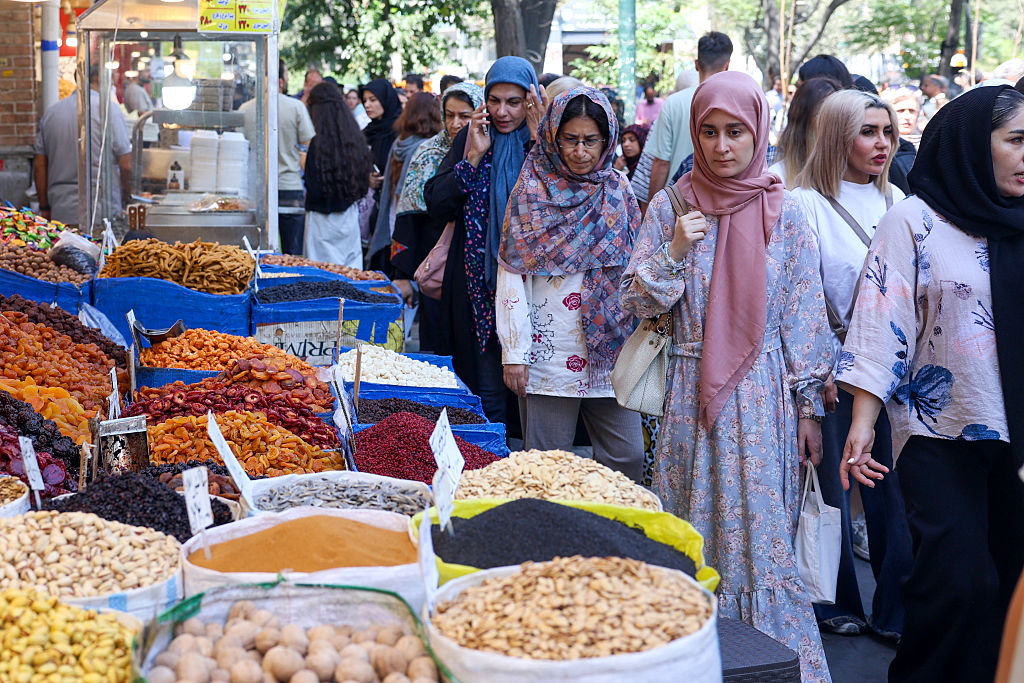

Over the course of three weeks, Iran’s rial has lost more than a quarter of its value while Iranians are reporting job losses, rising fuel and transportation costs, shortages of vehicle parts, and growing difficulty paying for medicines and everyday necessities.
The deterioration comes as the United States steps up economic pressure on the Islamic regime, seeking to cut it off from revenue and financial networks abroad.
On Aug. 24, the Treasury Department announced its “Economic Outcast” campaign, sanctioning 24 individuals, 48 companies and entities, and six vessels linked to the Iranian regime. The measures also target digital assets and expand efforts to disrupt the networks Tehran uses to sell oil and move money through third countries.
Treasury Secretary Scott Bessent called the campaign an “economic D-Day” against the Islamic regime.
“We are launching an economic onslaught against Iran’s financial connections around the globe,” Bessent said at a press conference in Washington Aug. 24. “Our objective is to sever every economic lifeline that sustains this tyrannical regime until Tehran stands alone.”
Bessent said the Treasury had identified intermediaries and financial routes used by Tehran to evade sanctions and was seeking to prevent revenue from reaching the regime.
In the weeks since the campaign began, economic conditions in Iran have worsened, but the latest U.S. measures are not the only source of pressure. The war, the U.S. naval blockade, previous sanctions, and Iran’s longstanding economic problems are also contributors.
Iran’s economic problems go back nearly 47 years, to the 1979 Islamic Revolution. Since then, Iranians have faced persistent high inflation, a weakening currency, unemployment, sanctions, and other economic problems.
As of mid-September, the dollar was trading at around 2,350,000 rials on Iran’s open market. In the week before the U.S. campaign was announced, it was at about 1,865,000 rials, meaning the rial lost more than 25 percent of its value in roughly 20 days.
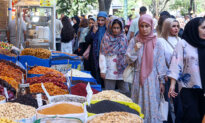
As the rial loses value, Iranians are losing purchasing power and paying more for imported goods.
The Workers’ House in Hormozgan province has reported that about 20,000 workers have become unemployed amid business closures and a slowdown in economic activity.
Esmail Hajizadeh, executive secretary of the Workers’ House in Hormozgan, said on Aug. 28 that the five-star Persian Gulf Hotel in Bandar Abbas had dismissed all of its employees after being closed for four months. Companies operating at Shahid Rajaee port, Iran’s largest commercial port, have also reduced their workforces.
Workers and customs clearance agents at the port told the Iranian Labour News Agency that many contractors had scaled back operations or dismissed employees following a decline in shipping as a result of the war.
One woman in Tabriz told The Epoch Times in a message, on condition of anonymity for fear of retaliation, that both she and her husband had recently been laid off.
“I was a nurse and my husband worked at a refinery, but recently both of us were laid off, and now we have no jobs or source of income,” she said.
She blamed the Islamic regime for the worsening economic conditions, saying it placed little value on the livelihoods of ordinary Iranians and had deprived many families of jobs and sources of income.
The woman said she and her husband had decided to leave Iran with their two young children because they could no longer tolerate the situation.
“Why should we have to live like this? Why should we lose our jobs and our source of income?” she said. “Why should we be forced to emigrate and leave our homeland just to have an ordinary life?”
She described the regime as “corrupt and incompetent,” saying she believes that overcoming the current system is the only way for Iranians to have “a normal life without constant worries.”
Fuel and Medicine
Meanwhile, truck drivers, often considered the lifeblood of a country’s economy, say it is becoming more expensive to stay on the road.
On Sept. 6, the Iranian regime doubled gasoline prices, adding to transportation costs at a time when drivers were already facing reduced fuel allocations and rising prices for vehicle parts.
A truck driver from Chaharmahal and Bakhtiari province told The Epoch Times, on condition of anonymity for fear of retaliation, that the cost of keeping his truck on the road had risen sharply.
“The price of fuel keeps going up every day, while our fuel quota keeps getting smaller,” he said. “Many vehicle components and spare parts are scarce, and their prices have become astronomical.”
He also said obtaining insurance services had become difficult, while road tolls and fines continued to add to drivers’ expenses.
“It is perfectly clear that the Islamic Republic and the government-affiliated organizations do not value us drivers and truckers,” he said. “We are not willing to remain silent in the face of this government oppression and the violation of our rights.”
Shayan Samii, a national security analyst, said the U.S. naval blockade of Iran was adding to the financial pressure on Tehran.
“The naval blockade has closed off the Islamic Republic’s economic lifeline,” Samii told The Epoch Times. He pointed to gasoline lines in Iranian cities as one of the visible signs of the economic strain.
“When we see long gasoline lines in large cities and small towns, we see what happens when people are squeezed, when gasoline prices rise sharply, when the prices of goods go up, and when people can no longer afford to buy,” he said.
Iranian Health Minister Mohammad Reza-Zafarghandi said on Sept. 14 that 32 pharmaceutical products were in short supply, including imported medicines and drugs that have domestic equivalents.
When medicines cannot be imported by sea, he said, shipments have to be moved in several stages by air and then overland, raising transportation costs to 10 times their normal level.
Meanwhile, Iran’s Pharmacists Association has said that prices of domestically produced medicines have risen by about 150 percent since mid-March.
Although medicines are generally exempt from U.S. sanctions, importing them has become more expensive amid transportation disruptions, the weakening rial, and difficulties making international payments.
Pressure on Security Forces
The Trump administration has also sought to speak directly to members of Iran’s military and security forces.
At the Aug. 24 press conference, Bessent suggested that some Iranian soldiers could soon face delayed or missing salaries.
“To the ordinary soldiers supporting this regime: as more and more of your paychecks stop or are supposedly ‘just delayed,’ ask whether your commanders are leading your country to triumph or to ruin,” he said. “And recall that the Berlin Wall fell when ordinary soldiers decided not to shoot [at their own people].”
Samii said economic pressure could become a problem for the regime if members of the security forces begin questioning their commanders.
“When those forces don’t receive their salaries, they look at their commanders, who themselves are looking for an escape route, and that sense of hopelessness grows,” he said, adding that Bessent’s reference to the Berlin Wall was a direct message to members of Iran’s Basij and the Islamic Revolutionary Guard Corps.
“Bessent is sending a message to those same forces of repression,” Samii said. “He is telling them that this can happen through you, that if you don’t attack your own people now, you may survive the collapse of the government tomorrow.”
Bijan Kian, a national security expert, said the pressure should be directed at the regime rather than Iranian civilians, and that some members of Iran’s armed forces, including the Islamic Revolutionary Guard Corps, may eventually refuse to continue defending the government.
“There are people in the army, and even in the Revolutionary Guards, who are human beings and who have come to the conclusion that this system cannot be kept alive by killing Iranians until the very end,” he told The Epoch Times Persian. “Those military personnel should be embraced.”
 Friends Read Free
Copy
Facebook
Tweet
Friends Read Free
Copy
Facebook
Tweet