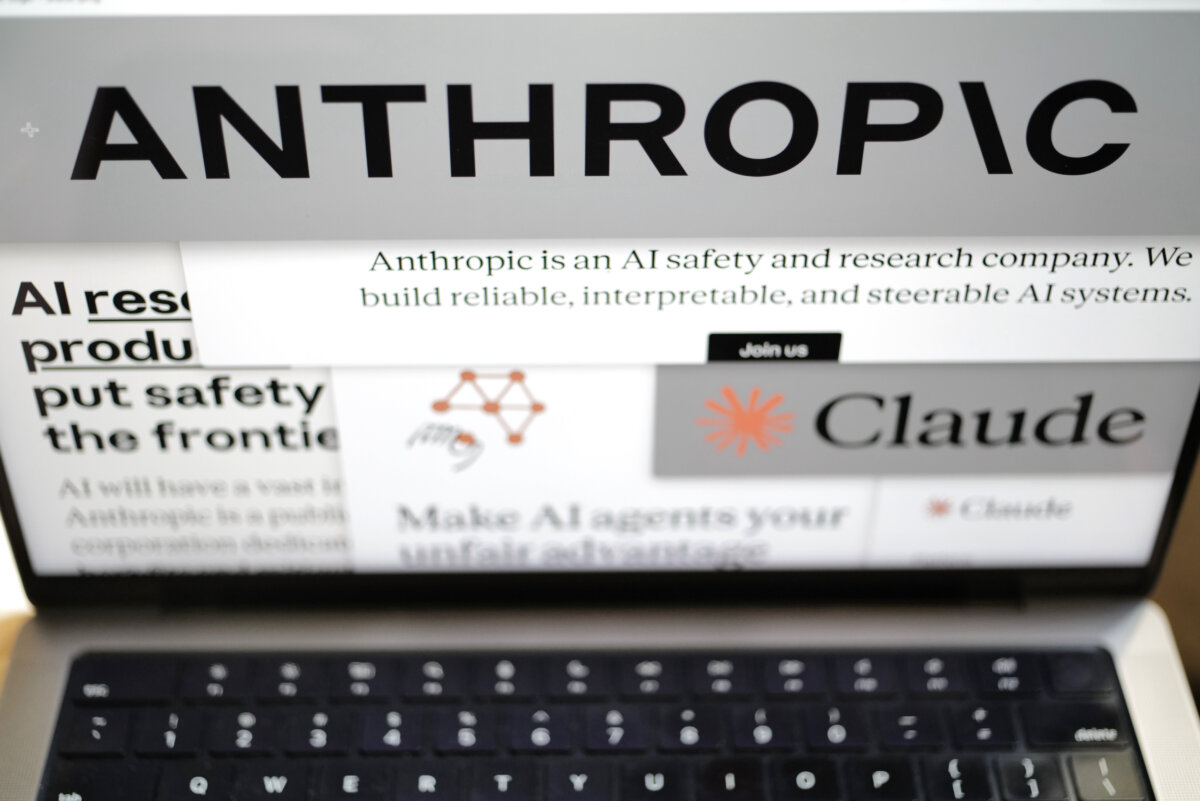

The U.S. Treasury Department will end all use of Anthropic products in the latest standoff between the federal government and the artificial intelligence (AI) company.
Treasury Secretary Scott Bessent announced the move on March 2, saying the ban applies across the department and is part of a broader federal move by President Donald Trump directing agencies to stop using the company’s technology.
“The American people deserve confidence that every tool in government serves the public interest, and under President Trump no private company will ever dictate the terms of our national security,” Bessent said in a post on X.
William Pulte, director of the Federal Housing Finance Agency, also announced on X that his agency and government-sponsored mortgage enterprises Fannie Mae and Freddie Mac are terminating all use of Anthropic products.
Anthropic, a San Francisco-based startup with a stated focus on AI safety, is now locked in a showdown with the Trump administration over the guardrails it has placed on its AI tools, including its flagship product Claude. The company has stated that it is drawing red lines around the use of its systems in what it described as “mass surveillance” and “fully autonomous weapons,” while the Pentagon has insisted that the company must accept “any lawful use” of its tools and technology to support the U.S. military.
Anthropic’s CEO, Dario Amodei, declared on Feb. 26 that his company would rather not work with the Pentagon than agree to give the U.S. military unfettered access to its AI tools. That refusal prompted War Secretary Pete Hegseth to direct his department to designate Anthropic a supply chain risk, meaning that the company would be considered not secure enough for government use.
Both Trump and Hegseth announced their moves against Anthropic on social media. The war secretary said on X that he would bar any military contractor from engaging in “any commercial activity with Anthropic.” In a separate statement on Feb. 27, Trump said that the United States would “never allow a radical left, woke company to dictate how our great military fights and wins wars,” arguing that such decisions belong to the commander-in-chief and his chosen leaders.
Trump also gave all government networks six months to phase out Anthropic’s products.
In response, Anthropic stated that being designated a supply chain risk “would both be legally unsound and set a dangerous precedent for any American company that negotiates with the government.”
“No amount of intimidation or punishment from the Department of War will change our position on mass domestic surveillance or fully autonomous weapons,” the company stated. “We will challenge any supply chain risk designation in court.”
Anthropic’s rival OpenAI announced on Feb. 27 that it had reached its own deal with the Pentagon for AI models to be deployed in classified environments.
Over the weekend, hundreds of members of the tech industry signed an open letter urging the War Department to withdraw its plans to designate Anthropic as a supply chain risk. The letter also calls on Congress to “examine whether the use of these extraordinary authorities against an American technology company is appropriate.”
Among the signatories are dozens of OpenAI employees. Boaz Barak, a computer science professor at Harvard University and researcher at OpenAI, wrote on X that he shares Anthropic’s red line of blocking governments from using AI for mass domestic surveillance, saying that the technology “should be all of ours.”
“If anything good can come out of the events of the last week, it would be if we in the AI industry start treating the issue of using AI for government abuse and surveilling its own people as a catastrophic risk of its own right,” he wrote.
 Friends Read Free
Copy
Facebook
Tweet
Friends Read Free
Copy
Facebook
Tweet