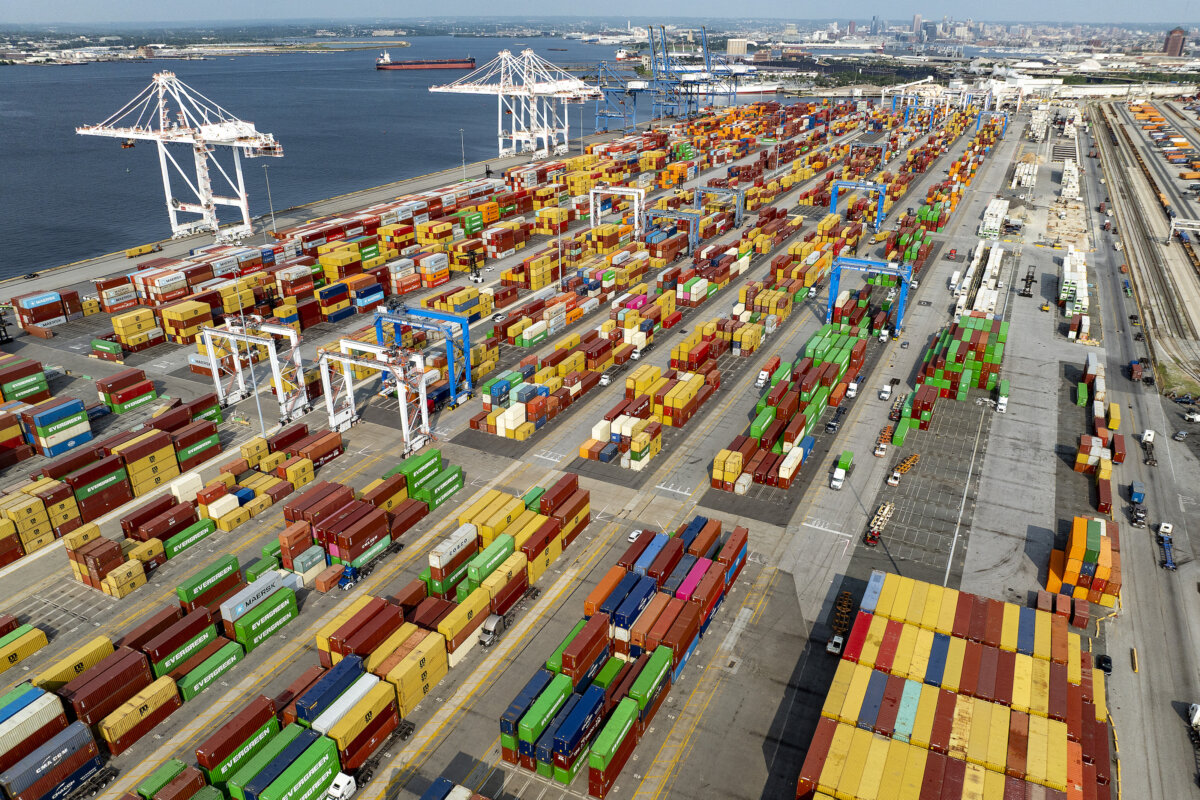


The Trump administration asked the Supreme Court on the night of Sept. 3 to review a lower court order that struck down most of President Donald Trump’s global tariffs.
A divided federal appeals court, the U.S. Court of Appeals for the Federal Circuit, ruled 7–4 on Aug. 29 in V.O.S. Selections Inc. v. United States and Oregon v. Trump that the president had overstepped his authority when he imposed reciprocal tariffs on imports from U.S. trade partners in April using the International Emergency Economic Powers Act (IEEPA).
On Sept. 3, the Trump administration filed a petition for certiorari at the Supreme Court to challenge this ruling, asking the court to review what the president described as “one of the most important” cases to go before the tribunal.
In a separate motion, the government asked the Supreme Court to expedite its consideration of the review, the administration said in its appeal.
“This Court should grant certiorari, expedite consideration of the merits, and reverse,” the administration wrote.
In the appeal, Treasury Secretary Scott Bessent said that letting the decision to take effect “would lead to dangerous diplomatic embarrassment,” “expose the United States to the risk of retaliation,” and “interrupt ongoing negotiations midstream, undermining [the administration’s] ability to protect the national security and economic welfare of the American people.”
That’s because the Trump administration has been using tariffs as diplomatic leverage, allowing the United States to respond to national emergencies arising from mass importation of fentanyl and other illegal drugs “that have taken hundreds of thousands of American lives,” as well as decades of trade deficits that are undermining U.S. manufacturing capacity and military readiness, the administration wrote in its appeal.
The Federal Circuit said the president overstepped his authority when he imposed tariffs via the IEEPA, because Congress likely did not intend to give this much power to the commander-in-chief.
“The statute bestows significant authority on the President to undertake a number of actions in response to a declared national emergency, but none of these actions explicitly include the power to impose tariffs, duties, or the like, or the power to tax,” the court said in its Aug. 29 ruling. “Whenever Congress intends to delegate to the President the authority to impose tariffs, it does so explicitly.”
The Trump administration wrote in its Sept. 3 appeal that the Supreme Court “has long approved broad congressional delegations to the President to regulate international trade, including through tariffs” and that the statute’s authorization of the president to regulate importation encompasses the power to impose tariffs.
The president told a group of reporters during a White House meeting with Polish President Karol Nawrocki on Sept. 3 that he thinks the U.S. government will “have a big victory.”
“Tariffs are vital to our country. Just so you know, other countries use them on us, but I just use them a lot better,” Trump said, hours before the administration appealed to the high court.
Meanwhile, those opposing the tariffs say that they hurt small businesses in the United States.
“These unlawful tariffs are inflicting serious harm on small businesses and jeopardizing their survival,” Jeffrey Schwab, senior counsel at the Liberty Justice Center, the organization that represented small businesses that brought one of the lawsuits, said in a statement. “We hope for a prompt resolution of this case for our clients.”
The Associated Press contributed to this report.
 Friends Read Free
Copy
Facebook
Tweet
Friends Read Free
Copy
Facebook
Tweet