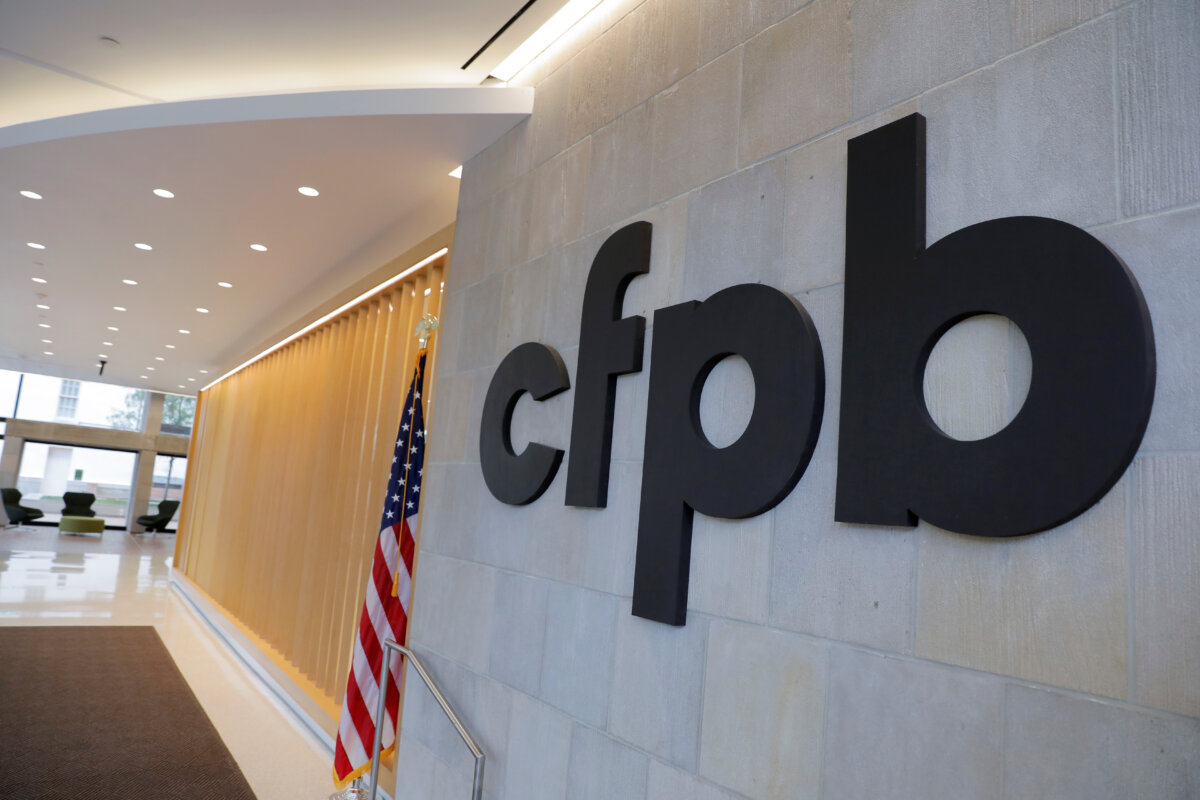

The Trump administration has deemed the funding for the Consumer Financial Protection Bureau (CFPB) to be unlawful, potentially putting the agency on a track to close.
A Nov. 10 court filing disclosed the Department of Justice finding, which is the most recent attempt by President Donald Trump’s administration to shut down the agency.
It’s the CFPB’s job to implement and enforce federal consumer financial laws and ensure that markets for consumer financial products are transparent and fair, according to the agency’s website.
The agency works independently of the government.
The administration said in its filing that it considers the bureau legally barred from seeking funding from the Federal Reserve, which is the typical monetary source for the agency.
The court documents indicated that the agency has “at least” enough money to last through the end of the year but “anticipates exhausting its currently available funds in early 2026.”
If no alternative is found, a lack of funds to cover operational costs would likely shutter the agency, unless Congress passes new funding.
A move by Congress is not considered likely, given Republican control of the legislative branch and the general party opposition to the CFPB.
Funding for the bureau is supplied by the Dodd-Frank Act, which states that the Fed should transfer from the “combined earnings of the Federal Reserve System” whatever the CFPB director believes is necessary for operations.
However, the Department of Justice argues that the “combined earnings” refers to profits and that “if the Federal Reserve has no profits, it cannot transfer money to the CFPB.”
The CFPB was established under, and signed into law by, President Barack Obama in 2010 as an attempt to curb predatory lending during the 2007–2009 financial crisis.
Several court cases regarding funding for the CFPB have already been decided in the agency’s favor, including a Supreme Court case from May 2024.
The Supreme Court upheld the agency’s funding in a 7–2 decision. Justice Clarence Thomas said that the funding design was constitutional in nature.
“The statute that authorizes the bureau to draw money from the combined earnings of the Federal Reserve System to carry out its duties satisfies the Appropriations Clause,” Thomas wrote.
The Justice Department is now arguing, however, that although taking operational expenses from the “combined earnings of the Federal Reserve System” might be constitutional, if the Federal Reserve has no profits, there can be nothing for CFPB to draw from.
The administration has made it known for months that the White House wants to dismantle the agency. A Feb. 10 article from the White House asserted that the CFPB “used its slush fund … to support radical advocacy groups.”
Other reasons the Trump administration has taken offense with the agency include the accusation that the agency is mining American citizens’ personal financial information and that it granted itself “broad new powers” while under the previous administration.
Just weeks after the Trump administration took over the White House, the bureau was ordered to stop all activities by Treasury Secretary Scott Bessent.
Bessent was made acting director of the agency and put a freeze on all rule-making, enforcement investigations, and litigation against financial institutions until the Trump administration could investigate its inner workings.
The agency was targeted by the Department of Government Efficiency and its head at the time, Elon Musk.
“CFPB RIP,” Musk wrote on X on Feb. 7.
He wrote in another post, “They did above zero good things, but still need to go.”
Sen. Elizabeth Warren (D-Mass.) recently spoke out against how the agency is being run under the Trump administration, saying in a social media post: “This year, the CFPB brought the fewest cases against big banks and giant companies for cheating consumers in the history of the bureau.
“Trump and his hatchet man Russ Vought are letting grifters and scammers off the hook—and trying to kill the agency that would hold them accountable.”
In August, the Trump administration secured a legal victory when a federal appeals court lifted an order that kept the government from cutting CFPB staff.
Warren again responded to the DOJ’s assessment of the CBPF funding on Nov. 11, saying: “This is absurd and plainly illegal. The courts should reject this fringe theory.”
The lawmaker said that Trump was attempting to “kill an agency that has returned more than $21 billion to scammed Americans.”
 Friends Read Free
Copy
Facebook
Tweet
Friends Read Free
Copy
Facebook
Tweet