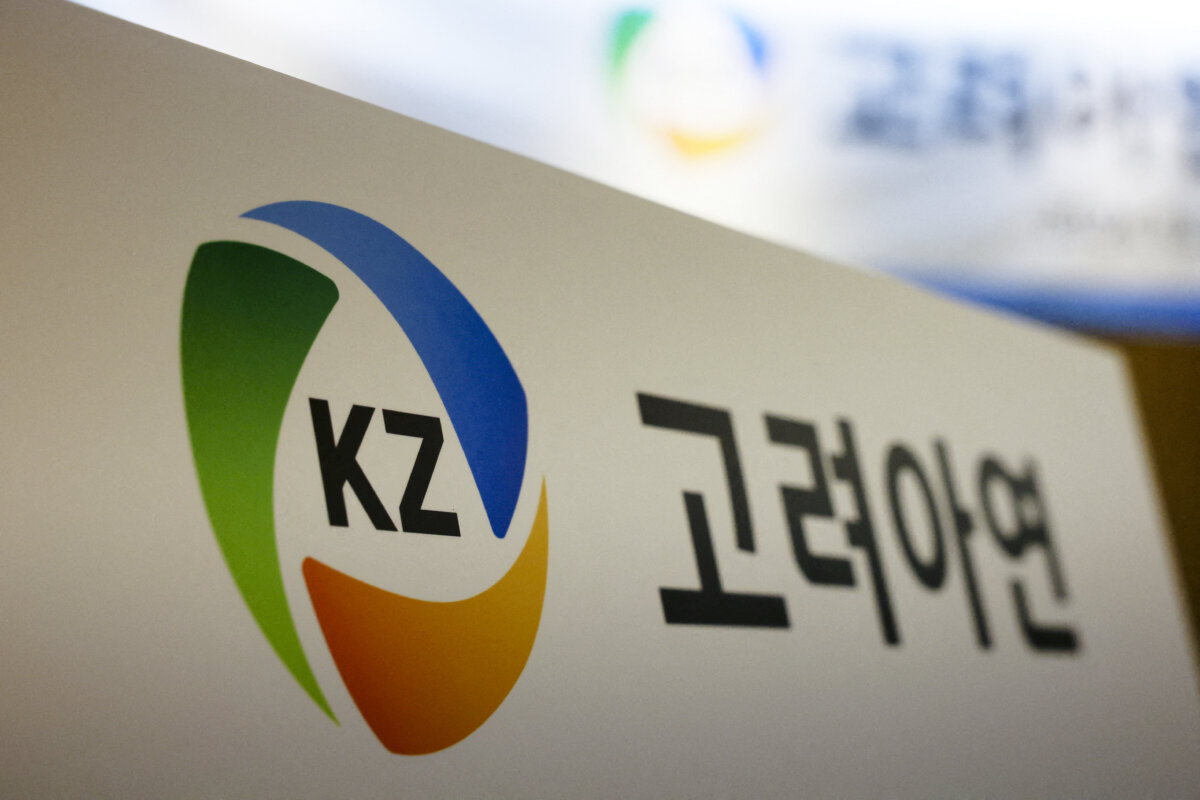

The Trump administration’s ongoing efforts to onshore the production of critical minerals took another step forward on Dec. 15 with the announcement that the world’s largest zinc smelter would be building a multibillion-dollar mineral smelting and processing facility in Tennessee.
Korea Zinc Co.’s $7.4 billion zinc smelter will produce as much as 540,000 tons of essential minerals per year, Commerce Secretary Howard Lutnick said in a post on X.
In addition to zinc, gold, silver, copper, and lead, the facility will produce critical minerals such as gallium, germanium, and antimony, which are used in the production of semiconductors and advanced chips, as well as fiberoptics and thermal-imaging cameras.
“These minerals power the technologies that matter most for our future: defense systems, semiconductors, artificial intelligence, quantum computing, autos, data centers, and advanced manufacturing,” Lutnick said.
Currently, much of the world’s supply of gallium and germanium comes from China, which banned exports of the minerals in late 2024 but lifted the ban last month.
Korea Zinc will operate in the United States under a joint venture called Crucible JV LLC, the company said in regulatory filings.
Approximately $1.9 billion will come from a mix of investors, including the U.S. government; Kataman Metals LLC of St. Louis; Ark Energy Macintyre Pty Ltd. of Sydney; Sun Metals Corporation of Townsville, Australia; and U.S.-based Crucible Metals, the filing said.
Currently, there is only one zinc smelter in operation in the United States.
Nyrstar of Budel-Dorplein, Netherlands, said in a statement on Dec. 15 that it plans on selling its fully permitted smelter operations in Clarksville, Tennessee, to Korea Zinc. Terms of the sale weren’t disclosed; however, zinc produced at the smelter in 2026 will be sold to Nyrstar parent Trafigura of Singapore.
The deal, pending regulatory approval, is expected to close in the first half of 2026. Nyrstar’s operations in Tennessee have been running for nearly 50 years. Now, Korea Zinc plans on building a new state-of-the-art smelter, the company said.
“This transaction would enable a secure and stable US zinc and zinc by-products supply for the future,” Nyrstar CEO Guido Janssen said.
“Korea Zinc is a world leader in smelting technology, and we are confident they will build on the strong foundations Nyrstar has laid in the State of Tennessee.”
The announcement with Korea Zinc is among a handful of deals the Trump administration has inked to boost domestic mining production.
In July, MP Minerals of Las Vegas announced a public-private partnership with the Department of War to build a magnet manufacturing facility.
In October, the Department of Energy took a 5 percent stake in Lithium Americas, as well as an additional 5 percent stake in the company’s lithium mine that’s under construction in central Nevada.
The administration in October also announced a $35.6 million partnership and 10 percent stake in Trilogy Metals to advance mining operations in Alaska’s remote Ambler Mining District.
Jarrod Agen, executive director of the National Energy Dominance Council, said during a critical minerals conference on Dec. 15 that more public-private deals are likely to follow as the Trump administration works to reduce the United States’ dependence on foreign suppliers of critical minerals.
“We are tracking very closely what minerals we need, what we are behind and need to ramp up on. We take a very methodical approach across the board, across the periodic table,” Agen said.
“From technology to autos to defense, it is across the board a huge urgency to make sure our supply chain and the critical minerals they need are flowing. You are going to see throughout this administration historic deals when it comes to critical minerals [and] historic partnerships with the private sector and a revitalization of mining in this country.”
 Friends Read Free
Copy
Facebook
Tweet
Friends Read Free
Copy
Facebook
Tweet