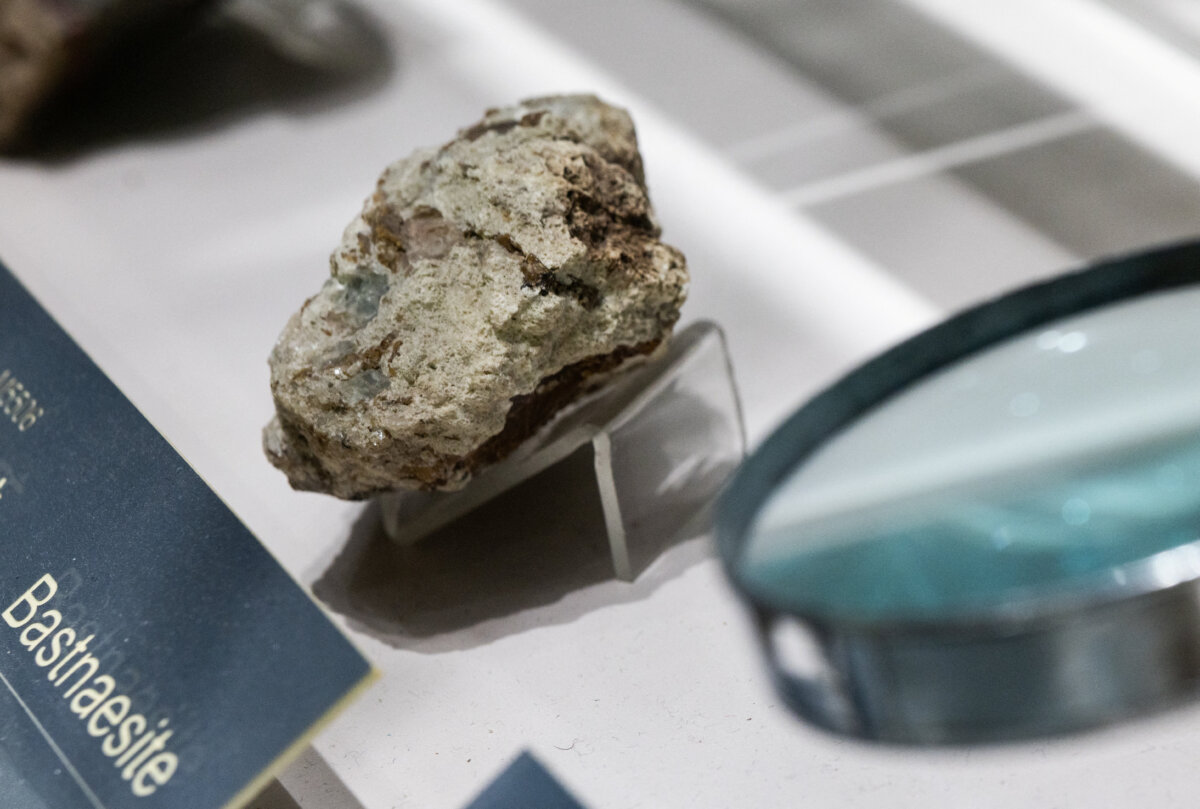

The Department of the Interior (DOI) and the U.S. Geological Survey (USGS) released its final 2025 List of Critical Minerals on Thursday, identifying 60 minerals that are “essential to our economy, national security and way of life,” Interior Secretary Doug Burgum said in a Nov. 6 post on X.
“Under [President Donald Trump’s] leadership, we are restoring American mineral independence. The 2025 List is a bold, data-driven roadmap to reduce dependence on foreign adversaries and unleash U.S. innovation!” Burgum said.
“In 2024, the U.S. imported 80 percent of the rare earth elements we used. That’s a risk we can’t afford. We are investing in domestic production and securing access through trusted global partnerships!”
According to a Nov. 6 report by USGS, the 2025 list contains 50 critical minerals from the previous 2022 list. It also features 15 rare earth elements.
The 60 critical minerals in the new list power everything from advanced tech, smartphones, defense systems, and energy grids, making them important for keeping America strong, competitive, and secure, Burgum said.
The 10 new minerals added to the list are silver, copper, uranium, boron, potash, phosphate, lead, rhenium, silicon, and metallurgical coal.
USGS is mapping out new deposits while advancing material science to better understand how the United States can mine these resources within the country in a responsible manner, said Burgum.
Earlier this year, Trump signed an executive order aimed at boosting the mining and production of critical minerals in the country.
During the signing ceremony on March 20, Trump said the order would “dramatically increase” the production of rare earths and critical minerals in the United States.
“It’s a big thing in this country,” he said. “We’re also signing agreements in various locations to unlock rare earths and minerals and lots of other things all over the world.”
The new list was created after assessing 84 mineral commodities and analyzing more than 400 industries and over 1,200 trade disruption scenarios, USGS said.
“Each mineral commodity is then categorized by its risk of a trade disruption,” it said.
“If the risk is high, elevated, or moderate, the commodity is proposed for inclusion on the List.
“If the risk is limited, negligible, or negative, the commodity is then assessed for a single point of failure in the supply chain. If there is a single domestic producer for that commodity, it is proposed for inclusion on the List.”
Minerals such as rhodium, gallium, germanium, and potash, and rare earths such as terbium, dysprosium, yttrium, and gadolinium, are determined as having the “highest risk” of supply chain disruption, said the agency, noting that many of the critical minerals that the United States relies on via imports are available within the country in some form.
However, due to economic, policy, or geological challenges, these minerals have not yet been extracted, USGS said, adding that it was currently identifying and mapping domestic critical mineral resources.
“The 2025 List represents the most comprehensive, science-based assessment to date of the minerals our nation depends on. These resources support industries worth trillions of dollars, and reducing import reliance is critical to U.S. economic and technological leadership,” Burgum said.
China Threat
China’s control over the market for critical minerals and rare earths poses a strategic threat to the United States.
According to an analysis of USGS data by Statista, China had a 99 percent share in the mining or production of gallium, 95 percent of magnesium, 83 percent of tungsten, 79 percent of natural graphite, 69 percent of rare earths, and 60 percent of aluminum in 2024.
Beijing has leveraged this dominance against other nations. During a diplomatic dispute with Japan in 2010, China imposed export controls on rare earths.
In April this year, Beijing expanded its export control list. And last month, it announced sweeping restrictions covering even products containing trace amounts of rare earths, which Trump said was a hostile action against the world. It later suspended those restrictions for a year.
Earlier this month, Trump said the United States would end its dependence on Chinese rare earth minerals within 18 months.
In July, a group of lawmakers introduced bipartisan legislation on securing critical minerals supply chains for the United States, according to a July 30 statement from the Senate Foreign Relations Committee.
The bill authorizes the president to establish an international coalition to coordinate the mining and processing of critical minerals, it said.
“This summer, China demonstrated the capability and willingness to deprive the world of critical minerals that are critical for our economic prosperity and our military preparedness,” said Sen. Jeanne Shaheen (D-N.H.), one of the lawmakers backing the bill.
“The United States cannot solve its critical minerals supply chain challenges alone. Rather, we must coordinate closely with our allies and partners, and this bipartisan legislation will support those efforts.”
The United States recently signed a $3 billion critical minerals partnership with Australia to counter China’s dominance in the sector.
On Nov. 6, Trump hosted leaders of five Central Asian Nations—Kazakhstan, Kyrgyzstan, Tajikistan, Turkmenistan, and Uzbekistan—at the White House, with talks focused on the issue of critical minerals.
During the meeting, Trump said he intended to strengthen America’s partnership with these nations.
“One of the key items on our agenda is critical minerals. In recent weeks, my administration has strengthened American economic security by forging agreements with allies and friends across the world to broaden our critical mineral supply chains,” he said.
Tajik President Emomali Rahmon said during the meeting that his country possesses an abundance of various critical minerals, including metallic antimony, which he said “the United States is deeply interested in.”
 Friends Read Free
Copy
Facebook
Tweet
Friends Read Free
Copy
Facebook
Tweet