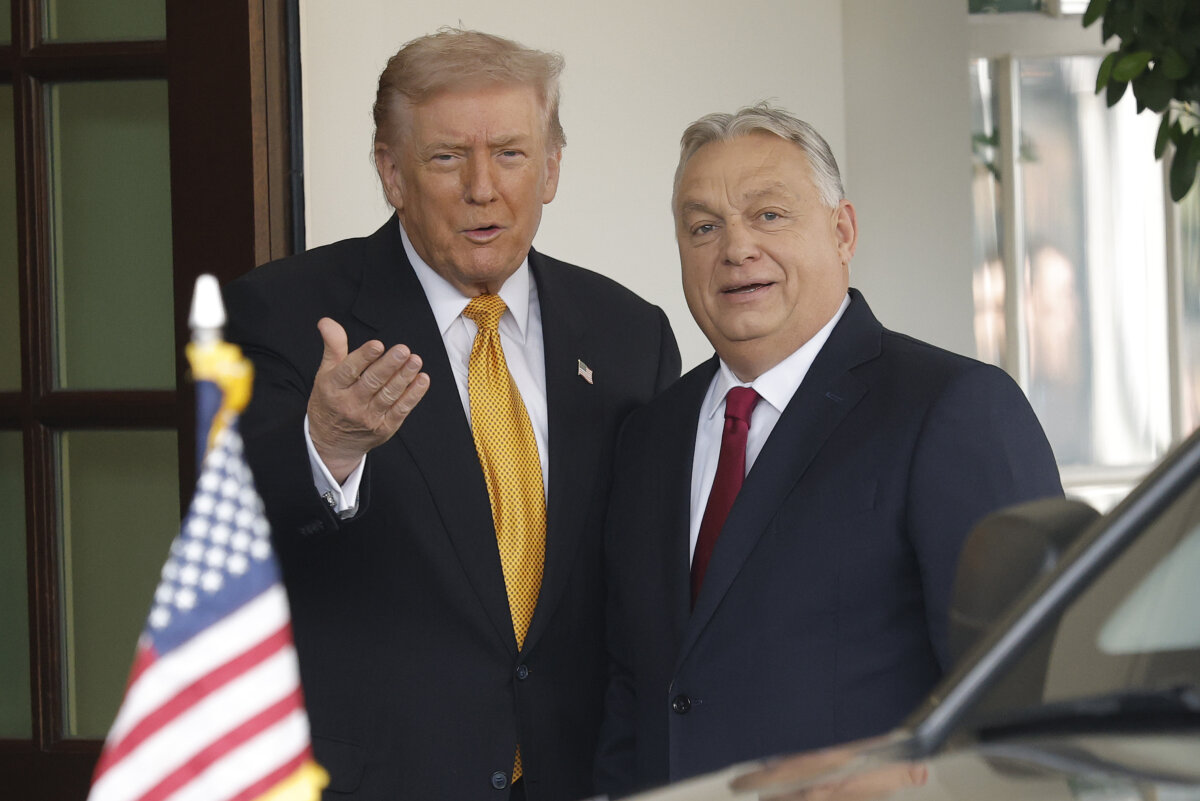

WASHINGTON—U.S. President Donald Trump granted Hungary exemptions from sanctions on Russian energy during a White House meeting on Nov. 7 with Hungarian Prime Minister Viktor Orban.
After discussions with the president, Orban told Hungarian media that Hungary had “been granted a complete exemption from sanctions” affecting Russian gas delivered from the TurkStream pipeline and oil from the Druzhba pipeline.
“We asked the president to lift the sanctions,” Orban said. “We agreed and the president decided, and he said that the sanctions will not be applied to these two pipelines.”
Hungary agreed to buy U.S. liquefied natural gas as part of the discussions, the State Department said in a fact sheet, noting that the contracts were expected to be worth about $600 million. The two nations also agreed to work together on nuclear energy, including small modular reactors.
Hungary will also purchase nuclear fuel from the U.S.-based Westinghouse Electric Co., Orban said.
A White House official confirmed to Reuters that Hungary has been granted a one-year U.S. sanctions waiver allowing it to continue using Russian oil and gas.
As one of the largest purchasers of Russian oil in Europe, Hungary has been a major challenge to the Trump administration’s efforts to end the war in Ukraine.
Before Orban’s comments on the results of the discussions, Trump said he may consider exempting Hungary from the sanctions.
“We’re looking at it,” Trump told reporters, “because it’s very difficult for him to get the oil and gas from other areas.”
“They don’t have the advantage of having the sea.”
It is the first bilateral meeting in Washington between the two long-time allies since Trump’s return to the White House.
“He’s a great leader,” Trump said of Orban, asserting that some European leaders are “jealous” of him.
“Those leaders are proven to be wrong,” Trump said, highlighting Hungary’s strict approach to immigration. “If you look at Europe, they’ve made tremendous mistakes on immigration.”
Orban said the exemption from the U.S. sanctions was needed because Hungary is a landlocked country dependent on Russian oil.
He noted that there would be potential consequences of cutting the supply of Russian energy on the Hungarian people and the economy.
“We are supplied by pipelines. The pipeline is not an ideological or political issue—it’s a physical reality,” Orban said. “It’s vital for us.”
On Oct. 22, the Trump administration announced tougher sanctions on Moscow, including on Russia’s two largest oil companies, Lukoil and Rosneft, in an effort to affect Russia’s ability to fund its war with Ukraine.
The move could expose other buyers—including China, India, and in Europe—to secondary sanctions. Orban earlier said that he’s looking for ways to “circumvent” the U.S. sanctions.
Trump said that, besides energy and trade, both leaders would discuss Russia’s war in Ukraine. Orban said he would present some ideas on how to end the war.
The Hungarian leader also pointed to a “misunderstanding” within the European Union bloc, where, he said, many members falsely believe that Ukraine can win on the front line.
“It’s a complicated issue,” he said.
When asked by Trump whether he believes Ukraine cannot win that war, Orban responded, “A miracle can happen.”
Orban called out European leaders for imposing financial sanctions on Hungary for not letting migrants come into his country.
“In Hungary, the number of illegal immigration is zero because we have a crystal clear system,” Orban said.
Last year, the EU’s top court decided to fine Hungary 1 million euros per day until it complies with EU refugee laws.
“I told them, they should respect this man,” Trump said of Orban.
The Biden administration maintained a distant relationship with Orban’s government, citing corruption, erosion of judicial independence, pressure on independent media and nongovernmental organizations, and democratic backsliding in Hungary. The Biden administration also criticized Budapest for its close ties with Moscow and Beijing.
After Trump returned to the White House in 2025, ties warmed. Orban said the shift is the start of a “golden age” in U.S.–Hungarian relations.
Orban told Trump that during the Biden administration, “everything was basically blocked, ruined, canceled” between the two countries.
Victoria Friedman and The Associated Press contributed to this report.
 Friends Read Free
Copy
Facebook
Tweet
Friends Read Free
Copy
Facebook
Tweet