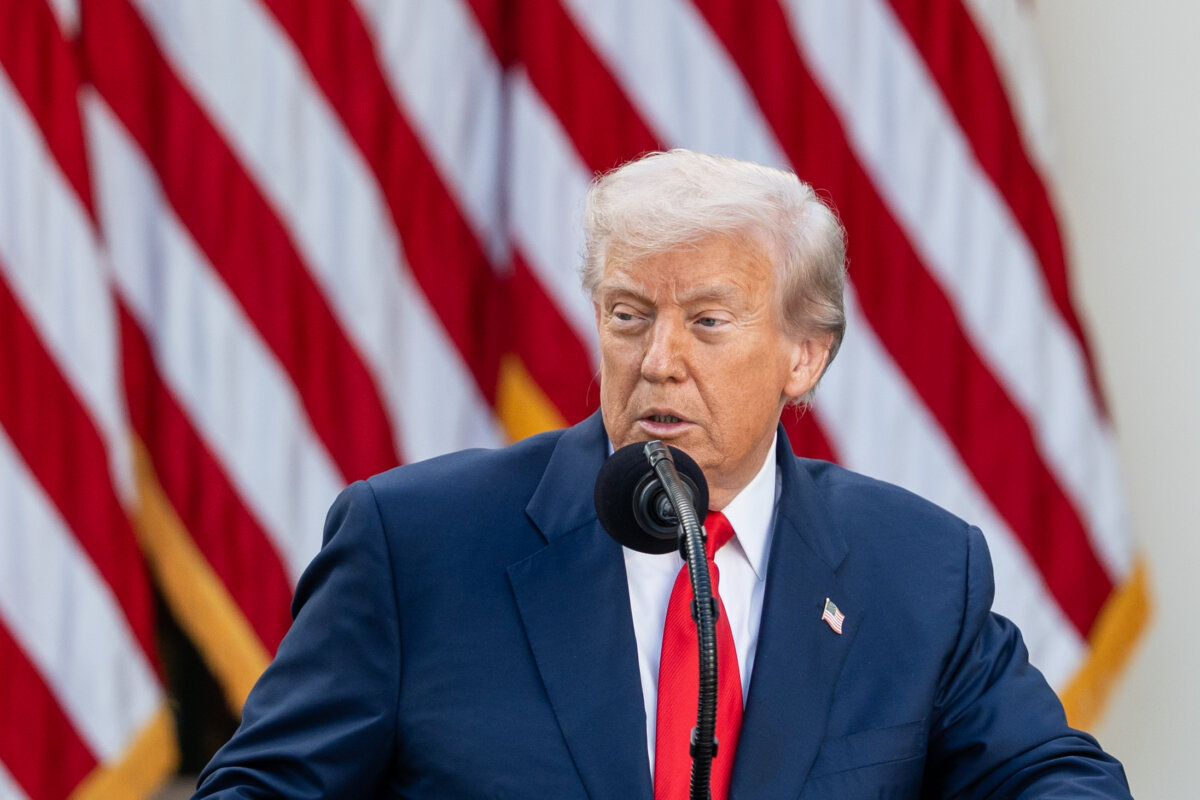

President Donald Trump said over the weekend that most Americans could receive a $2,000 dividend sourced from U.S. tariff revenues, the suggestion coming as the Supreme Court is set to rule on the administration’s import taxes.
Trump’s suggestion, which was made early on Nov. 9 on Truth Social, came after the administration defended his use of tariffs in the Supreme Court last week. Some justices appeared skeptical of his usage of the International Emergency Economic Powers Act (IEEPA) to invoke the tariffs.
What Trump Said
Praising the tariffs in his weekend post, Trump said those opposing the duties are “fools” and that the revenue generated as a result will be used to pay off the U.S. national debt. He then suggested that payments could be sent to Americans who are not “high-income people.”
“We are now the Richest, Most Respected Country In the World, With Almost No Inflation, and A Record Stock Market Price. [401(k)s] are Highest EVER,” Trump wrote in the post.
“We are taking in Trillions of Dollars and will soon begin paying down our ENORMOUS DEBT, $37 Trillion. Record Investment in the USA, plants and factories going up all over the place. A dividend of at least $2000 a person (not including high income people!) will be paid to everyone.”
Trump reiterated his suggestion to provide the payments to non-wealthy Americans in a post on Truth Social on the morning of Nov. 10.
“All money left over from the $2,000 payments made to low and middle income USA Citizens, from the massive Tariff Income pouring into our Country from foreign countries, which will be substantial, will be used to SUBSTANTIALLY PAY DOWN NATIONAL DEBT,” he wrote.
Not the 1st Time It’s Been Suggested
Last month, Trump told the One America News Network that tariff-related payments were being considered.
“We’re going to do something, we’re looking at something. Number one, we’re paying down debt. Because people have allowed the debt to go crazy,” Trump told the outlet in early October. “We’ll pay back debt, but we also might make a distribution to the people, almost like a dividend to the people of America.”
Sen. Josh Hawley (R-Mo.) in July introduced a bill that would send tariff rebate checks to some Americans, noting that the U.S. government pulled in record tariff revenue in 2025. His bill would send a rebate check to American workers and their families with requirements similar to those for the stimulus checks that were sent out during the COVID-19 pandemic in 2020.
In the pandemic, Congress passed several rounds of stimulus checks, two of which were signed into law by Trump in his first administration in 2020. President Joe Biden sent out another round of pandemic stimulus payments in 2021.
Bessent Suggests Tax Decrease
Treasury Secretary Scott Bessent said in an interview on Nov. 9 that the tariff dividend could come in the form of a tax decrease instead of a direct payment similar to the stimulus checks.
In an interview with ABC News’s “This Week” with George Stephanopoulos, the Treasury secretary was asked about Trump’s comment on $2,000 payments and responded by saying he hasn’t yet spoken with Trump about the proposal.
“I haven’t spoken to the president about this yet, but … the $2,000 dividend could come in lots of forms, in lots of ways, George,” Bessent said.
“It could be just the tax decreases that we are seeing on the president’s agenda. … You know, no tax on tips, no tax on overtime, no tax on Social Security. Deductibility of auto loans.”
Tariffs Likely to Stay
Bessent has said that no matter what the Supreme Court does, the tariffs will likely remain in place because the administration has other means to impose them.
“There are lots of other authorities that can be used, but IEEPA is by far the cleanest, and it gives the U.S. and the president the most negotiating authority,” he told CNBC last week. “The others are more cumbersome, but they can be effective.”
Bessent cited Section 232 of the Trade Expansion Act of 1962 and Section 301 of the Trade Act of 1974 as ways to get around a possible Supreme Court ruling against the tariffs.
Bessent also told Reuters earlier this month that Trump can also invoke Section 338 of the Tariff Act of 1930, a statute that allows tariffs up to 50 percent on nations that show a bias against U.S. commerce.
“You should assume that they’re here to stay,” Bessent said, referring to the duties.
Regarding countries that have negotiated tariff-lowering trade deals with Trump this year, he said those that “got a good deal should stick with it.”
The Supreme Court case covers only a portion of the tariffs Trump has imposed this year. The administration is already using other authorities for certain tariffs.
Reuters contributed to this report.
 Friends Read Free
Copy
Facebook
Tweet
Friends Read Free
Copy
Facebook
Tweet