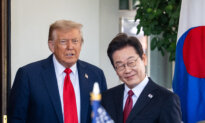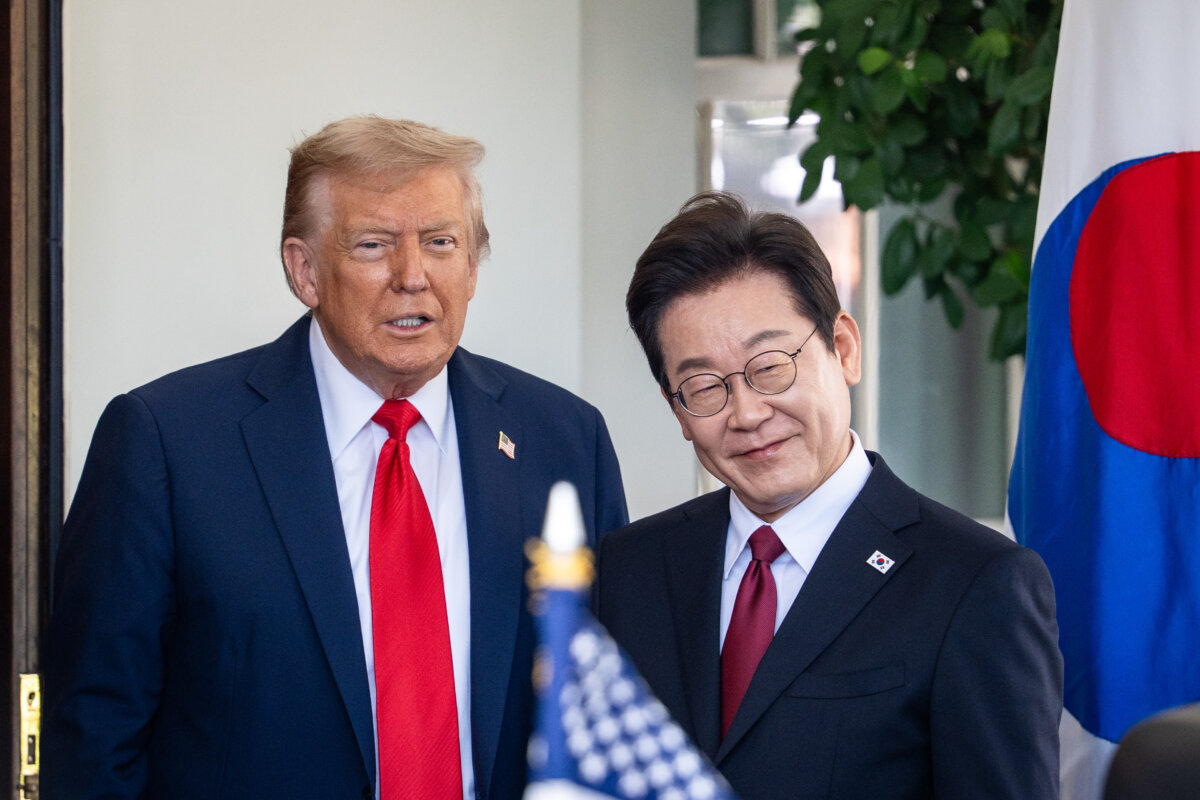
WASHINGTON—U.S. President Donald Trump welcomed South Korea’s newly elected president, Lee Jae Myung, to the White House on Aug. 25 to discuss trade, investment, and defense collaboration. Both leaders signaled optimism about restarting talks with North Korean leader Kim Jong Un.
Lee commended Trump’s efforts to promote peace around the world.
“I would like to ask for your role in establishing peace on the Korean Peninsula,” Lee said in the Oval Office, sitting alongside Trump.
He added that he hoped that Trump might meet with Kim, consider building a Trump Tower in North Korea, and even play golf with the North Korean leader.
“We’ll make relations better,” Trump said in response.
The U.S. president touted his “very good relationship” with the North Korean leader and signaled the possibility of another summit with him.
“I’d like to meet him this year,” Trump said.
During his first term, Trump met with the communist leader three times and became the first sitting U.S. president to step foot in North Korea.
The South Korean leader sought to ease trade tensions with Trump and offered praise during the meeting. He called Trump’s Oval Office renovations “bright and beautiful” and applauded him for the surge in the Dow Jones index.
“I think America is becoming great again,” Lee said.
He highlighted opportunities for cooperation in shipbuilding and manufacturing.
This was Lee’s first visit to Washington since taking office in June, following a snap presidential election triggered by political turmoil in South Korea. The crisis began in December 2024, when then-President Yoon Suk-yeol declared martial law to protect the country from “North Korean communist forces” and to eliminate “pro-North Korean anti-state forces” that he said were undermining South Korea’s constitutional order—a move that swiftly led to his impeachment and removal from office in April. In the subsequent June election, Lee, representing the liberal Democratic Party, secured victory and assumed the presidency.
Just hours before the White House meeting, Trump posted on Truth Social, prompting speculation about whether the two leaders would be able to build a good relationship.
“WHAT IS GOING ON IN SOUTH KOREA? Seems like a Purge or Revolution,” Trump wrote. “We can’t have that and do business there. I am seeing the new President today at the White House. Thank you for your attention to this matter!!!”
During the meeting, Trump said he had recently heard about raids on churches in the country.
Later, regarding the raids, the U.S. president said, “I am sure it’s a misunderstanding.”
“There is a rumor going around about churches—raiding churches, so we’ll talk,” he said. “I’m sure that’s going to be worked out fine.”
The Trade Deal
During the meeting, Trump also commented on Seoul’s push to renegotiate a recently finalized trade deal.
“I hear they want to renegotiate the deal, but that’s OK. I don’t mind that,” Trump said. “That doesn’t mean they’re going to get anything, but I don’t mind.”
Following the meeting, Trump said that South Korea would have to honor the original deal.
“I think we have a deal done. They had some problems with it, but we stuck to our guns,” Trump told reporters. “They’re going to make the deal that they agreed to make.”
On July 30, the two countries reached a trade deal that allowed South Korea to avoid high U.S. tariffs.
Seoul agreed to a 15 percent tariff on its goods entering the United States, while allowing U.S. products to enter South Korea duty-free.
Trump announced the deal in a Truth Social post, stating that South Korea would be “completely open to trade,” including accepting American cars, trucks, and agricultural products.
Under the deal, Seoul will invest $350 billion in U.S.-owned assets chosen by Trump and purchase $100 billion in liquefied natural gas and other energy products from the United States.
South Korea ranks as the sixth-largest trading partner of the United States. In 2024, the U.S. goods trade deficit with the country reached $66 billion—up by nearly 29 percent from 2023.
While both sides have reached a trade and investment framework, many details still have to be ironed out.
During the White House meeting, Trump announced that he would go to South Korea for a trade meeting “pretty soon.”
Make American Shipbuilding Great Again
South Korea has proposed a $150 billion investment plan called Make American Shipbuilding Great Again as part of the tariff deal.
During a news conference in July, South Korean finance minister Koo Yoon-cheol said the goal of the project is to help rebuild the U.S. shipbuilding industry using Korea’s expertise in the field.
South Korea’s shipbuilding giants Hanwha and HD Hyundai were already active in the United States before the tariff talks. Hanwha bought the Philly Shipyard in Philadelphia in 2024 and secured three U.S. Navy contracts for maintenance, repair, and operations, and HD Hyundai signed a memorandum of understanding with Huntington Ingalls in April to accelerate ship production.
Trump praised South Korea’s leadership in shipbuilding.
“They build them very well in South Korea,” he said. “During World War II, we built a ship a day, and today we don’t build ships anymore, which is ridiculous.
“We’re going to be buying ships from South Korea, but we’re also going to have them make ships here with our people—using our people.”
According to Victor Cha, the Korea chair at the Center for Strategic and International Studies, cooperation on shipbuilding is a priority for Trump.
“The South Koreans have worked very hard at engaging Trump on this. They’ve created their own sort of moniker for this,” he said during a news briefing last week, referring to the shipbuilding plan.
Yet many details of the plan have not been finalized, according to Cha.
Following his meeting with Trump, Lee is expected to travel to Philadelphia on Aug. 26 to tour the Hanwha Philly Shipyard.
Defense and Security Alliance
Another key item on the agenda was modernizing the U.S.–South Korea security alliance to better confront regional challenges, particularly those posed by China in the Indo-Pacific.
“South Korea is a big buyer of military equipment, and we’re going to talk about that also,” Trump said during the meeting.
More than 28,500 U.S. military personnel are stationed in South Korea, according to the U.S. State Department.
The United States has long been asking for flexibility that would allow its troops to operate beyond deterring North Korea, including potential responses to a possible communist invasion of Taiwan.
Asked whether he planned to reduce U.S. forces in South Korea to allow for greater flexibility, Trump declined to answer directly. Instead, he said he wanted ownership of the land in South Korea where U.S. troops are stationed.
“I would like to see if we could get rid of the lease and get ownership of the land where we have a massive military base,” Trump said.
The U.S. president also commented on China during the White House meeting.
He warned that Beijing must increase its supply of magnets to the United States or face a 200 percent tariff.
The Chinese communist regime had restricted exports of several rare-earths and magnets in April in retaliation for U.S. tariffs. While those restrictions have since been lifted, shipments have not returned to previous levels.
“They have some cards. We have incredible cards, but I don’t want to play those cards,” Trump said. “If I played those cards, that would destroy China.”
 Friends Read Free
Copy
Facebook
Tweet
Friends Read Free
Copy
Facebook
Tweet