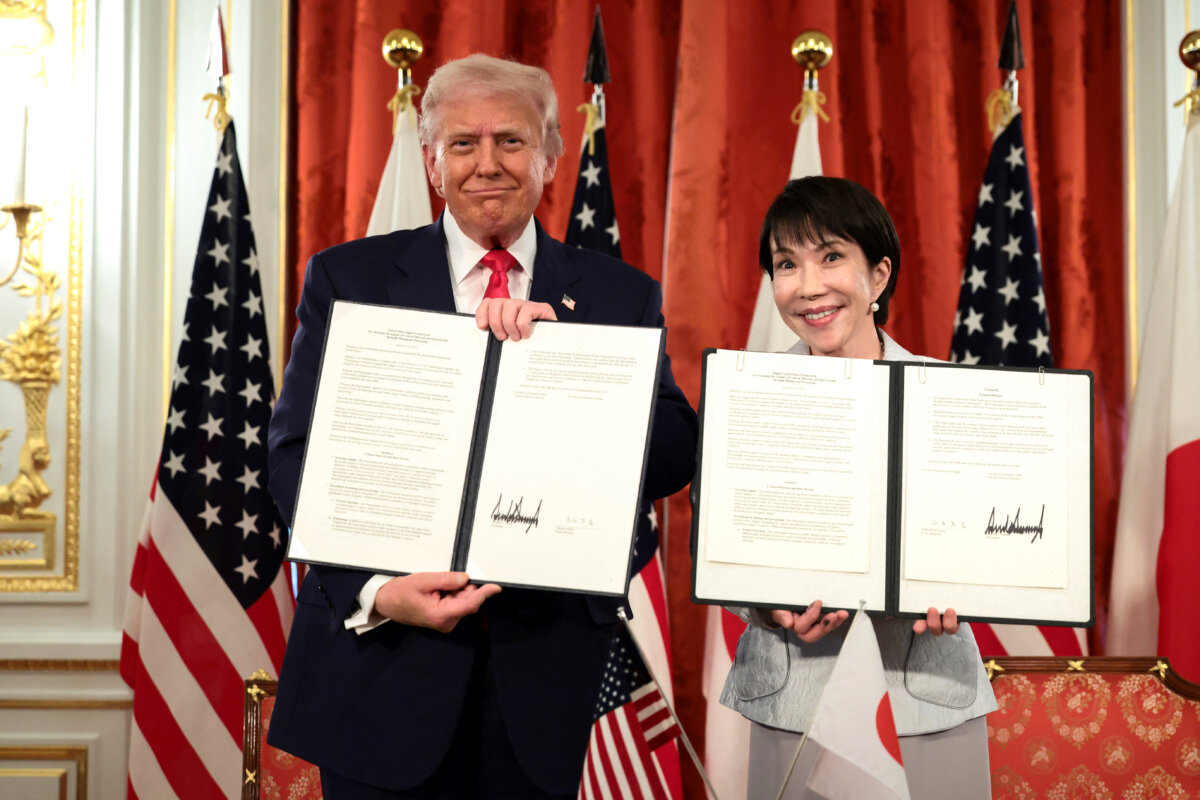

U.S. President Donald Trump met with Japanese Prime Minister Sanae Takaichi in Tokyo on Oct. 27 for bilateral talks on security, trade, and other issues, before signing a framework agreement outlining the two nations’ plans for an expanded partnership.
“I would like to realize a new golden age of Japan–U.S. alliance, where both Japan and the United States will become stronger and also more prosperous,” Takaichi said.
“I am ready to promote further collaboration with you and the United States.”
Leaders first signed an agreement “toward a new golden age for the U.S.–Japan alliance.”
“The Agreement will help both countries to strengthen economic security, promote economic growth, and thereby continuously lead to global prosperity,” the document reads.
The directive follows similar arrangements made in July between the two countries and Trump’s subsequent executive action from September.
Securing sustainable supplies of critical minerals and rare earth metals was the topic of the second agreement signed on Oct. 27.
Japan and the United States will partner to maximize efficient mining, processing, investing, and project management operations, according to the details of the framework.
The elimination of unfair trade practices and market manipulation is a key aspect of the agreement.
“The Participants plan to accomplish this through use of economic policy tools and coordinated investment to accelerate development of diversified, liquid, and fair markets for critical minerals and rare earths,” the document reads.
By day’s end, Trump came close to securing the administration’s goal of $550 billion in Japanese investment under the new trade framework.
Ahead of a Tokyo dinner with business leaders, U.S. Commerce Secretary Howard Lutnick announced about $490 billion in commitments, including major funding for nuclear and semiconductor projects. He called the deal a milestone for both nations’ economic and national security, made possible by the administration’s push to renegotiate trade ties.
“These deals are driven by the Japanese strategic investment initiative, which was created by your tariff policy and by your historic trade agreement with Japan,” Lutnick told Trump, who was standing alongside him at a press conference.
“The commitments ensure the economic and national security of the United States of America.”
Lutnick listed some pledged investments, including $100 billion each for nuclear projects involving Westinghouse and GE Vernova.
Strong Allies
Ahead of the signing, the two leaders spoke for approximately 10 minutes in front of the media, accompanied by their respective delegations.
She said the island nation is gifting 250 cherry trees to Washington to reside among the thousands living in the city that were donated from Tokyo to the U.S. capital in 1912. Special Japanese-made fireworks will also launch into the sky around Capitol Hill to celebrate the nation’s 250th anniversary in 2026.
Takaichi was chosen as prime minister in an unprecedented election in the nation’s lower parliament on Oct. 21.
“I want to congratulate you on being the first woman prime minister,” Trump said. “That’s a big deal.”
The president thanked Takaichi for Japan’s recent order of U.S. military equipment.
“We make the best military equipment in the world: the jets, the missiles, and everything else,” Trump said. “And we hope we don’t have to use them much, if at all, but we appreciate that order, and we appreciate the trade.”
He said that the two countries will continue doing “tremendous trade.”
Trump welcomed her leadership style and noted her close relationship with his friend, Japanese Prime Minister Shinzo Abe, who was assassinated in 2022.
Takaichi expressed gratitude for the U.S. president’s long-lasting support of her predecessor.
After the signing ceremony, Trump told Takaichi, “I want to just let you know, anytime you have any question, any doubt, anything you want, any favors you need, anything I can do to help Japan, we will be there.
“We are an ally at the strongest level.”
Masanao Ozaki, deputy chief cabinet secretary; Kei Sato, deputy chief cabinet secretary; and Keiichi Ichikawa, national security adviser, were among those representing the host nation at the ceremony.
Also present, representing the United States, were Ambassador to Japan George Glass, Secretary of State Marco Rubio, Treasury Secretary Scott Bessent, and Commerce Secretary Howard Lutnick, among others.
The president is next scheduled to address U.S. troops aboard the USS George Washington before attending a dinner with Japanese business leaders.
He will then travel to South Korea for the final stop on his tour of Asia, where bilateral discussions on the side of the Asia-Pacific Economic Cooperation conference will precede a meeting with Chinese Communist Party leader Xi Jinping to cap off his trip.
 Friends Read Free
Copy
Facebook
Tweet
Friends Read Free
Copy
Facebook
Tweet