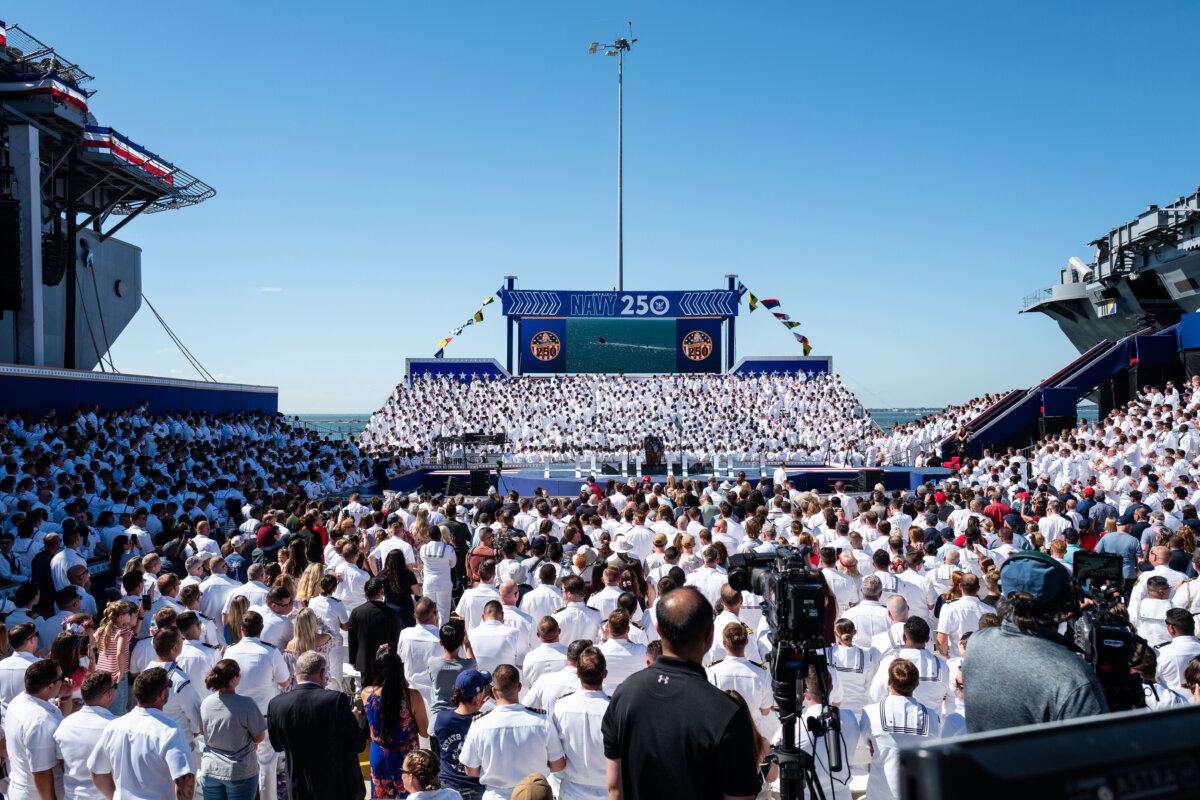


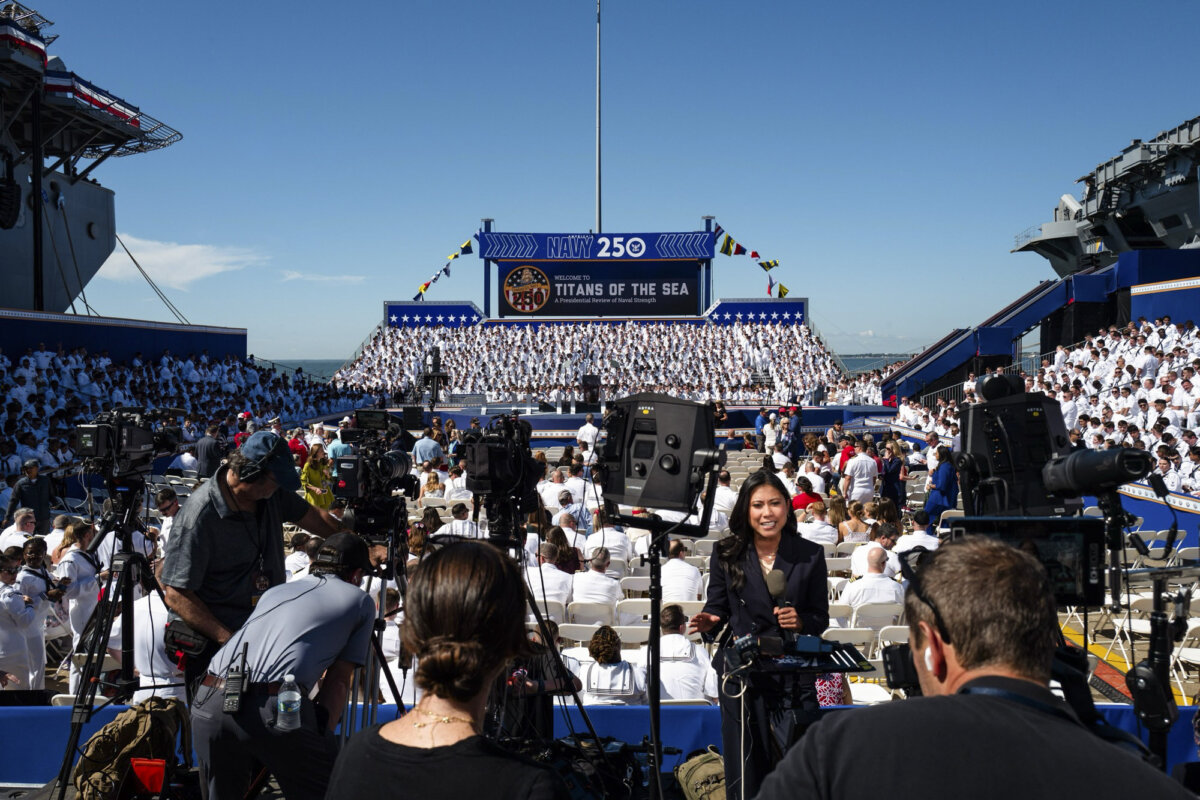
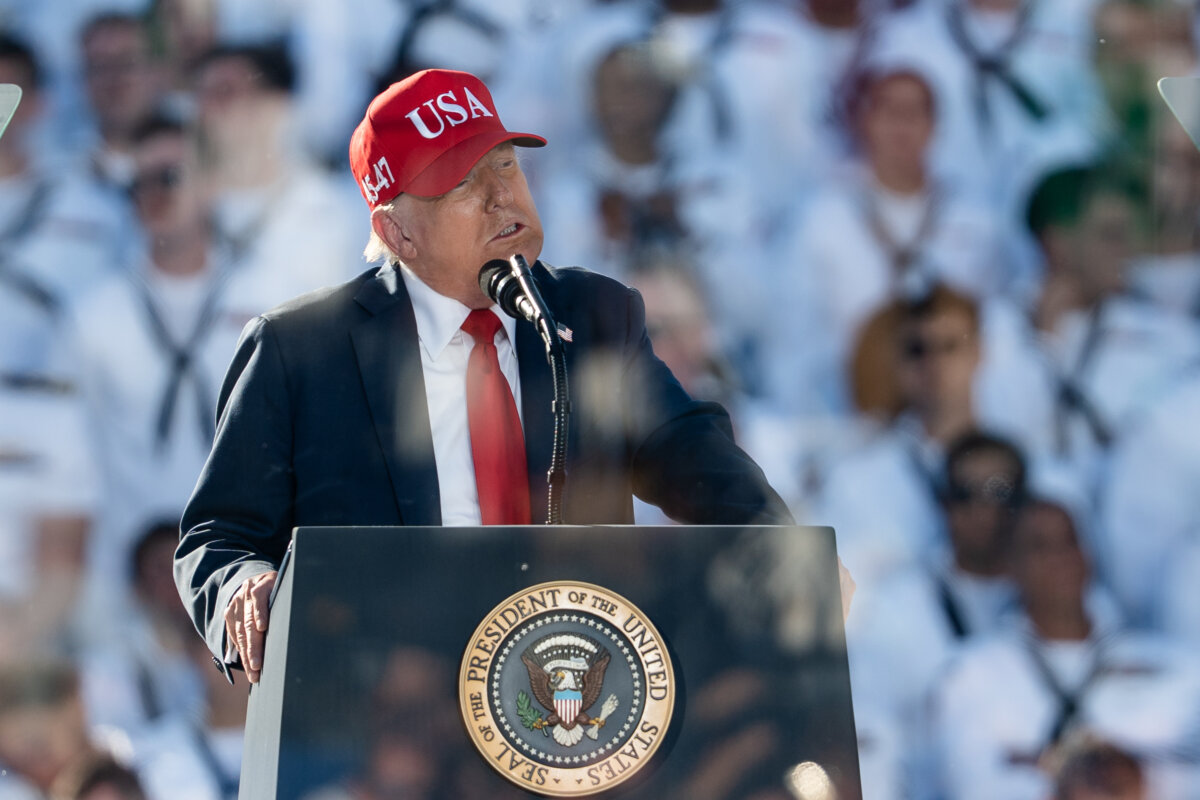
NORFOLK, Va.—President Donald Trump on Oct. 5 reflected on a quarter millennium of U.S. Navy heroes and achievements during an event celebrating the branch’s semiquincentennial, or 250th, anniversary.
“We’re gathered on this storied waterfront to celebrate 250 years of strength, tenacity, and unwavering courage,” Trump told a crowd of U.S. Navy sailors, U.S. Marines, and others gathered along a pier in Norfolk, Va.
Trump was introduced by First Lady Melania Trump, who spoke after War Secretary Pete Hegseth. Rep. Jen Kiggans (R-Va.), whose district includes Norfolk, was also in attendance.
Ahead of Trump’s arrival, sailors and marines crowded the pier. The sea of white uniforms was flanked on the water by the USS Harry Truman, a nuclear-powered aircraft carrier, and the USS Kearsarge, an amphibious assault ship.
“Beside us today are a combined 150,000 tons of pure American naval supremacy and two colossal reasons why no one should ever want to start a fight with the U.S.A.,” the president said of the two ships.
The crowd applauded and cheered when Trump referenced the sailors on board the nearby ships.
Trump spent much of the speech reflecting on what the U.S. Navy had achieved in its 250 years, predating even the declaration of American independence.
“The Continental Congress formed a fleet of just two ships in October 1775. Many scoffed at their chances against the most powerful empire on Earth,” Trump said.
“The war for independence gave us some of the greatest American heroes of all time.”
Trump also spoke of Captain John Paul Jones, famous for what he said when asked by a much stronger British vessel to surrender.
“I have not yet begun to fight,” he replied.
Trump then moved on to the United States’ second great conflict, the War of 1812, which produced a famous story about Captain James Lawrence. After he was mortally wounded during a battle with the British, Lawrence spoke his last words to his crew: “Don’t give up the ship! Fight her till she sinks!”
The phrase “Don’t give up the ship” is now one of the most famous in U.S. naval history, serving as an unofficial motto for the branch.
Trump also reviewed other defining American victories, such as the early 19th-century triumph over the Barbary pirates who had been targeting U.S. trade vessels in the Mediterranean.
He also reflected on U.S. victories over German “wolfpack” tactics during World War II, which involved coordinated submarine attacks by several U-boats, and the U.S. victories in the Pacific theater against the Japanese.
“In World War II, Adm. Bull Halsey’s motto was ‘Hit hard, hit fast, hit often,'” Trump said. “And that is exactly what the sailors do.”
Trump also spoke about a member of the audience, 100-year-old Felix Mauricio, who retired from the branch in 1966.
Trump said that Mauricio had enlisted at age 18 and trained in Norfolk.
During the D-Day invasion of Normandy, France, during World War II, Mauricio piloted amphibious landing vehicles, crossing the obstacle-strewn waters six times to drop off reinforcements.
Mauricio later fought in the Battle of Iwo Jima in the Pacific theater.
“Felix celebrated his 100th birthday, and he is here this afternoon as a living testament to the glory of the United States Navy,” Trump said.
Trump also referenced the U.S. Navy SEALs’ role in the 2011 killing of Osama bin Laden, the mastermind of the Sept. 11 terror attacks.
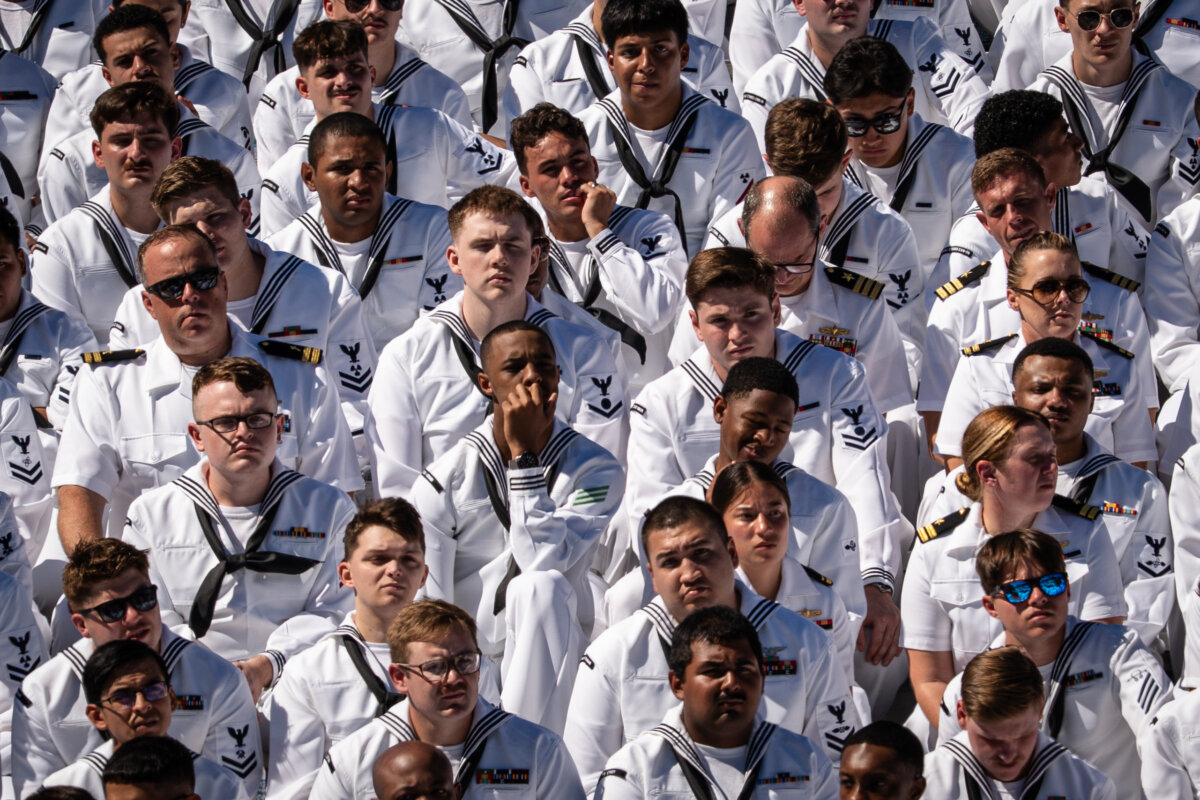
Navy SEALs present in the crowd stood when the special operations force was mentioned.
Attendees who spoke with The Epoch Times reflected on their own connections with U.S. military history and what the future could bring.
Lt. Cmdr. Robert Ford said he had been serving for 13 1/2 years. He said he was the principal assistant for logistics on the Truman in 2019 and 2020, which involved a deployment to Oman and coincided with the start of the COVID-19 pandemic.
“We were the clean carrier,” he recalled of Truman, which was COVID-19-free during a period of surging cases.
Lt. Col. Rick Oertel, who served in the U.S. Army and is now retired, said that during Operation Desert Storm, he was in Korea.
He remembered being told why it mattered: “[The North Koreans] may come across the border while we’re distracted.”
Both Ford and Oertel warned of the growing risk from China in the Pacific.
“As we go down the road of great power competition, hopefully, we continue to do what we need to to keep the country safe,” Ford said.
 Friends Read Free
Copy
Facebook
Tweet
Friends Read Free
Copy
Facebook
Tweet