
WASHINGTON—President Donald Trump cautioned the heads of foreign nations on Jan. 16 that tariffs are on the table for those considering opposing his plan for the United States to acquire Greenland.
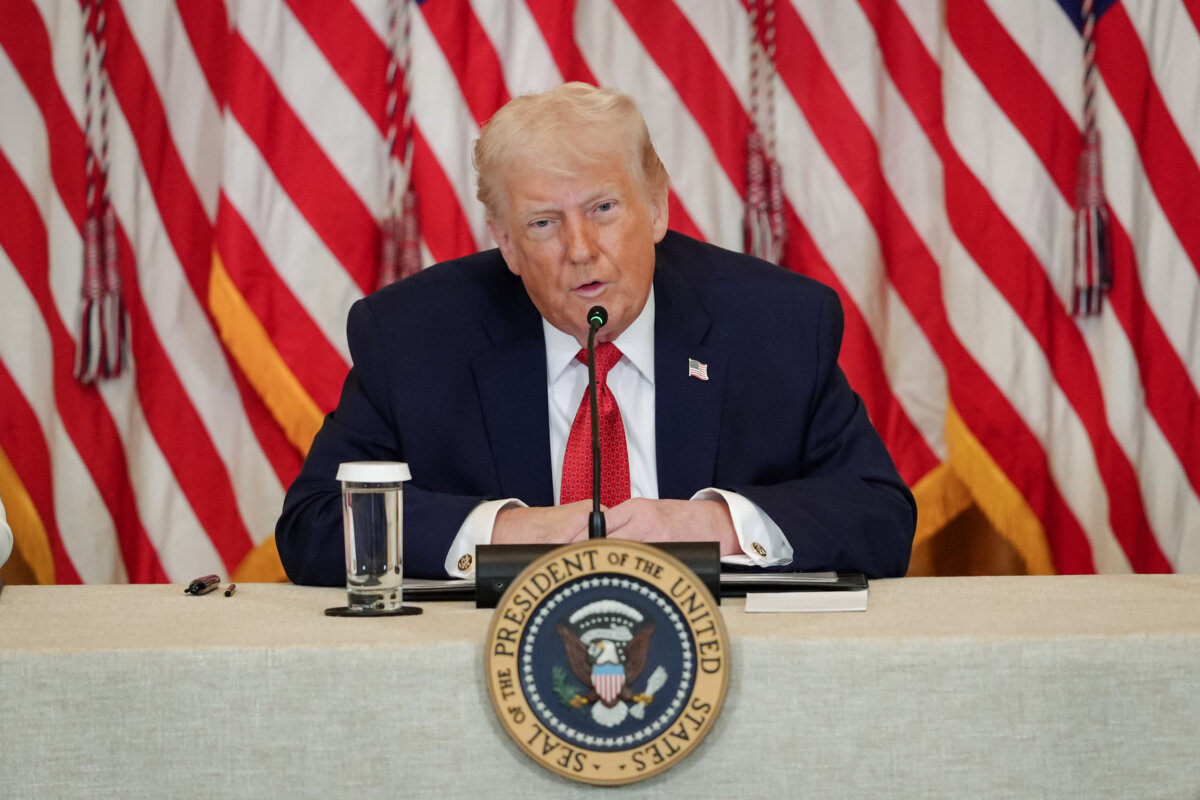
“I may put a tariff on countries if they don’t go along with Greenland,” Trump said while speaking at a rural health roundtable in the East Room of the White House. “Because we need Greenland for national security.”
Discussions are underway between Danish and U.S. officials following a meeting Vice President JD Vance and Secretary of State Marco Rubio held with Denmark’s Foreign Minister Lars Lokke Rasmussen and Greenland’s Foreign Minister Vivian Motzfeldt at the White House on Jan. 14.
Negotiations resulted in the formation of a working group to study future control of the arctic territory.
Trump has repeatedly called for the United States to acquire the world’s largest island as a defensive strategy to protect the Western Hemisphere.
“It is vital for the Golden Dome that we are building,” the president posted Jan. 14 on Truth Social, suggesting NATO should facilitate the acquisition to deter Chinese and Russian aggression.
“NATO becomes far more formidable and effective with Greenland in the hands of the UNITED STATES. Anything less than that is unacceptable.”
The president first proposed acquiring Greenland in 2019 during his first term in office.
A bipartisan congressional delegation of 11 lawmakers, led by Democrats, arrived in Denmark Jan. 16 to discuss matters with Danish and Greenlandic officials.
“I know there are real, deep concerns here in Denmark and in Greenland,” Sen. Jeanne Shaheen (D-N.H.) said in a speech at the University of Copenhagen on Friday. “These concerns are understandable when trust is shaken. But I believe saner heads will prevail.”
White House press secretary Karoline Leavitt told reporters on Jan. 7 that Trump is considering a range of options to gain control of the territory.
“I know that past presidents and past leaders have often ruled things out. They’ve often been very open about ruling things in and basically broadcasting their foreign policy strategy to the rest of the world, not just to our allies, but most egregiously, to our adversaries,” she said. “That’s not something this president does.”
While the administration would prefer a diplomatic solution, the use of military force is a possibility, according to the press secretary.
“All options are always on the table for President Trump as he examines what’s in the best interest of the United States, but I will just say that the president’s first option always has been diplomacy,” Leavitt said.
Denmark’s roots in Greenland date to colonization in 1721, with formal control established 30 years later. Self-governance began in 1979 with the establishment of a parliament, with Denmark recognizing the island’s autonomy. The Greenland Self-Government Act of 1979 further expanded the island’s autonomy.
Officials from the arctic island—including Greenland’s Prime Minister Jens-Frederik Nielsen and a host of political party leaders—released a statement Jan. 9 rejecting all attempts to impede on Greenland’s autonomy.
“We don’t want to be Americans, we don’t want to be Danes, we want to be Greenlanders,” the statement reads.
“The future of Greenland must be decided by the Greenlandic people. … No other country can interfere in this.”
 Friends Read Free
Copy
Facebook
Tweet
Friends Read Free
Copy
Facebook
Tweet