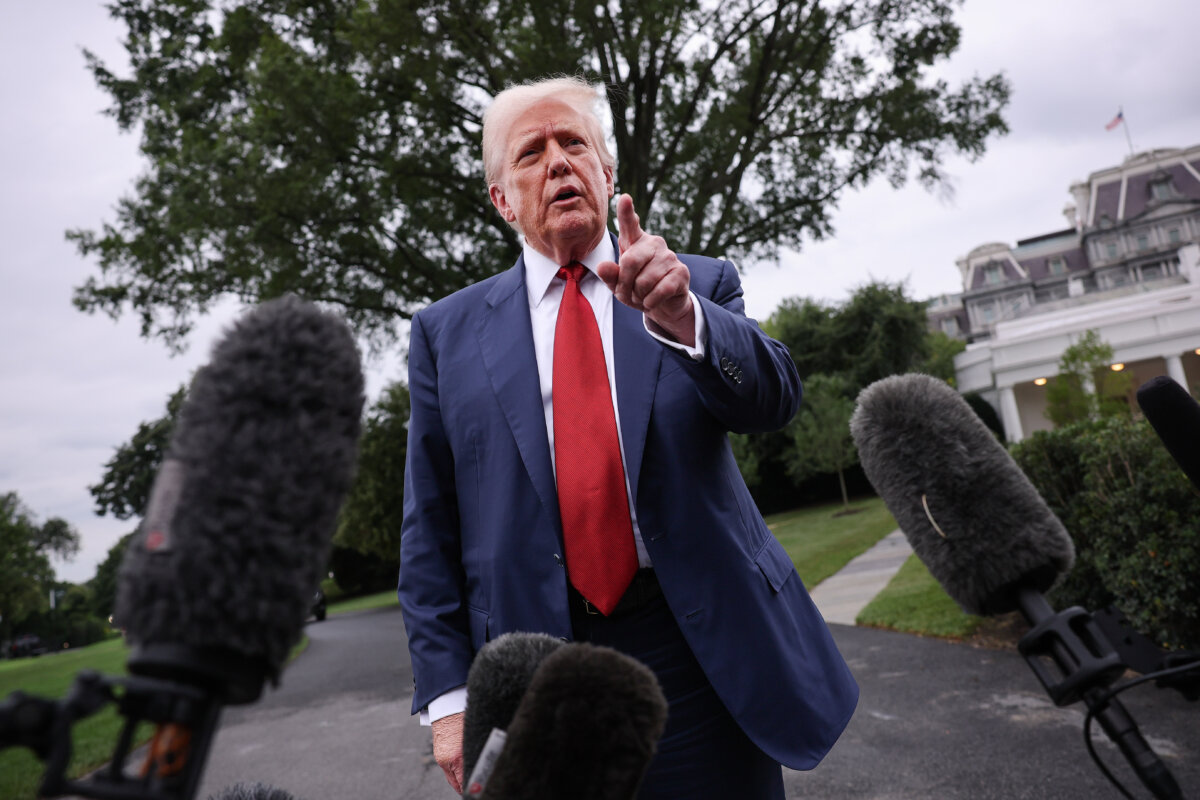

WASHINGTON—President Donald Trump signed an executive order on Aug. 7 to stop banks from denying people financial services because of their political or religious beliefs, a practice known as debanking.
According to a White House fact sheet, the executive order requires federal banking regulators to investigate whether banks have engaged in “politicized or unlawful debanking” and to issue penalties such as “fines or consent decrees.”
The order also directs regulators to remove terms such as “reputational risk” from their guidance—language that has allegedly been used to justify debanking.
Trump first announced his plan on Aug. 5, stating in an interview with CNBC’s “Squawk Box” that banks and regulators have been involved in alleged discrimination against conservatives, including himself.
During the interview, Trump accused two major banks—JPMorgan Chase and Bank of America—of denying financial services to his business after the 2020 election.
He said the same treatment has been given to many conservatives, particularly his supporters.
The order requires federal banking regulators to review complaints for cases of unlawful debanking based on religion and report them to the attorney general.
In addition, the order directs the Small Business Administration to ask all banks under its oversight to try to reinstate individuals or entities previously denied financial services.
The order also asks the secretary of the Treasury and the president’s economic adviser to create a comprehensive plan to fight politicized or unlawful debanking. This could include suggesting new laws or regulations.
According to the White House, there are numerous examples of politicized debanking. In one case it cited, a major bank allegedly refused to process ticket payments for a Republican event, only reversing the decision after its action gained public attention. Federal regulators have also allegedly encouraged banks to flag individuals for transactions with companies such as Bass Pro Shop or Cabela’s, or for using terms such as “Trump” and “MAGA” in peer-to-peer payments, even without any evidence of criminal activity, according to the White House.
Federal initiatives such as Operation Chokepoint have allegedly targeted lawful industries for political reasons, and the digital asset sector has also faced similar unfair debanking practices, the White House said.
Both Trump and his wife have said that they were refused banking services over the past several years, alleging that it was on political grounds.
Bank United in Florida closed Trump’s accounts in 2021, stating, “We no longer have any depository relationship with him.”
Professional Bank, another Florida bank, closed Trump’s accounts at the same time.
Signature Bank and Deutsche Bank in New York also ended their relationship with the president following the breach of the U.S. Capitol on Jan. 6, 2021.
Writing in her autobiography, “Melania,” First Lady Melania Trump stated that she was denied banking services at the time.
“I was shocked and dismayed to learn that my long-time bank decided to terminate my account and deny my son the opportunity to open a new one,” she said.
During the CNBC interview, Trump alleged that his political opponents pressured banking regulators to target him, saying that banks “are not afraid of anything but a regulator.”
He alleged that the previous administration instructed banking authorities to do everything they could “to destroy Trump.”
“We don’t close accounts for political reasons, and we agree with President Trump that regulatory change is desperately needed,” Trish Wexler, a spokesperson for JPMorgan Chase, told The Epoch Times in a statement. “We commend the White House for addressing this issue and look forward to working with them to get this right.”
In a January statement, a Bank of America spokesperson told The Epoch Times: “We serve more than 70 million clients, and we welcome conservatives. We are required to follow extensive government rules and regulations that sometimes result in decisions to exit client relationships. We never close accounts for political reasons and don’t have a political litmus test.”
The Bank Policy Institute, American Bankers Association, Consumer Bankers Association, and Financial Services Forum issued a statement welcoming the new executive order.
“It’s in banks’ best interest to take deposits, lend to and support as many customers as possible. Unfortunately, regulatory overreach, supervisory discretion and a maze of obscure rules have stood in the way as the [executive order] makes clear,” the statement reads.
“We thank the Administration for its efforts to protect access to banking and rein in runaway regulations and look forward to working with the White House, Congress and the agencies to create a national standard that advances these goals.”
 Friends Read Free
Copy
Facebook
Tweet
Friends Read Free
Copy
Facebook
Tweet