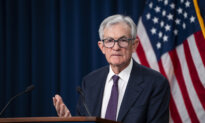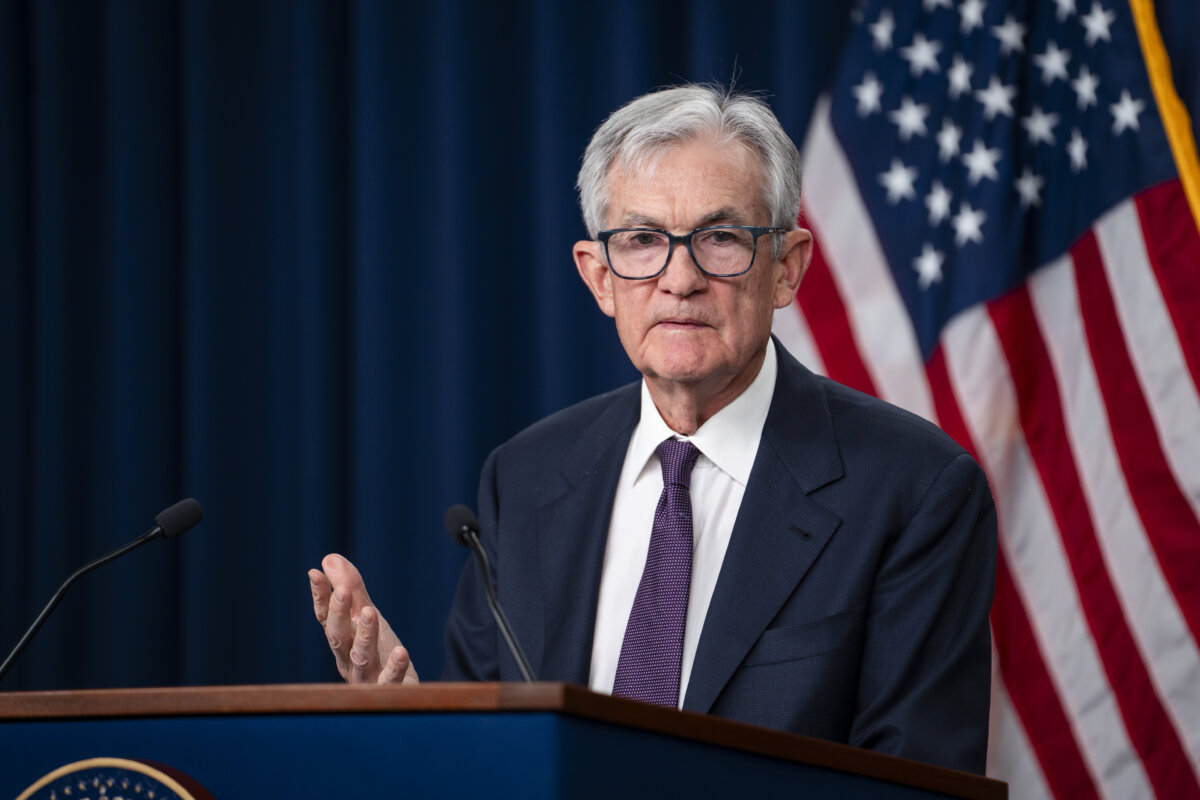
President Donald Trump has said he would fire Federal Reserve Chairman Jerome Powell if he refuses to leave office when his term ends next month.
Even though the Fed chief’s term expires on May 15, Powell told reporters last month that he would stay on as chair until his successor, former Federal Reserve board member Kevin Warsh, is confirmed.
But Trump says he will fire Powell if he does not step down from his position.
“I’ve held back [from] firing him. I’ve wanted to fire him,” Trump said in an April 15 interview with Fox Business anchor Maria Bartiromo. “But I have to be controversial, you know. I want to be uncontroversial. But he will be fired.”
The president also said that the investigation into the Federal Reserve’s construction project needs to continue.
“What they’ve done to that … it is probably corrupt, but what it really is is incompetent, and we have to show the incompetence of that,” he said.
Renovations to the building have been ongoing since 2017 and have exceeded their initial $1.9 billion budget by more than $600 million. Officials cited higher labor and material costs, the discovery of asbestos and soil contamination, and extended construction schedules as reasons that it has gone over budget.
Trump lambasted the renovations, telling Fox Business that he could have done them for $25 million.
Earlier this month, Judge James Boasberg, of the U.S. District Court for the District of Columbia, upheld his prior decision to block subpoenas issued in a criminal investigation into Powell.
Jeanine Pirro, U.S. attorney for the District of Columbia, had pursued information regarding cost overruns in renovations at the Fed’s headquarters and Powell’s congressional testimony last summer.
Powell, however, ascribed the investigation to a months-long pressure campaign by the current administration to loosen monetary policy.
“This unprecedented action should be seen in the broader context of the administration’s threats and ongoing pressure,” Powell said in a Jan. 11 video statement.
“The threat of criminal charges is a consequence of the Federal Reserve setting interest rates based on our best assessment of what will serve the public, rather than following the preferences of the president.”
Boasberg agreed, writing in his March 13 ruling that the subpoenas were put together to “harass and pressure” Powell to lower interest rates.
“Did prosecutors issue those subpoenas for a proper purpose? The Court finds that they did not,” Boasberg said in the ruling.
“On the other side of the scale, the Government has offered no evidence whatsoever that Powell committed any crime other than displeasing the President.”
At the post-meeting press conference on March 15, Powell stated that he will serve as “chair pro tem” if Fed board member Kevin Warsh is not confirmed by the Senate.
This, Powell says, follows Fed policy.
“[It] what we’ve done on several occasions, including involving me, and that’s what we’re going to do in this situation,” he said.
But although his chair position expires next month, his seat on the Board of Governors does not end until early 2028.
He has not decided whether to resign early.
“I will make that decision based on what I think is best for the institution and for the people we serve,” Powell told reporters.
The Senate Banking Committee will hold a hearing on Warsh’s nomination on April 21.
The Fed chair nominee cleared a key Senate hurdle when he filed his financial disclosures.
The documents revealed Warsh’s enormous fortune, potentially making him the wealthiest central bank chief in the institution’s century-old history.
Warsh and his wife, Jane Lauder, who sits on the board of cosmetics giant Estée Lauder, have holdings worth at least $100 million.
His path to confirmation remains uncertain, as all Democrats on the Senate Banking Committee, as well as Sen. Thom Tillis (R-N.C.), have said they oppose his nomination.
Tillis, who is also on the Senate Banking Committee, has said he would block the final approval of Warsh until the criminal probe into Powell is resolved.
“They saw either two minutes of bogus testimony that was used as a perjury trap—or into the investigation,” the senator told reporters on April 14.
“But I’m open. Kevin’s a creative guy. Maybe he’s got a way to accomplish that and through a different means, but that’s the only way I get off the dime.”
Warsh has expressed support for lowering interest rates, citing the coming artificial intelligence-fueled productivity boom that he has predicted will be disinflationary. At the same time, investors view Warsh as a policy hawk, as the former Bush White House economist has advocated tightening the balance sheet.
Investors widely expect the central bank will keep the benchmark federal funds rate—a key policy rate that influences business and household borrowing costs—unchanged this year in the current target range of 3.5 percent to 3.75 percent.
Nathan Worcester contributed to this report.
 Friends Read Free
Copy
Facebook
Tweet
Friends Read Free
Copy
Facebook
Tweet