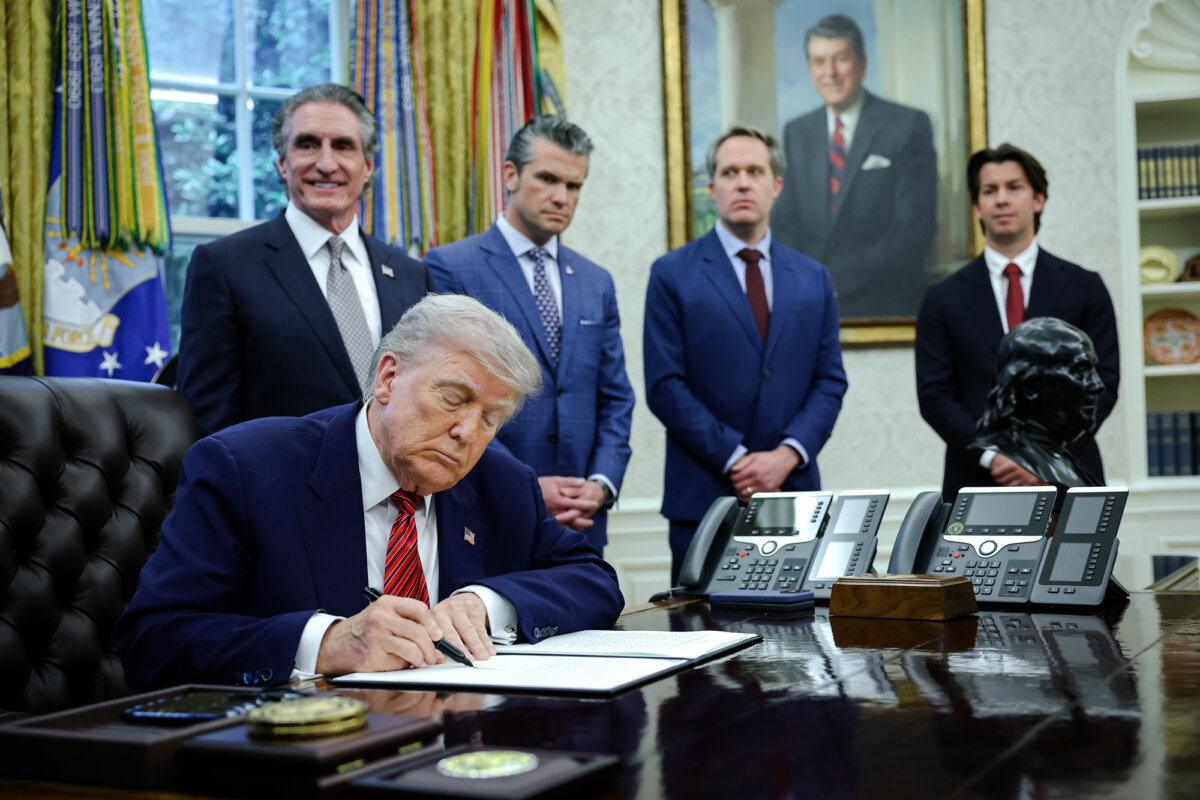

President Donald Trump signed an executive order on June 30 to lift most sanctions on Syria, giving the Middle Eastern country an opportunity to develop economically.
Sanctions on former Syrian leader Bashar al-Assad and other malign actors will remain.
“This is in an effort to promote and support the country’s path to stability and peace,” White House press secretary Karoline Leavitt said during a press briefing ahead of the signing.
“He’s committed to supporting a Syria that is stable, unified, and at peace with itself and its neighbors.
“They’re saying, ‘We are going to give you an opportunity.'”
Trump announced in Saudi Arabia on May 13 that U.S. sanctions would be lifted on Syria “to give them a chance at greatness.”
He met with Syrian leader Ahmed al-Sharaa the following day.
“I say: ‘Good luck, Syria. Show us something very special,’” he said.
There have been sanctions on Syria since the country’s civil war began in 2011.
In a call with reporters ahead of the signing, senior administration officials talked about the significance of lifting U.S. sanctions on Syria.
One official said that the lifting of sanctions on Syria, which were a response to the repressive Assad regime, creates an “ability for them to have their own initiative, their own mandate, their own architecture of how they move forward.”
“Neither the president nor the secretary of state are nation-building,” the official said. “They’re not giving the framework of the democratic model that needs to be implemented to their architecture or desire.”
A second senior administration official said the sanctions on Syria were necessary, but circumstances have changed thanks to Assad no longer being in power.
“From our perspective, Syria has been under comprehensive sanctions for decades, which expanded in response to the regime’s brutality during the country’s civil war. Our sanctions played an important role in limiting Assad’s ability to wage war against his own people, and frustrating his cronies’ efforts to enrich themselves at the expense of the country and the Syrian people,” the official said.
At the end of the day, a third senior administration official said, the sanctions relief “will end the country’s isolation from the international financial system.”
President Joe Biden took a softer stance on Syria following the Assad regime’s fall.
“We’ve taken note of statements by the leaders of these rebel groups in recent days. And they’re saying the right things now, but as they take on greater responsibility, we will assess not just their words, but their actions.”
The Biden administration removed a $10 million bounty on Ahmad al-Sharaa, Syria’s new leader who played a key role in the country’s regime change. He is the leader of Hayat Tahrir al-Sham, a U.S.-designated terrorist group. It was U.S. policy not to normalize ties with Syria.
The executive order signing comes as Israel looks to normalize ties with Syria, which dropped its demand to get back control of the Golan Heights that Israel has had since 1967.
“We have an interest in adding countries such as Syria and Lebanon, our neighbors, to the circle of peace and normalization, while safeguarding Israel’s essential and security interests,” Israeli Foreign Minister Gideon Saar said at a news conference.
 Friends Read Free
Copy
Facebook
Tweet
Friends Read Free
Copy
Facebook
Tweet