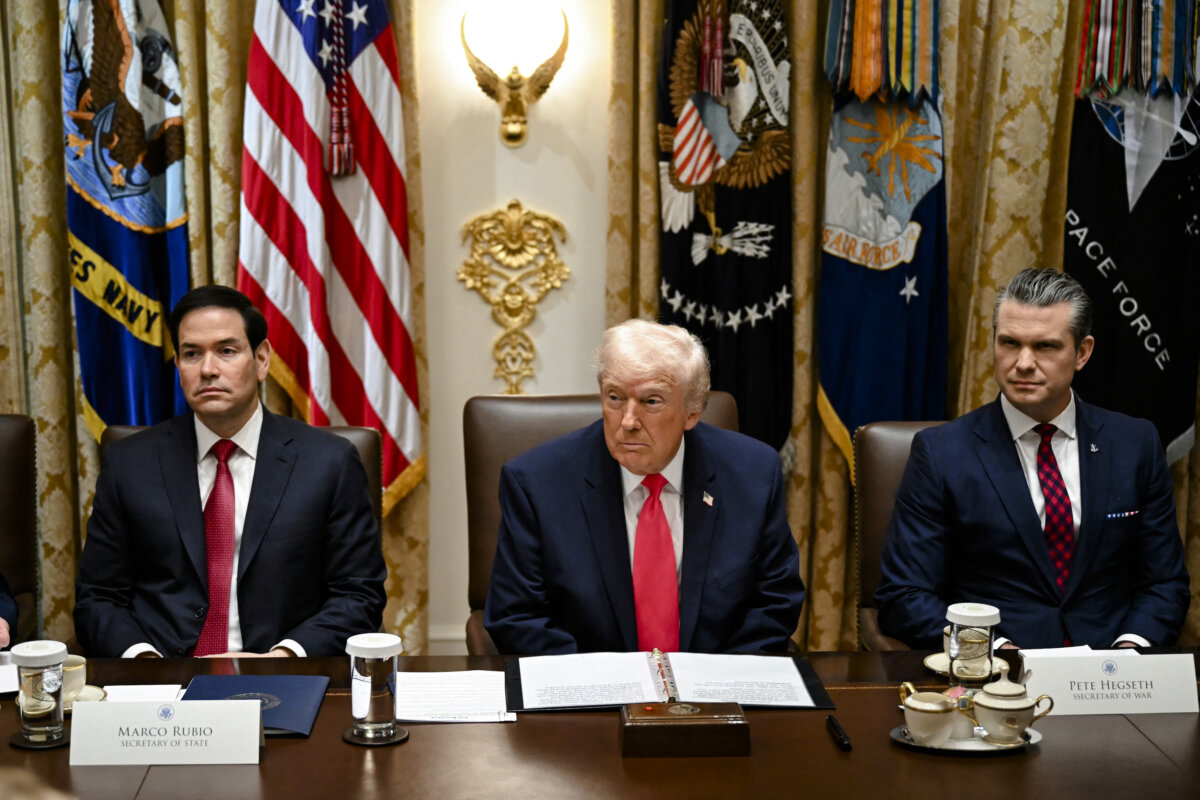

President Donald Trump’s new national security strategy lays out the clearest articulation yet of a second-term doctrine: The United States will no longer act as “Atlas,” with the global order on its shoulders, but will instead prioritize border control, industrial strength, and uncontested influence in the Western Hemisphere while approaching the rest of the world with sharper selectivity.
Here are five major takeaways from the strategy and how they redefine America’s global posture, reshaping U.S. priorities in Europe, China and the Indo-Pacific, Ukraine, the Middle East, and the wider Western Hemisphere.
Europe: a Continent Urged to Reclaim Its Own Security
The strategy presents Europe as a region confronting structural challenges—mass migration, demographic decline, and political polarization—and suggests that the continent risks “civilizational erasure” if it fails to reverse these dynamics.
It calls on European governments to “regain [their] civilizational self-confidence” and assume far greater responsibility for their own security.
For Washington, this means a shift in role. The strategy states that the United States will continue supporting NATO allies, but primarily as a strategic coordinator rather than the continent’s default security guarantor. Instead of relying on U.S. troops and funding, Europe is expected to rebuild its defense capacity, stiffen its borders, and stabilize its politics.
“We want to support our allies in preserving the freedom and security of Europe, while restoring Europe’s civilizational self-confidence and Western identity. … We will oppose elite-driven, anti-democratic restrictions on core liberties in Europe, the Anglosphere, and the rest of the democratic world, especially among our allies,” the document reads.
This shift underpins the administration’s stated goal of pursuing a negotiated end to the war in Ukraine, what the document calls a “core interest” needed to halt the drain on European economies and allow the United States to reallocate military and industrial resources to higher-priority regions.
The document describes Europe as a region that is “strategically and culturally vital” to the United States, with transatlantic trade identified as a key pillar of both the global economy and U.S. prosperity.
“Not only can we not afford to write Europe off—doing so would be self-defeating for what this strategy aims to achieve,” the document states, noting that it is in the U.S. national interest for Europe to be “strong” and to “work in concert with [the United States] to prevent any adversary from dominating” the region.
Beyond security burden-sharing, the strategy also calls for a broader realignment of Europe’s economic and political posture. This involves expanding U.S. access to European markets; strengthening commercial and defense ties with Central, Eastern, and Southern European nations; ending both the perception and reality of NATO as a perpetually expanding alliance; and pressing European governments to combat “hostile economic practices” such as mercantilist overcapacity, technology theft, or cyberespionage.
China: Competition Refocused Around Economic Power
Although the strategy affirms that China remains the chief long-term competitor of the United States, it frames the contest as primarily economic rather than military.
The document emphasizes restoring supply-chain sovereignty, securing critical technologies, controlling mineral flows, and rebuilding domestic industrial capacity through tariffs and reshoring incentives.
“In the long term, maintaining American economic and technological preeminence is the surest way to deter and prevent a large-scale military conflict,” the document states, suggesting that the Trump administration sees economic power as the backbone of deterrence.
Although military commitments in the Indo-Pacific are to remain firm, the strategy calls on U.S. allies to take on far more responsibility for regional defense.
The strategy notes that “the American military cannot, and should not have to, do this alone,” signaling a long-term burden shift that extends from Australia to Japan and South Korea, as well as to other existing and emerging partners in Southeast Asia.
The strategy declares that the United States will preserve a regional military presence capable of “denying aggression anywhere in the First Island Chain,” reaffirming commitments to Taiwan and regional stability. However, it emphasizes joint responsibility among allies, not unilateral U.S. coverage.
“America’s diplomatic efforts should focus on pressing our First Island Chain allies and partners to allow the U.S. military greater access to their ports and other facilities, to spend more on their own defense, and most importantly to invest in capabilities aimed at deterring aggression,” the document states.
“This will interlink maritime security issues along the First Island Chain while reinforcing U.S. and allies’ capacity to deny any attempt to seize Taiwan or achieve a balance of forces so unfavorable to us as to make defending that island impossible.”
The strategy also calls for “strong measures” to prevent any “potentially hostile power” from controlling the South China Sea, a vital shipping lane that China has increasingly sought to dominate.
The combined approach of rebalancing America’s economic relationship with China while maintaining a robust focus on deterrence “can become a virtuous cycle as strong American deterrence opens up space for more disciplined economic action, while more disciplined economic action leads to greater American resources to sustain deterrence in the long term,” the strategy states.
It outlines a broad agenda for countering China’s global influence, including reducing U.S. dependence on Chinese manufacturing, tightening protections on advanced technologies, securing critical mineral supply chains, and expanding economic and security cooperation with Indo-Pacific partners to ensure that the region cannot be coerced or dominated by Beijing.
Ukraine: Negotiated Peace as Strategic Necessity
The strategy casts the Ukraine war as a major drain on European stability and U.S. strategic bandwidth, arguing that resolving the conflict is essential for rebalancing America’s global posture.
“It is a core interest of the United States to negotiate an expeditious cessation of hostilities in Ukraine, in order to stabilize European economies, prevent unintended escalation or expansion of the war, and reestablish strategic stability with Russia, as well as to enable the post-hostilities reconstruction of Ukraine to enable its survival as a viable state,” the document states.
The strategy describes Europe as increasingly strained by the conflict, noting that Russian aggression has left European states deeply unsettled, with many Europeans now regarding Russia as an “existential threat.”
“Managing European relations with Russia will require significant U.S. diplomatic engagement, both to reestablish conditions of strategic stability across the Eurasian landmass, and to mitigate the risk of conflict between Russia and European states,” the document reads.
At the same time, the document faults certain European governments for maintaining “unrealistic expectations for the war” while suppressing political opposition, arguing that this has prevented the public’s desire for peace from translating into policy.
Pursuing a negotiated settlement is portrayed in the document not as abandonment of Ukraine but as a prerequisite for a stable Europe capable of reforming itself and resuming its role as a reliable ally.
Although the document does not outline a settlement plan, it characterizes the conflict as one Europe must increasingly manage, with Washington playing a supporting rather than leading role.
The new approach fits into the broader doctrine of reducing “forever global burdens,” pivoting away from the expectation that the United States should shoulder the long-term defense of other regions.
Western Hemisphere: A ‘Trump Corollary’ to the Monroe Doctrine
A central pillar of the new doctrine is a key geographic reorientation toward the Western Hemisphere, with the strategy explicitly reviving and updating the Monroe Doctrine.
“The United States must be preeminent in the Western Hemisphere as a condition of our security and prosperity—a condition that allows us to assert ourselves confidently where and when we need to in the region,” the strategy states, arguing that U.S. strength at home and abroad depends on securing the hemisphere first.
To that end, the document introduces a “Trump Corollary” to the Monroe Doctrine, pledging to block foreign adversaries—implicitly China—from acquiring key ports, telecommunications systems, or infrastructure across Latin America.
It calls for expanded naval and Coast Guard operations, aggressive targeting of drug cartels—including potential lethal force—and greater commercial engagement to displace foreign investment.
“We want a Hemisphere that remains free of hostile foreign incursion or ownership of key assets, and that supports critical supply chains,” the document states.
“And we want to ensure our continued access to key strategic locations.”
Part of the administration’s assertive hemispheric strategy entails ensuring regional stability and governance to discourage mass migration to the United States and crack down on cartels, “narco-terrorists,” and other criminal networks whose operations harm U.S. communities.
Middle East: Security Commitments Without ‘Nation-Building’
The strategy categorizes the Middle East differently than earlier U.S. foreign policy did: still strategically relevant, but no longer a theater for open-ended military or political engineering.
The document argues that decades of large-scale interventions and state-building efforts delivered little lasting stability and often diverted U.S. resources from higher-priority regions. Going forward, Washington’s approach is defined by a narrower set of objectives: protecting vital waterways, defending key partners, containing terrorism, and preventing adversaries from establishing footholds that threaten global energy security or U.S. interests.
“America will always have core interests in ensuring that Gulf energy supplies do not fall into the hands of an outright enemy, that the Strait of Hormuz remain open, that the Red Sea remain navigable, that the region not be an incubator or exporter of terror against American interests or the American homeland, and that Israel remain secure,” the document states.
“We can and must address this threat ideologically and militarily without decades of fruitless ‘nation-building’ wars. We also have a clear interest in expanding the Abraham Accords to more nations in the region and to other countries in the Muslim world.”
The strategy notes that the shift in U.S. foreign policy toward the Middle East is driven by the fact that the region is “no longer the constant irritant, and potential source of imminent catastrophe, that it once was,” and is instead emerging as a place of investment and partnership.
Overall, Trump’s new strategy codifies a worldview in which U.S. power remains formidable but more narrowly concentrated.
It demands greater self-reliance from allies, reduces America’s footprint in distant theaters, and seeks to restore national strength by focusing first on closer-to-home priorities such as border security, industrial revival, and stability in the Western Hemisphere.
 Friends Read Free
Copy
Facebook
Tweet
Friends Read Free
Copy
Facebook
Tweet