
From the Mississippi Delta to the Yukon-Kuskokwim Delta, the United Cajun Navy journeyed north this week, bringing supplies and decades of disaster response experience to communities in western Alaska devastated by Typhoon Halong.
Meteorologist Amy Metz and United Cajun Navy Incident Commander Josh Gill met up in Anchorage on Oct. 18, forming the spearhead of their nonprofit’s presence amid the consortium of government and nonprofit recovery teams already working hard to evacuate hundreds of people to safe, warm shelters, keep them clothed and fed, and complete a damage assessment as winter weather begins to descend upon the state.
The American Red Cross and the University of Alaska are working with the Municipality of Anchorage, Alaska’s Department of Health, and local volunteer organizations on sheltering and feeding operations. World Central Kitchen is also assisting with feeding operations inside shelters, and the Alaska Native Tribal Health Consortium is providing traditional Alaskan native food. The Salvation Army is also involved, supporting sheltering, donation management, and mass care.
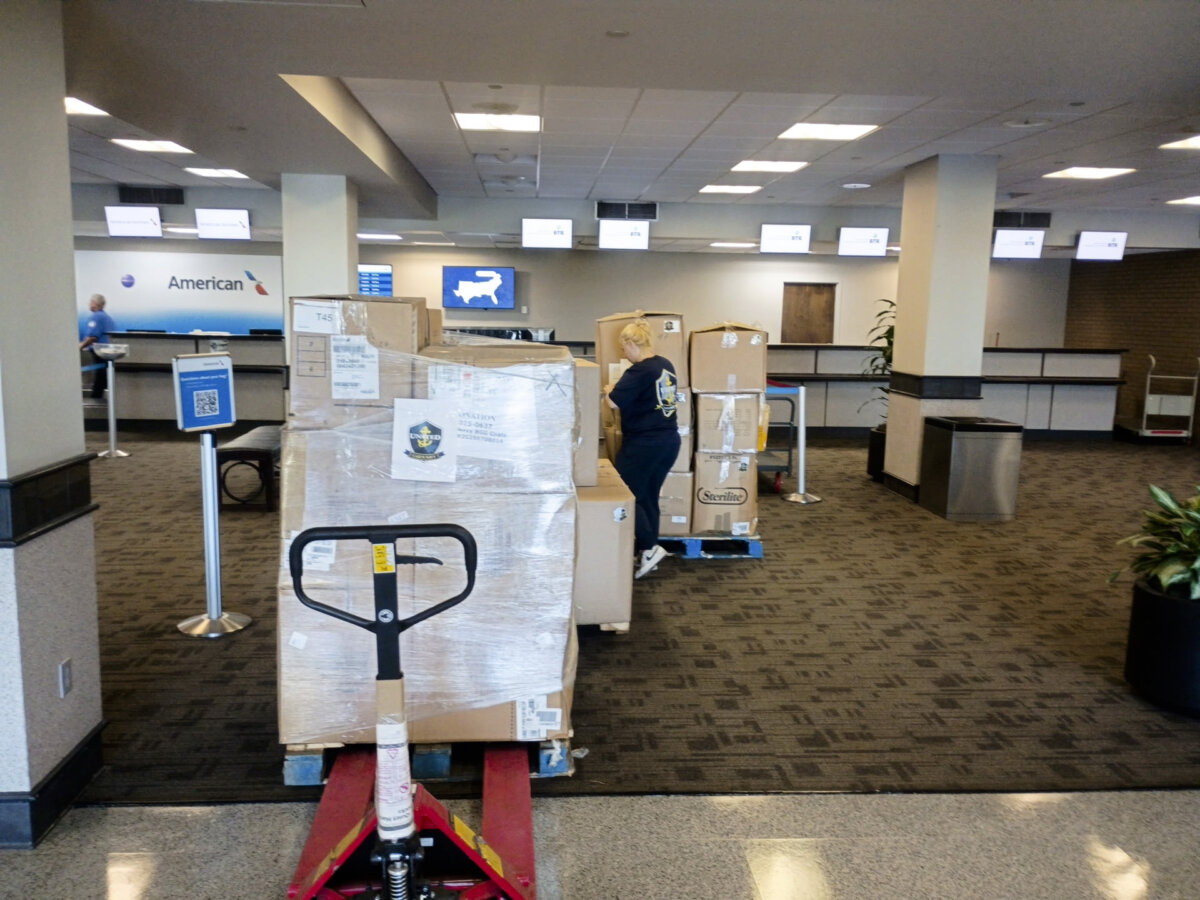
Metz told The Epoch Times that the first day’s objectives included ensuring the delivery of supplies inbound from Baton Rouge, Louisiana. The United Cajun Navy announced on social media on Oct. 18 that a shipment of 11 pallets of clothing, including 2,500 coats from Ocean State Job Lot, left Baton Rouge at noon CDT, set to arrive in Anchorage that night.
“Thousands of coats, socks, warm … clothing, and more being loaded onto American Airlines planes headed to Alaska to provide warm … clothing to Typhoon Halong affected residents,” the organization stated.
“We are in a race against time to get warm clothing to those being put into shelters as well as the people in areas that are struggling to get their homes back livable. Freezing temperatures, including snowfall, [are] approaching, and we have to help our Alaskan brothers and sisters.”
Metz confirmed that she and Gill helped secure air transport for the last leg of that journey from Seattle to Anchorage, and they were now working on securing military transport from there to the affected communities as well as space to store their supplies in FEMA’s warehouse. Shortly afterward, she said that 30 boxes of that supply haul were approved to be dropped off at the Anchorage shelters.
Reuniting Families, Pets
The remnants of Typhoon Halong descended on the southwest coast of Alaska on Oct. 12, pummeling the coastal lowlands with heavy winds and storm surge, killing at least one person, displacing more than 1,500, and washing entire homes and buildings clear off their foundations. It marked the climax of a series of storms to hit the state’s west coast beginning on Oct. 8 that was made worse because of a coinciding king tide, according to Metz.
Alaska Gov. Mike Dunleavy declared a state of emergency on Oct. 9.
Jeremy Zidek, a spokesman for Alaska’s Division of Homeland Security and Emergency Management, told The Epoch Times that more than 40 remote communities were affected by the storms to various degrees, with the Yup’ik communities of Kipnuk and Kwigillingok hit the hardest.
As of the morning of Oct. 18, he said that 633 people had been evacuated out of Bethel, one of the Alaska National Guard’s regional hubs closest to the affected communities.
Metz said the United Cajun Navy was also helping to look for missing family members, confirming that she and Gill made contact with Bethel Search and Rescue.
“We’ll also be trying to see what we can do about looking for the missing people,” she said.
As of Oct. 18, two people were confirmed missing. Metz said they were family members of the one person confirmed dead in this disaster and that all three were in the same home.
“Of course, they’ve cleared the home, and now it would be, maybe, would we be able to find them in the water?” she said, adding that she and Gill were helping Bethel Search and Rescue acquire some K-9s to help with the search.
The United Cajun Navy is also working to secure portable kennels for the next stage of the recovery mission.
The state’s Emergency Management division had previously stated that all evacuees had to leave their pets behind.
“Safety and survival often require impossible choices in moments like these, and we want every pet owner to know that their love and concern for their animals has not gone unnoticed,” the division stated. “At this time, evacuation of people is the priority.
It stated that several government groups are “actively working to coordinate rescue efforts for stranded and displaced animals.”
“Every effort is being made to reunite families with their animals safely and as quickly as possible.”
Metz said 100 dog kennels were needed to collect the pets left behind and that she and Gill were able to get their hands on several from Petco that were to be shipped to Bethel on Oct. 19 but that more were still needed.
After speaking with The Epoch Times, Metz and Gill headed into a shelter in Anchorage to ask how they could help.
In an earlier conversation with The Epoch Times, United Cajun Navy President Todd Terrell said that volunteers were also going to the coastal communities to assist with debris clean-up and to help convince those not already evacuated to do so.
Damage Assessment Update
As of Oct. 17, the state’s Emergency Management division announced that 573 people and eight pallets’ worth of personal belongings were transported to Anchorage from Bethel. On that day, 307 were flown out and an additional flight scheduled. However, 72 remain sheltered at village schools in Bethel.
There have been 416 applications submitted for individual assistance.
The Department of Transportation and Public Facilities conducted initial damage inspections of the communities that were hit.
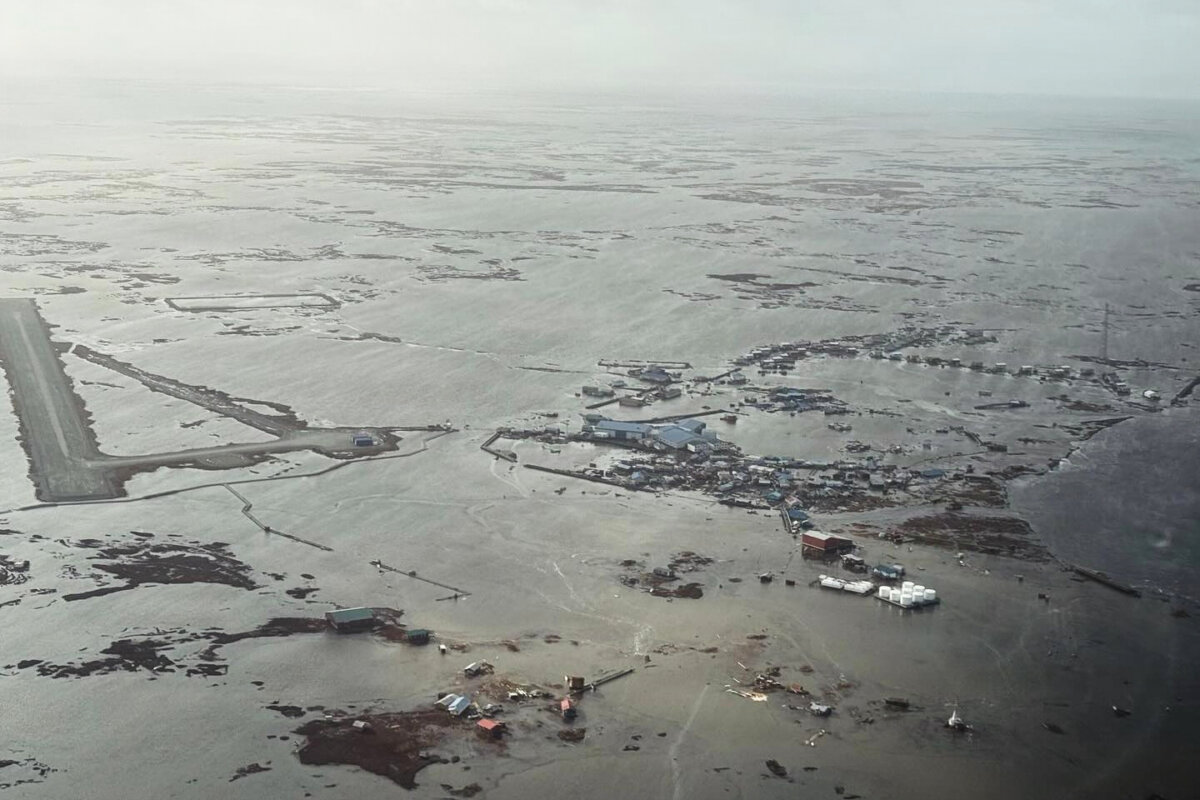
It reported that 90 percent of structures in the community of Kipnuk were destroyed in the storm, including half of its boardwalk. Its freshwater supply was contaminated with fuel and sewage, as half the utility supports were lost with raw water and sewer mains compromised. State agencies continue to address widespread debris and biohazard contamination.
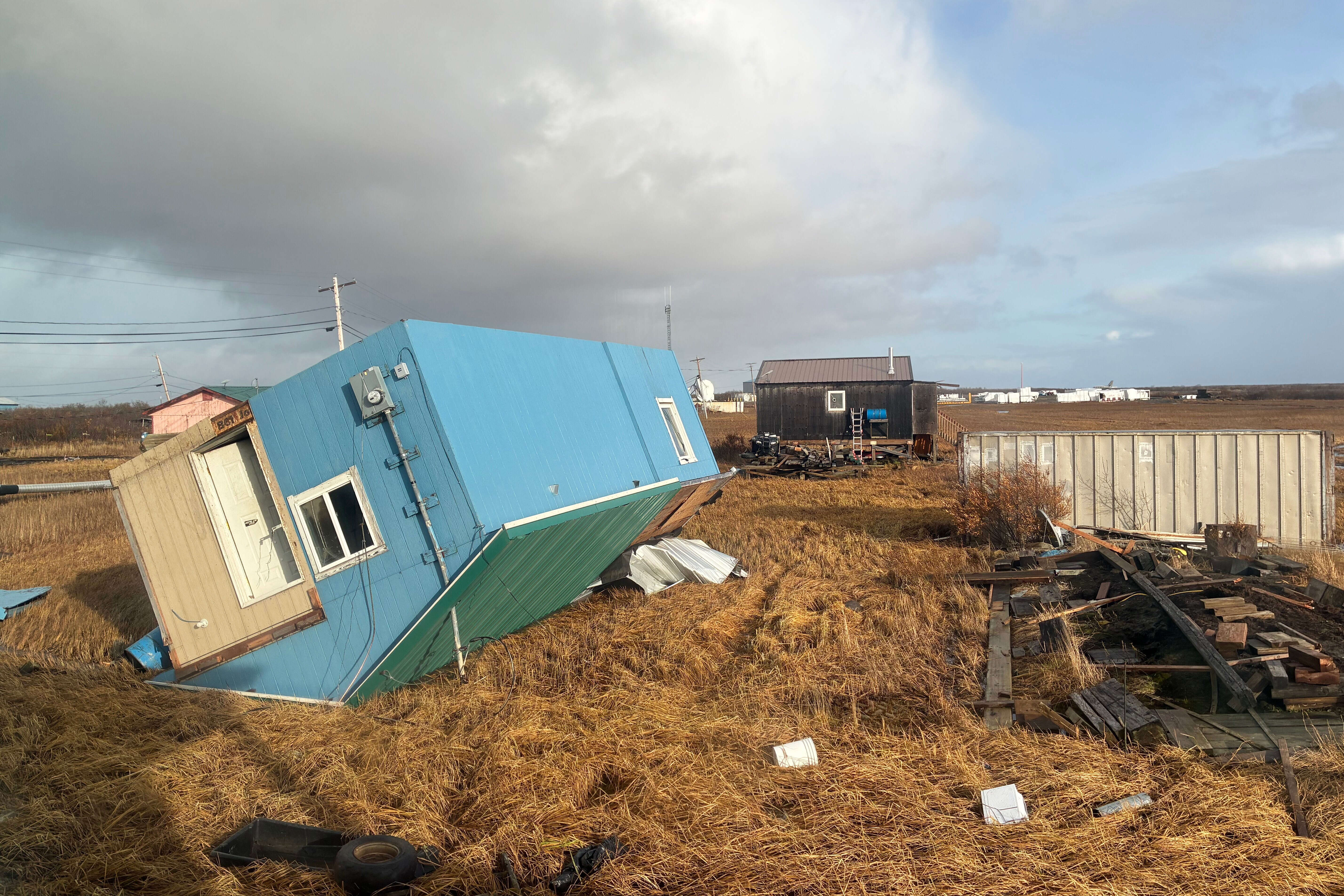
The community of Kwigillingok suffered the second-worst amount of damage, with approximately 35 percent structural loss, according to the transportation and public facilities department. Displaced buildings, residences, and debris fields extended two miles from the community. Most of the damage was dealt to the southern half of the community, which was scattered with bare house foundations and its boardwalk system was also nearly destroyed.
“There are no roads to those communities,” Zidek said. “They have some roads within the communities but primarily the homes are connected by boardwalks. And just think of a raised deck above the tundra. They don’t have a lot of cars and trucks there, so there’s not really a need for a gravel road or anything like that. They just rely on those boardwalks.”
Extensive structural damage was reported in Tuntutuliak. At least 13 homes were damaged in Kasigluk, and more than 40 boats with fuel were lost in Chevak.
Repairs to roads, infrastructure, and sewer lines have already begun in communities like Kotlik, Quinhagak, Scammon Bay, and Kotzebue. To the northwest, the town of Nome, famous for being the finishing point of the Iditarod dog sled race, reported no severe damage.
These coastal communities have no road access to Alaska’s major cities such as Anchorage, making runway and hangar damage and boat loss and damage all the more significant because of their reliance on connection to the outside world. Zidek said that barge access is now very minimal.
That remoteness left the communities dependent upon subsistence hunting and fishing, storing much of the meat and fish collected during warmer months to carry them through the winter. However, whether due to power outages, flooding, or other storm-related issues, those food stores are now going bad.
“When they lose their subsistence food this late in the year, it can be a real bad deal for them, because they don’t have any way to replace them,” Zidek said. “The birds are gone. Hunting season is over. The animals have moved to different spots. The fish are no longer running, and so they don’t have the opportunity to replenish their food supply.
“We are aware of the problem. We deal with this for other disasters, and we have a lot of partners that come forward and provide resources to folks when this happens. We’re going to be working on those processes and getting people the food they need.”
There is also a strong initiative by tribal communities across the state to not only provide traditional food but also provide jobs, housing, and other resources to these people.
“The Alaska Native community, they take care of one another,” he said.
Long Road to Recovery
As of Oct. 16, Alaska’s National Guard had helped nearly 350 people to evacuate from Kipnuk and Kwigillingok, according to Alaska’s governor. It is unclear when they will be able to return home again.
Zidek said the state activated its housing task force, which provides housing assistance for up to 18 months, and people are taking various methods to secure housing.
“Some of those folks have found relatives here in Anchorage to go and stay with,” he said. “I would imagine some of them have just [gone] out and got their own accommodations, whether that’s a hotel room, an Airbnb, or something else. Maybe they found some other housing. So it’s a real variety of solutions that are taking place.”
He said that while some rebuilding was underway, some communities would not be reached until well into winter and that Kipnuk was going to have a long recovery process. Overall, it was still unclear when all of the displaced people would be able to return home.
Dunleavy, who sent a letter to President Donald Trump on Oct. 16 asking him to declare a major disaster for Alaska, visited the Kipnuk and Kwigillingok communities on Oct. 17.
“We listened to the concerns of the residents and told them about additional steps my administration is incorporating into the recovery plan so every community damaged by the storm can begin to recover as quickly as possible,” the governor said on X.
Vice President JD Vance wrote on X: “President Trump & I are closely tracking the storm devastation that resulted in over 1,000 citizens being airlifted out of Alaska villages.
“Alaskans, our prayers are with you, and your federal government is working closely with @SenDanSullivan and @GovDunleavy to get you the help you need.”
 Friends Read Free
Copy
Facebook
Tweet
Friends Read Free
Copy
Facebook
Tweet